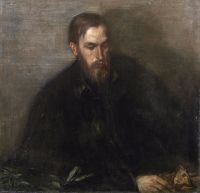
Thomas Sturge Moore

Thomas Sturge Moore

Summary

Portrait of Thomas Sturge Moore Thomas Sturge Moore Some soldier poets (1920)

Youth binds these and the other tacts and aptitudes in a solid faggot, but after a time there is possibly more gain than loss, should life cut the cord and use the sticks singly. Then, perhaps, engrossed by political reform, the poet's soul may be felt as an agent and no longer by its cohesion provoke the echo, beauty from stony world. Death has settled that, and for many minds, when Wordsworth's hare is watched, racing on the moors while that mist raised by her feet from the wet turf runs with her, a boy will soon appear accompanied with a sweeping veil of rain coursing the same uplands.
Source: Wikisource

Portrait of Thomas Sturge Moore Thomas Sturge Moore Some soldier poets (1920)

Only I think to substitute a man for the woman would heighten the effect, and for this the imagination can relieve our young captain of his accoutrements and exchange his gas mask for one which laughs. Yes, nimble youth plays with life and death, and interchanges agony with ecstasy, even as laughter sheds tears for very pleasure.
Those who shall gaze back a century hence may discern rather in Nichols than in Sassoon or Graves the poet's mind that is independent of time and approaches all human circumstance with the kinsman's joy or pain.
Source: Wikisource

Portrait of Thomas Sturge Moore Thomas Sturge Moore Some soldier poets (1920)

It is in vital interest that Shakespeare's Macbeth, Lear, Hamlet and Othello are so superior to Paradise Lost, though that poem perhaps maintains a higher level of beauty than they do.
Can the interest proper to great poems be distinguished from that aroused by imaginative prose? By intensity? Hardly: rather by quality, by perfection. Poetry transports us into its newly created world more delicately, with a finer respect for the bloom of the soul. The superiority is of mood rather than of power.
Source: Wikisource

Get perspective with Kwize: daily news enlightened by great literature