“ It is only within quite recent times that scholars have troubled to render each letter of the Arabic alphabet by an equivalent and distinct letter of the Roman alphabet-and although no particular system has been universally adopted by European orientalists, every writer has some system by which any reader with a knowledge of Arabic is able to turn back every name into the original script. ”
Arabic alphabet
Definition and stakes
The theme of “Arabic alphabet” has been addressed by authors such as Edward Clodd, Louis Charles Karpinski, Samuel Marinus Zwemer, Muhammad Diyab al-Itlidi and Carl Albert Thimm. It is often associated with terms like language, vowel, consonant, Hebrew and script.
Quotes about “Arabic alphabet”
“ Arabic can't be transliterated. Of course, a great deal can be passably approximated with Latin letters, but when you come to words involving certain sounds peculiar to the Arabic language, you are stuck. One sound can not be expressed by any letter or combination of letters in our alphabet ”
Rufus Anderson, History of the missions of the American Board Of Commissioners For Foreign Missions to the oriental churches…
“ Imperfect translations, and type which seemed to caricature their alphabet, had done much to prejudice Arabic scholars against the Christian Scriptures. By the labors of the mission, these objections were now removed. The educated Arab finds a book printed in characters modeled after the most approved specimens of Arab caligraphy. He soon perceives the style to be that of a man who is master of this wonderful language in all its grammatical and idiomatic niceties and rich resources. As a literary work it secures his respect, and thus invites a candid perusal. ”
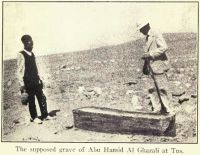 Samuel Marinus Zwemer,
Arabia: The Cradle of Islam
Samuel Marinus Zwemer,
Arabia: The Cradle of Islam
“ The Malay language, with the Moslem conquest, was also touched by Arabic influence and likewise adopted its alphabet. In Africa its influence was yet more strongly felt. The language extended over all the northern half of the continent and is still growing in use255 to-day. The geographical nomenclature of the interior is Arabic and Arabs preceded Livingstone, Stanley and Speke in all their journeys. The languages of the southern Sudan, the Hausa, and even those of Guinea borrowed largely from the Arabic. Europe itself did not escape the influence of the conquering Semitic tongue. ”
 Edward Clodd,
The Story of the Alphabet
Edward Clodd,
The Story of the Alphabet
“ The later alphabets—Parsi, Hebrew, Syriac, Mongolian, and Arabic—were at first local varieties of the Aramean. Owing to accidental circumstances they became the sacred scripts of the five great faiths of Asia—Zoroastrianism, Judaism, Christianity, Northern Buddhism, and Islam. Hence the descendants of the Aramean alphabet occupy a space on the map second only to that filled by the Latin alphabet itself. ”
Various, St. Nicholas Vol. XIII, September…
“ For algebra, though an Arabic word, is a science of which the Arabs were ignorant before they reached India. How long the Indians of Hindostan had used this system of notation along with their alphabet, we can not yet determine; but it is quite possible that the old grammarians who improved the Sanskrit were enabled to fashion its alphabet into so scientific an order of groups because this separate system of numerals existed at even a more remote period, and had been found handier than the signs of the alphabet. ”
A. H. Keane, Man, Past and Present
“ It will be a true alphabet, the wonderful nature of which may be inferred from the fact that only two, or possibly three, such alphabetic systems are known with absolute certainty to have ever been independently evolved by human ingenuity [112] . From the above exposition we see how inevitably the Phoenician parent of nearly all late alphabets expressed at first the consonantal sounds only, so that the vowels or vowel marks are in all cases later developments, as in Hebrew, Syriac, Arabic, Greek, the Italic group, and the Runes. ”
1911 Encyclopædia Britannica (1911)
“ The alphabet of the Sabaean inscriptions is most closely akin to the Ethiopic, but is purely consonantal, without the modifications in the consonantal forms which Ethiopic has devised to express vowels. There are twenty-nine letters, one more than in Arabic, Samech and Si, being distinct forms, as in Hebrew. This alphabet, which is probably the parent of the South-Indian character, is undoubtedly derived from the so-called Phoenician alphabet, the connecting link being the forms of the Ṣafa inscriptions and of the Thamudaean inscriptions found by Doughty and Euting. ”
Various, Notes and Queries, Vol. IV, Number 102…
“ Both the valley and the mountains are named from these "Inscriptions" = Mocatteb in Arabic; that fact alone indicates considerable antiquity, especially in a country like Arabia, where the fashion of changing any usage, especially that of names of places, has never prevailed. The vicinity of these inscriptions to that portion of the world wherein the Mosaic law had its origin, and probably, as a necessary consequence, the invention of an alphabet also ”
 William Dwight Whitney,
Language and the Study of Language
(1867)
William Dwight Whitney,
Language and the Study of Language
(1867)
“ In no other family of human speech would it be possible that the most antique and original of its dialects, the fullest in its forms, the most uncorrupted in its phonetic structure, the most faithful representative of the ideal type inherent in them all, should be the youngest of their number. But such is the character of the classical Arabic, whose earliest literary monuments are from fifteen to twenty centuries later than those of the Hebrew and Assyrian. ”
Louis Charles Karpinski, The Hindu-Arabic Numerals
“ The Egyptians, for example, had three systems of writing, with a numerical notation for each; the Greeks had two well-defined sets of numerals, and the Roman symbols for number changed more or less from century to century. Even to-day the number of methods of expressing numerical concepts is much greater than one would believe before making a study of the subject, for the idea that our common numerals are universal is far from being correct. It will be well, then, to think of the numerals that we still commonly call Arabic, as only one of many systems in use just before the Christian era. ”
The Book of the Thousand Nights and a Night…
“ In reading Arabic from transliteration for the purpose of scanning poetry, we have therefore in the first instance to keep in mind that no Arabic word or syllable can begin with a vowel. Where our mode of rendering Arabic in the Roman character would make this appear to be the case, either Hamzah (silent h) , or 'Ayn (represented by the sign') is the real initial, and the only element to be taken in account as a letter. It follows as a self- evident corollary that wherever a single consonant stands between two vowels, it never closes the previous syllable, but always opens the next one. ”
Muhammad Diyab al-Itlidi, Historical Tales and Anecdotes of the Time of the Early Khalîfahs (1873)
“ The vocal sound of ow in how I express by au; when doubled in the same word, by aww, as in Tawwâm. "The Arabic suffix, when used to denote an ordinary or gentilic adjective, I have represented by y, which somewhat in the same way constitutes the formative of many of our English adjectives, e.g., windy from wind, stormy from storm, etc. This terminal y should be pronounced with a ringing Italian i sound. "The acute accent (ˊ) over a vowel denotes the syllable to be accentuated: attention to this expedient will prevent such mispronunciations as Maskát instead of Máskat. ”
1911 Encyclopædia Britannica (1911)
“ Classical Arabic is rich not only in words but in grammatical forms. The wanton development of the broken plurals, and sometimes of Grammatical forms and rules. the verbal nouns, must be regarded as an excess of wealth. The sparing use of the ancient terminations which mark the plural has somewhat obscured the distinction between plurals, collectives, abstract nouns, and feminines in general. In its manner of employing the verbal tenses genuine Arabic still exhibits traces of that poetical freedom which we see in Hebrew; this characteristic disappears in the later literary language. ”
active 1820 Abd Salam Shabeeny, An Account of Timbuctoo and Housa Territories in the Interior of Africa
“ Besides these, there are other letters, whose power is extremely difficult to be acquired by an European, because no language in Europe possesses sounds similar to the Arabic letters خ غ ع, nor has any language, except, perhaps, the English, a letter with the power of the Arabian ث. Those who travel into Asia or Africa scarcely ever become sufficiently masters of the Arabic to speak it fluently, which radical defect proceeds altogether from their not learning, while studying it, the peculiar distinction of the synonymous letters. ”
The Book of the Thousand Nights and a Night…
“ Of the Badi'a or euphuistic style, "Parleying euphuism," and of AI Saj'a, the prose rhyme, I shall speak in a future page.The characteristics of the whole are naivete and simplicity, clearness and a singular concision. The gorgeousness is in the imagery not in the language; the words are weak while the sense, as in the classical Scandinavian books, is strong; and here the Arabic differs diametrically from the florid exuberance and turgid amplifications of the Persian story-teller, which sound so hollow and unreal by the side of a chaster model. ”
Peter Giles, 1911 Encyclopædia Britannica (1911)
“ At all periods, moreover, hieroglyphic writing was a branch of decorative art, and it may have been that the ancient Egyptian, like the modern Turk, resented too much lucidity, and liked his literary compositions to be veiled in a certain obscurity. The alphabet devised by the Egyptians consisted of twenty-four letters. Egyptologists are at variance on the question whether this alphabet was the original, or had any influence upon the development of the Phoenician alphabet. ”
Edward Clodd,
The Story of the Alphabet
“ It has exterminated its fellow-Semitic scripts, "expelled the Greek alphabet from Asia Minor, Thrace, Syria, and Egypt, and the Latin alphabet from Northern Africa, and is now used over regions inhabited by more than one hundred millions of the human race." The transactions of the East are recorded in the alphabet of the Koran, so that it would seem, in the world's history, that if "trade follows the flag," the alphabet follows religion. ”
 Frances Delavan Page Jermain,
In the path of the alphabet
Frances Delavan Page Jermain,
In the path of the alphabet
“ Again, the clew given by the Coptic to the sounds of the old Egyptian, was also afforded by the ancient Zend, the sacred language of the Parsees.Notwithstanding the fact that alphabetic signs were the key to each of these systems of writing, we are not to find that either the hieroglyphic or cuneiform systems were founded on the alphabet. We are to find that alphabetism and a pure alphabet are not identical. We are also to find that before the simplicities of an alphabet are reached; the art of writing in all systems is a series of bewildering complications. ”
Samuel Marinus Zwemer,
Arabia: The Cradle of Islam
“ It is not without reason that Mohammed’s cognomen for Jew and Christian alike was, “the people of the Book.” At first, like the Hebrew, Arabic had no vowel-points or diacritical marks. In the earliest Cufic Koran manuscripts these have the form of accents, horizontal lines or even triangles. The Arabs tell many interesting stories about the cause and occasion of their invention by Abu Aswad ad Duili or by Nasr bin ’Asim. In each case the awful sin of mispronouncing a word in the Koran leads to the device of vowel-points as a future preventative. ”
 F. Max Müller,
Chips from a German Workshop, Volume 1
F. Max Müller,
Chips from a German Workshop, Volume 1
“ What we mean can best be illustrated by the fact that the dictionaries of Semitic languages are mostly arranged according to their roots. When we wish to find the meaning of a word in Hebrew or Arabic we first look for its root, whether triliteral or biliteral, and then look in the dictionary for that root and its derivatives. In the Aryan languages, on the contrary, such an arrangement would be extremely inconvenient. In many words it is impossible to detect the radical element. ”
The Book of the Thousand Nights and a Night…
“ It consists of the three letters Fa (f) , 'Ayn (') , Lam (l) , and, like any other Arabic root, cannot strictly speaking be pronounced, for the introduction of any vowel-sound would make it cease to be a root and change it into an individual word. The above fa'l, for instance, where the initial Fa is moved by Fathah (a) , is the Infinitive or verbal noun, "to do," "doing." If the 'Ayn also is moved by Fathah, we obtain fa'al, meaning in colloquial Arabic "he did" (the classical or literary form would be fa'ala) . ”
Edward Clodd,
The Story of the Alphabet
“ Evans agree that the relics unearthed at Kahun are as old as that city; while, speaking of the signs known to be in use 1200 b.c., in a place occupied by people of the Ægean and Asia Minor, Turseni, Akhaians, Hittites, and others, Professor Flinders Petrie remarks that "it will require a very certain proof of the supposed Arabian source of the Phœnician alphabet before we can venture to deny that we have here the origin of the Mediterranean alphabets." (Ten Years' Digging in Egypt, p. 134.) ”
Louis Charles Karpinski, The Hindu-Arabic Numerals
“ It should be stated definitely at the outset, however, that we are not at all sure that the most ancient forms of the numerals commonly known as Arabic had their origin in India. As will presently be seen, their forms may have been suggested by those used in Egypt, or in Eastern Persia, or in China, or on the plains of Mesopotamia. We are quite in the dark as to these early steps ”
Hutton Webster, Early European History
“ EGYPTIAN HIEROGLYPHICS The Egyptians early developed such an alphabet. Unfortunately they never gave up their older methods of writing and learned to rely upon alphabetic signs alone. Egyptian hieroglyphics [11] are a curious jumble of object- pictures, symbols of ideas, and signs for entire words, separate syllables, and letters. The writing is a museum of all the steps in the development from the picture to the letter.PHOENICIAN ALPHABET As early, apparently, as the tenth century B.C. we find the Phoenicians of western Asia in possession of an alphabet. ”
Frances Delavan Page Jermain,
In the path of the alphabet
“ The earliest, nearest approach to a pure alphabet, was an alphabet of consonants.The Semitic languages differ from all other idioms in structure. The original roots of Semitic words are tri-consonantal, consisting of three consonants.Out of a language so constructed it is easy to understand the development of such an alphabet. The confusions of its use are also manifest. Thus, in the changes of signification of the Semitic root word, k-t-b, signifying “write” we have, when spoken, ka-ta-ba, “he has written,” ku-ta-ba, “it has been written,” ka-ta-bu, “writing,” and ka-tu-bu, “written.” ”
 Edward B. Tylor,
Primitive culture, vol. 1 (of 2…
(1871)
Edward B. Tylor,
Primitive culture, vol. 1 (of 2…
(1871)
“ We know that the numerical value of the Hebrew letters is given with reference to their place in the alphabet, which was arranged for reasons that can hardly have had anything to do with arithmetic. The Greek alphabet is modified from a Semitic one, but instead of letting the numeral value of their letters follow throughout their newly-arranged alphabet, they reckon α, β, γ, δ, ε, properly, as 1, 2, 3, 4, 5, 259then put in σ for 6, and so manage to let ι stand for 10, as י does in Hebrew, where it is really the 10th letter. ”
1911 Encyclopædia Britannica (1911)
“ But we must not suppose that people, for instance, from Mosul, Morocco, Ṣan‘ā, and the interior of Arabia would be able to understand one another without difficulty. It is a total error to regard the difference between the Arabic dialects and the ancient language as a trifling one, or to represent the development of these dialects as something wholly unlike the development of the Romance languages. No living Arabic dialect diverges from classical Arabic so much as French or Rouman from Latin ”
Louis Charles Karpinski, The Hindu-Arabic Numerals
“ In Arabic words adopted into English it is treated as silent, e.g. in Arab, amber, Caaba (‛Arab, ‛anbar, ka‛abah) . (A) A final long vowel is shortened before al ('l) or ibn (whose i is then silent) .Accent: (S) as if Latin; in determining the place of the accent ṁ and ṅ count as consonants, but h after another consonant does not. (A) , on the last syllable that contains a long vowel or a vowel followed by two consonants, except that a final long vowel is not ordinarily accented; if there is no long vowel nor two consecutive consonants, the accent falls on the first syllable. ”
Edward Clodd,
The Story of the Alphabet
“ If we reject M. de Rougé's explanation of the origin of the alphabet, there is practically no rival theory on which to fall back. There are only three other possible sources, none of which can, at present, be regarded in any higher light than as a mere guess. If the Semitic letters were not derived from Egypt they must have been invented by the Phœnicians, or they must have been developed either out of the Hittite hieroglyphics, or out of one of the cuneiform syllabaries. ”
Related terms
Authors who wrote about “Arabic alphabet”
Edward CloddLouis Charles KarpinskiSamuel Marinus ZwemerMuhammad Diyab al-ItlidiCarl Albert ThimmJohn PeileFrances Delavan Page Jermain John PayneW. E. Maxwellactive 1820 Abd Salam Shabeeny
 Bernard QuaritchJames Grey JacksonPeter GilesR. G. LathamJohn Beames
 Ignatius DonnellyPhilip Khuri HittiGurajada ApparaoVarious
 Hermann Ebbinghaus