Battle of Loos

Definition and stakes

Portrait of Philip Gibbs Philip Gibbs,  Now It Can Be Told

“ Let me now tell the story of the main battle of Loos as I was able to piece it together from the accounts of men in different parts of the field—no man could see more than his immediate neighborhood—and from the officers who survived. It is a story full of the psychology of battle, with many strange incidents which happened to men when their spirit was uplifted by that mingling of exultation and fear which is heroism, and with queer episodes almost verging on comedy in the midst of death and agony, at the end of a day of victory, most ghastly failure. ”
Source: Gutenberg

Various,  The New Gresham Encyclopedia. Estremoz to Felspar

“ All told, the British losses in the battle of Loos amounted to 50,000 men and 2000 officers, including three divisional commanders—Major-General Sir Thompson Capper (7th Division) , Major-General G. H. Thesiger (9th Division) , and Major-General F. D. V. Wing (12th Division) —each of whom was killed. A series of costly counter-attacks on the enemy's part failed to make much impression on the new British line, and mounted up the German casualties until they were estimated at many more than those of the British. The battle died down; the gains were consolidated ”
Source: Gutenberg

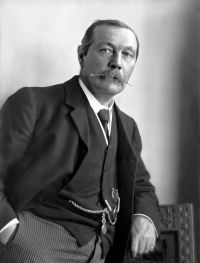
Portrait of Arthur Conan Doyle Arthur Conan Doyle,  The British Campaign in France and Flanders…

“ A modern battle is a sudden furious storm, which may blow itself out in two or three days, but leaves such a tempestuous sea behind it that it is difficult to say when the commotion is really over. In the case of the Battle of Loos, or of Loos-Hulluch, it may be said to have begun with the British advance upon September 25, and to have ended with the establishment of an equilibrium on the northern flank of our salient on October 13. ”
Source: Gutenberg

Get perspective with Kwize: daily news enlightened by great literature