“ Hammurabi's code, the most ancient known, says "Anna and Bel called me, Hammurabi the exalted prince, the worshiper of the gods; to cause justice to prevail in the land, to destroy the wicked, to prevent the strong from oppressing the weak, to go forth like the sun over the black-head race, to enlighten the land, and to further the welfare of the people." ”
Code of Hammurabi
Definition and stakes
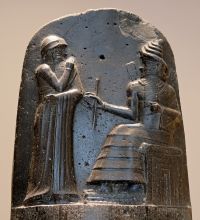
The Code of Hammurabi, a legal text from 1750 BCE, remains the most extensive and best-preserved legal framework of the ancient Near East. Carved onto a basalt stele, it blends a poetic introduction and conclusion with conditional laws, focusing on justice and social fairness. Scholars such as C. H. W.
Johns and Hutton Webster emphasize its impact on Mosaic Law and its depiction of societal values, although discussions continue regarding its intent and legal foundations. Its discovery in 1901 and lasting significance highlight its role as a cornerstone in the history of law, linking ancient Mesopotamian customs to subsequent legal traditions.
Quotes about “Code of Hammurabi”
Hutton Webster, Early European History
“ They were no more than the long-established customs of the community. As civilization advanced, the usages that generally prevailed were written out and made into legal codes. A recent discovery has given to us the almost complete text of the laws which Hammurabi, the Babylonian king, ordered to be engraved on stone monuments and set up in all the chief cities of his realm. [11] SUBJECT MATTER OF HAMMURABI'S CODE The code of Hammurabi shows, in general, a high sense of justice. A man who tries to bribe a witness or a judge is to be severely punished. ”
C. H. W. Johns, The Relations between the Laws of Babylonia and the Laws of the Hebrew Peoples
“ So if we could fasten upon just such a point in the Code of Hammurabi which appears so artificial or arbitrary, so purely local in its character that we cannot imagine it to have independently arisen elsewhere, we could use it as a test case to decide whether the great amount of common matter found in that Code and also the Laws of Moses may be set down as due to common Semitic origin, or to common human genius faced by similar needs. There is no question as to the relative age of the codes to be compared; we know definitely which is older and more original. ”
Related terms
Authors who wrote about “Code of Hammurabi”
C. H. W. JohnsTheophilus G. PinchesL. W. KingH. R. HallVariousFrederick Carl Eiselen Horace G. Hutchinson
 Henry James Sumner Maine
 J. A. ZahmDelphian SocietyHutton Webster
 Jeremiah Whipple JenksJames J. Walsh
 Crawford Howell Toy
 H. G. WellsWalter Matthew Gallichan
 W. E. B. Du BoisCharles Foster Kent
 Albert Tobias ClayWilliam Feilden Craies
Horace G. HutchinsonHenry James Sumner MaineJ. A. ZahmDelphian SocietyHutton WebsterJeremiah Whipple JenksJames J. WalshCrawford Howell ToyH. G. WellsWalter Matthew GallichanW. E. B. Du BoisCharles Foster KentAlbert Tobias ClayWilliam Feilden Craies