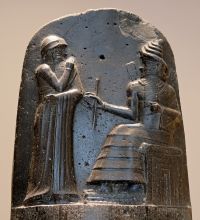
Khammurabi

Definition and stakes

G. Maspero,  History of Egypt, Chaldæa, Syria…

“ The country of Sumer and Accad, I gathered together its nations who were scattered, I gave them pasture and drink, I ruled over them in riches and abundance, I caused them to inhabit a peaceful dwelling-place. Then it was that Khammurabi, the powerful king, the favourite of the great gods, I myself, according to the prodigious strength with which Merodach had endued me, I constructed a high fortress, upon mounds of earth; its summit rises to the height of the mountains, at the head of the Nâr-Khammurabi, the source of wealth to the people. ”

Source: Gutenberg

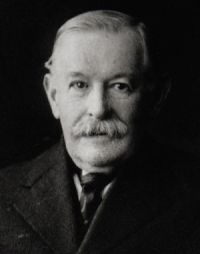
Portrait of Edgar Saltus Edgar Saltus,  The Lords of the Ghostland: A History of the Ideal

“ Sargon united principalities, Khammurabi their shrines. From one came the nation, from the other the god. It is in this way that they fuse. To the composite, if it be one, history added a heightening touch.
The Khammurabi legislation came from Bel, who, originally, was a local sun-god of Nippur. There he was regarded as the possessor of the Chaldean Urim and Thummin, the tablets of destiny with which he cast the fates of men. In the mythology of Babylonia these tablets were stolen by the god of storms, who kept them in his thunder fastness.
”
Source: Gutenberg

G. Maspero,  History of Egypt, Chaldæa, Syria…

“ The bilingual list published by Pinches makes Khammurabi an equivalent of the Semitic names Kimta- rapashtum. Hence Halévy concluded that Khammurabi was a series of ideograms, and that Kimtarapashtum was the true reading of the name; his proposal, partially admitted by Hommel, furnishes us with a mixed reading of Khammurapaltu, Amraphel. [Hommel is now convinced of the identity of the Amraphel of Gen. xiv. I with Khammurabi.—Te.] Sayce, moreover, adopts the reading Khammurabi, and assigns to him an Arabian origin. ”
Source: Gutenberg

Get perspective with Kwize: daily news enlightened by great literature