“ Above all on the threshold of Italy he knows again the solid and perfectly definable pleasure of finding himself among the traditions of the grand style in architecture. It must be said that we have still to go there to recover the sense of the domiciliary mass. In northern cities there are beautiful houses, picturesque and curious houses; sculptured gables that hang over the street, charming bay-windows, hooded doorways, elegant proportions, a profusion of delicate ornament; but a good specimen of an old Italian palazzo has a nobleness that is all its own. ”
Italianate architecture
Definition and stakes
Quotes about “Italianate architecture”
“ In fact, beginning with the time when the magnanimous King Charles VIII, who was the terror of all Italy, returned, victorious and crowned with glory, from Naples, architecture, certainly a beautiful art, began, not only in its Doric and Ionic forms, but also in its Italian form, to be practised with great elegance throughout this country of France. At Amiens, at Gaillon, at Tours, at Blois, at Paris, and in a hundred other well-known places, one may now see striking buildings, public and private, in the ancient style of architecture. ”

Mrs. Hugh Fraser,
Italian Yesterdays, vol. 2
“ I do not think any one Italian-born can feel much more than judicial admiration of the severe early architecture, perfect though it be. The sharp square outlines, the sulky [340] red—that might be rosso antico, so little has it yielded in tint or surface to the touch of Time,—all this, to me, seems misplaced under the dreamy blue of the Italian sky. Within the Churches the long aisles of double-storied arches cramp the spaces where fancy might soar and prayer take wing. They make an impression of narrowness, almost of Puritanism, that stifles emotion and frowns at joy. ”
Richard P. Spiers, John Bilson, William R. Lethaby and Henry H. Statham, 1911 Encyclopædia Britannica, Volume 2… (1911)
“ Secular Architecture.—In the application of the leading features of classical architectural design to palaces and mansions, the Italians had a much easier field on which to exercise their originality, as the requirements were very different from those which obtained in the middle ages. Moreover, the classic style lent itself more readily to the horizontal lines given by string courses, cornices and ranges of windows, which naturally exist in dwelling-houses on account of the various storeys. ”
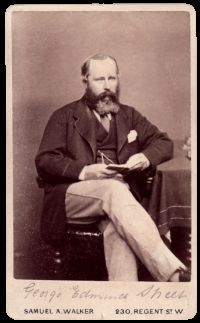
George Edmund Street,
Brick and Marble in the Middle Ages…
“ It is well here to observe, by the way, that there is much in the present position of architects and the world which may give to these few remarks upon the pointed architecture of the north of Italy—slight and sketchy though they may be—a degree of value beyond what they would have had only a short time since.It is impossible not to feel that the great and general interest in art, created by the revival of true principles within the last few years, is a subject of the greatest congratulation to all true artists. ”
Russell Sturgis, How to judge architecture: a popular guide to the appreciation of buildings
“ The Italians were ready to accept an imitation of classical architecture, in the hope that the real classical architecture would follow. No matter how poor the imitation, how inadequate the study had been, to the Italians it was so natural that architects should study that which they, the Italians, had always considered the best architecture, that they were willing to forgive mistakes. ”
Charles Herbert Moore, Character of Renaissance Architecture (1905)
“ Few of them had ever had a thorough training in architectural design and construction, such as had been general with the members of the great mediæval building corporations; and hardly any of them were endowed with a natural aptitude for logical construction. The artistic genius of the Italian people has, in fact, always been essentially a genius for painting, and the painter’s habits of mind are constantly manifested in the Italian architecture of all epochs. ”
A. D. F. Hamlin,
A Text-Book of the History of Architecture
“ THE RENAISSANCE OF THE ARTS. Classic Roman architecture had never lost its influence on the Italian taste. Gothic art, already declining in the West, had never been in Italy more than a borrowed garb, clothing architectural conceptions classic rather than Gothic in spirit. The antique monuments which abounded on every hand were ever present models for the artist, and to the Florentines of the early fifteenth century the civilization which had created them represented the highest ideal of human culture. ”
John Ruskin,
The Poetry of Architecture
“ Then in the purer air, and among the more refined energies of Greece, architecture rose into a more studied beauty, equally perfect in its school, because fostered in a district not 50 miles square, and in its dependent isles and colonies, all of which were under the same air, and partook of the same features of landscape. In Rome, it became less perfect, because more imitative than indigenous, and corrupted by the traveling, and conquering, and stealing ambition of the Roman; yet still a school of architecture, because the whole of Italy presented the same peculiarities of scene. ”
Richard P. Spiers, John Bilson, William R. Lethaby and Henry H. Statham, 1911 Encyclopædia Britannica, Volume 2… (1911)
“ The results of the Italian Revival in domestic architecture were not altogether satisfactory, for although it is sometimes claimed that the style was adapted by its architects to the traditional requirements and customs of the English people, the contrary will be found if they are compared with the work of the 16th century. ”
Joseph Woods, Letters of an Architect, From France…
“ The Italians frequently darken their churches, in order to enhance the splendour of the altar, and perhaps also because they consider a degree of gloom as favourable to religious impressions; but in general they require that the building should be naturally light, to exhibit the riches of the architecture, and the painting and sculpture with which it is adorned ”
Charles Herbert Moore, Character of Renaissance Architecture (1905)
“ The native traditions and innate tendencies of the Italian people were enough of themselves to give a strong classic quality to their art. In architecture what of classic feeling was natural to them needed only in the fifteenth century to be freed from the elements which had been misappropriated from the mediæval art of the North to allow it true expression in forms adapted to their needs. In normal human progress each successive stage of development creates its own appropriate forms ”
A. D. F. Hamlin,
A Text-Book of the History of Architecture
“ The second obstacle was the persistence of classic traditions of form, both in construction and decoration. The spaciousness and breadth of interior planning which characterized Roman design, and its amplitude of scale in every feature, seem never to have lost their hold on the Italians. The narrow lofty aisles, multiplied supports and minute detail of the Gothic style were repugnant to the classic predilections of the Italian builders. ”
John Ruskin,
The Poetry of Architecture
(1873)
“ Again, it is a life-like building, sparkling in its casements, brisk in its air, letting much light in at the walls and roof, low and comfortable looking in its door. The Italian's dwelling is much walled in, letting out no secrets from the inside, dreary and drowsy in its effect. Just such is the difference between the minds of the inhabitants; the one passing away in deep and dark reverie, the other quick and business-like, enjoying its everyday occupations, and active in its ordinary engagements. ”
William Beckford, Italy; with sketches of Spain and Portugal
“ It would have cost them almost as little trouble as the building in question, which, by many of the Italian devotees to a purer style of architecture, is esteemed a masterpiece of ridiculous taste and elaborate absurdity. The front, encrusted with alabaster, is worked into a million of fretted arches and puzzling ornaments. There are statues without number, and relievos without end or meaning. ”
Charles Herbert Moore, Character of Renaissance Architecture (1905)
“ The elaborate richness of this façade is unusual in the Renaissance architecture of central Italy, except in the smaller compositions of tombs and pulpits, which in treatment it resembles. But profusion of ornament is a marked characteristic of the architecture of the Renaissance in north Italy, to which we may now turn. In Milan and Venice the neo-classic influences were, even more than in Florence and Rome, confined to ornamental details, and in these details the designers of the North had still less regard for classic correctness and consistency than those of central Italy had shown ”
William Dean Howells,
Their Silver Wedding Journey — Complete
“ The clumsy baroque taste of the architecture is a German version of the impulse that was making Italy fantastic at the time; the carving is coarse, and the color harsh and unsoftened by years, though it is broken and obliterated in places. ”
Elizabeth Butler,
From sketch-book and diary
“ How that flat surface of blank wall spaces and the horizontal tendency of the design suit the Italian light. Architecture may well be placed as the most important of the Arts. It adds, if beautiful, to nature’s beauty, showing the height to which the human hand may dare to rise so as to join hands with the Divine Architect Himself. ”
Charles Herbert Moore, Character of Renaissance Architecture (1905)
“ The architecture of a people inevitably retains much of its original character while yielding to foreign influences. It had been so with the Italian art of the Middle Ages when it was subjected to the Gothic influence, and it could not be otherwise with the French art of the sixteenth century when the later Renaissance wave swept over it. ”
John Addington Symonds,
Renaissance in Italy, Volume 3…
“ With all its defects, it is not likely that the neo-Roman architecture, so profoundly studied by the Italians, and so anxiously refined by their chief masters, will ever wholly cease to be employed. In all cases where a grand and massive edifice, no less suited to purposes of practical utility than imposing by its splendour, is required, this style of building will be found the best. ”
John Addington Symonds,
Sketches and Studies in Italy and Greece…
“ In a great measure because it subserves utility, and is therefore dependent upon the necessities of life, does architecture present to us through form the human spirit. Comparing the palace built by Giulio Romano for the Dukes of Mantua with the contemporary castle of a German prince, we cannot fail at once to comprehend the difference of spiritual conditions, as these displayed themselves in daily life, which then separated Italy from the Teutonic nations. ”
Sir C. H. Reilly,
Some architectural problems of to-day
(1924)
“ If the general idea of a Florentine palace is used for the façades of a modern building, as in University Club, it is used thoroughly and with knowledge; the small refinements of contrasting textures and mouldings, the massive bulk and cliff-like walls which go to make up the charm of the original finding their echo in the modern building. The building is not Florentine in the basement, Milanese in the middle stories, and Venetian at the top. I should say that the distinguishing note of modern American architecture is its scholarship. ”
Richard Garnett, A History of Italian Literature (1901)
“ The earliest architectural remains were either classical or Byzantine, which passed so easily into the Palladian and other modern Italian styles as to render Gothic architecture in Italy little more than an episode, and to leave no room for those impressions of vague sublimity and solemn grandeur which Gothic architecture produces, and which so naturally spring up in the minds of the inhabitants of countries covered like England and Germany with ruined castles and abbeys. ”
Richard Glazier, A Manual of Historic Ornament
“ The Renascence capital was frequently marked by a fine feeling for profile, splendid craftsmanship, diversity of enrichment, and vitality of conception, more especially in Italy, where the tradition of architecture culminated in the works of such remarkable men as Leon Battista Alberti, Bramante, Baldassare Peruzzi, San Micheli, Serlio, Palladio, and Sansovenio. ”
James J. Walsh, The century of Columbus
“ Peter's at Rome and many of the great palaces and hospitals that now are the subject of so much admiration and attention from scholarly visitors to Italy. In our own time the reproduction of Renaissance architectural types and the careful study of what the Italian Renaissance did in modifying for modern use classic types of architecture has done more to give us handsome monumental buildings than any other inspiration that men have had. ”
Mary Wollstonecraft Shelley, Rambles in Germany and Italy in 1840… (1844)
“ Gothic architecture, on the contrary, resembles the overarching branches, and imparts the same solemn tranquillity as the aspect of a venerable avenue or darksome glade. The Italian architects seem not to have known well what to do with the vast space enclosed by the majestic walls of their edifices. They afforded glorious room for the painter; but where not adorned by him, they are bare, presenting no image of beauty, and inspiring no solemn feeling. The pictures and sculpture we find are, 160however, sources of ever new delight ”
Russell Sturgis, How to judge architecture: a popular guide to the appreciation of buildings
“ The so-called Gothic of Italy is never admirable as a style except in a few Cistercian monastic churches: and the magnificent cathedrals such as Orvieto, Siena, Monreale, and Florence are rightly beloved indeed for their magnificent combination of the decorative arts of form and color—their mosaics, their delicate sculptures in marble, their wrought and highly developed porches, their superb wall-tombs—but are of minor architectural importance from the very fact of their complete lack of constructional significance. ”
Charles Hitchcock Sherrill,
Stained Glass Tours in France
“ Because of this, architecture was among the first of the arts to be affected by the new Italian taste. We have before noticed the inter-relation of the needs and styles of the architect with those of the glass artist, and therefore we are not surprised to find our windows testifying that the latter quickly perceived Gothic architecture was being superseded by the classic style. During the last two centuries he had grown to appreciate more and more the light-admitting advantages of the canopy window, but now he changes the simulated architecture from Gothic to Renaissance. ”
Henry-Russell Hitchcock, Architecture (1963)
“ The long pre-eminence of Italy in the arts came to an end even before the end of the old regime. Architects still flocked there, finding in each generation new sources of inspiration as first Renaissance palaces and then medieval churches succeeded Roman ruins as the preferred quarry of travellers of taste. But not after Piranesi was there an Italian architect with real international influence. At the opening of the new century doctrine flowed from Paris, not from Rome; increasingly, moreover, architects turned to England and Germany for still fresher ideas and ideals. ”
Joseph Woods, Letters of an Architect, From France…
“ Externally, it is encrusted with a coat of white marble, with Corinthian columns, and rich ornaments; the architecture of Bramante, and good of its kind, but it is of a kind which I do not greatly admire. Italian monumental architecture, with some favourable exceptions, is composed of little parts, and highly ornamented. It is more broken than that of their larger edifices, often handsome, and with great beauty and delicacy in the details, but without anything magnificent or impressive ”
T. Roger Smith, Architecture: Gothic and Renaissance
“ The ordinary church roof is of flat pitch and frequently concealed behind a parapet. Dormer windows, crestings, and other similar features, by the use of which northern architects enriched their roofs, are hardly ever employed by Italian architects. Mouldings and Ornaments.Ornament is almost instinctively understood by the Italians, and their mastery of it is well shown in their architecture. The carving of spandrels, capitals, and other ornaments, and the sculpture of the heads and statues introduced is full of power and beauty. ”
John Addington Symonds,
Renaissance in Italy, Volume 2…
“ The pedantry of the classical revival did more harm to architecture than to letters, and pseudo-Roman purism superseded the genial caprices of the previous centuries.If architecture may be said to have suffered in Italy from the supremacy of local characteristics and personal genius, overruling tradition and thwarting the evolution of a national style, the case was quite different with the other arts. Painting and sculpture demand the highest independence in the artist, and are susceptible of a far more many-sided treatment than architecture. ”