“ Yes, Socrates, and there Homer is right: for he was speaking of chariots, as you were speaking of the Scythian cavalry, who have that way of fighting; but the heavy-armed Greek fights, as I say, remaining in his rank.Soc. And yet, Laches, you must except the Lacedaemonians at Plataea, who, when they came upon the light shields of the Persians, are said not to have been willing to stand and fight, and to have fled; but when the ranks of the Persians were broken, they turned upon them like cavalry, and won the battle of Plataea. ”
Plataea
Definition and stakes
Plataea, a name resonating through both ancient history and geological study, refers to a Greek city central to the Greco-Persian War and a lunar plain examined for its topographical characteristics. Plato’s Laches describes the Battle of Plataea, underscoring its strategic importance, while Thucydides elaborates on its involvement in the Peloponnesian War.
In the 19th century, geologists such as Sir Charles Lyell and A. C. Seward investigated Plataea as a geological structure, focusing on layering and fossil evidence. These varied viewpoints present Plataea as a location where historical events and natural phenomena converge, demonstrating humanity’s simultaneous desire to comprehend both human strife and the Earth’s development.
Quotes about “Plataea”
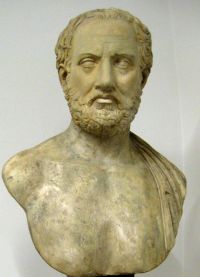 Thucydides,
The History of the Peloponnesian War
Thucydides,
The History of the Peloponnesian War
“ but the Plataeans in the town at once displayed a number of others, prepared beforehand for this very purpose, in order to render the enemy’s signals unintelligible, and to prevent his friends getting a true idea of what was passing and coming to his aid before their comrades who had gone out should have made good their escape and be in safety. ”
Popular Science Monthly (1877)
“ Plato is a circular plain 60 miles in diameter, surrounded by a belt of highlands from 3,000 to 3,500 feet in height. These highlands at sunrise are a pale yellowish gray, gradually changing to grayish white. At sunrise the interior of Plato appears of a cold gray, but, as the sun rises higher above the horizon of Plato, and the solar rays fall more perpendicularly on this region, the whole surface grows rapidly brighter, until, about two days after sunrise, the interior of the formation attains its brightest tint. ”