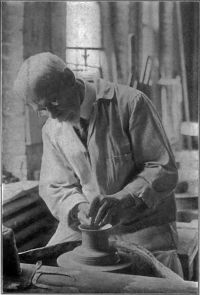
Staffordshire pottery

Definition and stakes

Léon Arnoux,  British Manufacturing Industries…

“ Experimenting for some time, with mixed or indifferent success, she seems to hesitate, till she begins to feel that she holds the thing in her grasp, and then the day soon comes when she teaches the world what she can make of it. We can scarcely give her credit in the preceding review for some Staffordshire pottery made with the yellow or red marl, thickly glazed with the galena extracted from the Derbyshire mines, the decoration of these pieces being effected by pouring the light clay on the dark one in a symmetrical manner. ”
Source: Gutenberg

Jennie J. Young,  The Ceramic Art

“ Many interesting facts relating to English pottery in general, and to that of Staffordshire in particular, are brought together by Mr. Marryat, whose able work deserves the study of all desirous of following the gradual development of the art in England. Early specimens of Staffordshire ware are the butter-pots of the period, and the tall vessels (Fig. 320) called “Tygs.” About 1650, Thomas and Ralph Toft and Thomas Sans were making round dishes with some pretensions to an ornamental character. The year 1680 was made memorable by the discovery of salt glaze. ”
Source: Gutenberg

Jennie J. Young,  The Ceramic Art

“ The leading English centres are the Staffordshire Potteries, including Tunstall, Burslem, Hanley, the Fentons, and other towns comprising Stoke-upon-Trent, Lambeth, Fulham, Liverpool, Leeds, Lowestoft, Bristol, Yarmouth, and Nottingham. Of these the place of honor must be accorded to Staffordshire. It has been associated with the ceramic art ever since the Roman invasion; and the name of a family in the district (Tellwright) is adduced as a proof that under the Saxons the advantages of the locality for the making of pottery were fully recognized. ”
Source: Gutenberg

Get perspective with Kwize: daily news enlightened by great literature