“ To this belongs costume, scenery, and all that tends to set forth time and place other than our own. If this idea be not kept in view there must be, or at all events there may be, some disturbing cause to the mind of the onlooker. This is all—literally all—that dramatic Art imperatively demands from the paint room, the wardrobe, and the property shop; and it is because the public taste and knowledge in such matters have grown that the actor has to play his part with the surroundings and accessories which are sometimes pronounced to be a weight or drag on action. ”
Drama shop
Definition and stakes
The theme of “drama shop” has been addressed by authors such as George Jean Nathan, Henry Albert Phillips, Brander Matthews, Richard Burton and Augustin Filon. It is often associated with terms like theatre, theater, actor, play and art.
Quotes about “drama shop”
 J. M. Synge,
The Tinker's Wedding
J. M. Synge,
The Tinker's Wedding
“ We should not go to the theatre as we go to a chemist’s, or a dram-shop, but as we go to a dinner, where the food we need is taken with pleasure and excitement. This was nearly always so in Spain and England and France when the drama was at its richest—the infancy and decay of the drama tend to be didactic—but in these days the playhouse is too often stocked with the drugs of many seedy problems, or with the absinthe or vermouth of the last musical comedy. ”
 Brander Matthews,
A Book About the Theater
Brander Matthews,
A Book About the Theater
“ The connection of the drama with the show business is intimate, and it always has been. In the long history of the theater there is no period without its successful pieces, the appeal of which was mainly sensuous—to the eye and to the ear, rather than to the emotions and to the intellect. While the drama is an art, and perhaps the loftiest of the arts, the show business is a trade. ”
 DeWolf Hopper,
Once a Clown, Always a Clown
(1927)
DeWolf Hopper,
Once a Clown, Always a Clown
(1927)
“ I didn't make that one to sell, but to show the critics that Tom Ince could do this art stuff if he wanted to." The theater has had the same obstacle to contend with, but the theater happily is specialized. It is divided into drama, melodrama, farce, operetta, musical comedy, vaudeville, burlesque, minstrelsy, and the like, for as many varying tastes. You pay your money and take your choice. The dramatic producer does not have to concern himself with the tastes of burlesque audiences. They attract different sets of playgoers. ”
Edward Hungerford, The Romance of a Great Store
“ A trip through the hinterland of the Macy store is like a visit behind the scenes of a modern theater. You see there just the way in which the drama of selling actually is staged, from the settings to the properties. You rub shoulders with the actors and actresses, just off stage; with the electrician, the stage-manager, the carpenter and the stage-hands. ”
Paul Claudel, The East I know (1914)
“ Pressed together, the hearts of the crowd beat one against the other. It oscillates with but one movement. Sometimes, stretching a row of arms, it surges against the stone wall of the stage; sometimes, withdrawing, is hidden by the sides. In the upper galleries, the wealthy and the mandarins smoke their pipes and drink tea in cups with brass saucers, surveying like gods both spectacle and spectators. As the actors themselves are hidden in their robes, so, as it enters each bosom, does the drama stir under the living stuff of the crowd. ”
Henry Albert Phillips, The photodrama (1914)
“ The play, the characters and the audience are lost in the debris both literally and artistically. Our object in dramatic expression is to enthrall, not to paralyze. Every distraction of attention [Pg 160] from the elemental mediums of pure art is an obstacle thrown into the clear channel of receptivity. Spectacles are for the most part acts that concern themselves and not deeds that are an intrinsic part of the drama. The characters and the action step back as it were, while the precipitated spectacle usurps the stage and the attention. Unlike the circus, drama has no legitimate side-shows. ”
Percy Holmes Boynton, A History of American Literature
“ The field into which we are led is so broad and so near that in a brief excursion we can undertake only a rough classification of the main products and the soil in which they are growing. Such a classification may be found if we consider in turn first the better play written for a better theater, which began to appear about 1890, then the various new types of theater which grew from the people’s interest instead of from managerial enterprise, and, finally, the literary drama in poetry or prose which profits from the coöperation of actor and stage-manager, but can survive in print unaided. ”
Henry Albert Phillips, The photodrama (1914)
“ The conquest of the lighter emotions is already a reality, as any one may learn who will take the trouble to step into a photoplay theater while a good comedy is being run. But the supreme test of the appeal of art—the drama that loosens the treasured tears of a self-conscious, conservative audience—is still the unattained, but attainable, goal of the new profession. ”
Charles Bullard Fairbanks, My Unknown Chum: "Aguecheek"
“ What a charm invests the place where we made our first acquaintance with the drama! It becomes an enchanted spot for us, and I doubt if the greatest possible familiarity in after life can ever breed contempt for it in our hearts. For my own part, I regarded the destruction of the old theatre in Federal Street, and the erection of warehouses on its hallowed site, as a positive sacrilege. ”
Papers and Proceedings of the Thirty-Fifth General Meeting of the American Library Association
“ Secondly, it would be an inestimable help in this task of improving dramatic taste of the community if the library would be sure to have on hand all the dramas listed in our study and reading courses. Thirdly, if the libraries would arrange a handy shelf of worthy drama where "he who runs may read," where the passerby would be attracted by a drama and pick it up to read it, it might induce a taste for better plays, a knowledge of good drama in a previously heedless theater goer. In Evanston, Illinois, for three years this shelf has been maintained in the library by the Drama Club. ”
 Arthur Bingham Walkley,
Pastiche and prejudice
(1921)
Arthur Bingham Walkley,
Pastiche and prejudice
(1921)
“ It has been said that women go to church for the sake of the hims, but they go to the theatre for the sake of chocolates. And the Lord Chancellor, good, easy man, says the primary business of the theatre is to present drama!No, its primary business is to provide comfortable and amusing surroundings for fair chocolate-eaters. The play is there for the same reason the coon band is at a restaurant, to assist mastication. That is the real explanation of recent vicissitudes in the dramatic genres. Why has tragedy virtually disappeared from the stage? ”
 Owen Davis,
I'd Like to Do It Again
Owen Davis,
I'd Like to Do It Again
“ The complete control of the drama in America by the business men of the theater started at about the time I entered the lists and continued for about twenty years. Under their rule prosperity came to us and lasted up to the time when the public became tired of a drama that soon became a factory product, as was the natural result of a system that put the business man in control of the creative artist. ”
Arthur Hornblow, The Easiest Way: A Story of Metropolitan Life
“ Here in the heart of theatredom was the players' curb market, the theatrical rendezvous of the metropolis, where the mummer comes both to talk shop with his fellow actor, and seek a new engagement. On every side luxurious theatres reared their stately facades, box-offices open for business invited all to enter, obstreperous ticket speculators jostled passersby in their eagerness to sell their seats. ”
Brander Matthews,
A Book About the Theater
“ And yet this point of view needs to be taken by every one who wishes to understand the drama as an art, for the drama is inextricably bound up with the show business, and to separate the two is simply impossible. The theater is almost infinitely various, and the different kinds of entertainment possible in it cannot be sharply distinguished, since they shade into each other by almost imperceptible gradations. ”
Owen Davis,
I'd Like to Do It Again
“ I am absolutely sure in my own mind that the theater will advance and that the talking picture will fall back, not to ruin, because it fills a place in the lives of so many people that nothing can replace. But soon now both theater and pictures will have a clearly defined audience—a true drama for an audience that demands 207a mature form of entertainment and a fictional entertainment for the millions who demand a sugar-coating on their pill. ”
Ernest Ford, A Short History of English Music
“ The music hall of those not remote days, together with the type of manager such performances indicate, is a thing of the past. Instead of offering attractions to the lowest tastes, the authorities frequently appeal to the highest, and invariably only to those which the average individual may honestly indulge.The greatest actors and actresses of every country in the world are constantly to be seen, and the Drama and the Variety Theatre are in complete agreement, instead of, as formerly, contemptuous on one side, and resentful on the other. ”
Henry Albert Phillips, The photodrama (1914)
“ The latter are inclined to remain money-makers and not become art producers; they are filling their [Pg 186] pockets today from the emptied brains of yesterday and forcing tomorrow to go begging. With few exceptions the plain drama is exaggerated into melodrama, startling the audiences thru the violent acts of the characters, or dynamic spectacle, or extraordinary setting—rather than thru the simple medium of pure dramatic construction that stirs the imagination and sways the emotions with a semblance of real experience. ”
 George Jean Nathan,
The Critic and the Drama
George Jean Nathan,
The Critic and the Drama
“ The ruling ethic of the American press so far as the theatre is concerned is one of unctuous laissez faire. “If you can’t praise, don’t dispraise,” is the editorial injunction to the reviewer. The theatre in America is a [150] great business—greater even than the department store—and a great business should be treated with proper respect. What if the reviewer does not admire “The Key to Heaven”? It played to more than twelve thousand dollars last week; it must be good. The theatre must be helped, and the way to help it is uninterruptedly to speak well of it. Fine drama? Art? ”
Various, The International Monthly, Volume 4…
“ It had all the broad, tall, low, narrow, visible, and invisible doors, for troublesome cases and exits, for the actors and actresses of the every day drama of the life of a young, rich, and independent man. No love drama was ever performed, though, on this theatre. ”
Rex T. Stout, Art for Art's Sake (1915)
“ Chidden better. If he could not properly be called a student of the modern drama, it was only because he had lacked opportunity for the collection of material. He had never seen the interior of a Broadway theater. But he spent twenty cents every night during the season at the stock theater around the corner on Eighth Avenue, and he was known to the delicatessen proprietor, tailor, cabmen, and other gentlemen of the neighborhood as a man to whom the deepest subtleties of the actor's art were an open book. ”
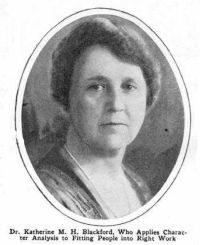 Katherine M. H. Blackford,
Analyzing Character
Katherine M. H. Blackford,
Analyzing Character
“ Here is where dramatic ability is everything and the heavier demands upon the actor in the ordinary drama, especially in the way of physical development, voice, etc., do not enter."Another line which might possibly interest you would be that of a salesman in an art or music store, where customers come to you, or in a book store. You probably would do better selling to women than to men. ”
 Sir Sidney Lee,
Shakespeare and the Modern Stage…
Sir Sidney Lee,
Shakespeare and the Modern Stage…
“ An accepted tradition of the modern stage ordains that every revival of a Shakespearean play at a leading theatre shall base some part of its claim to public favour on its spectacular magnificence.The dramatic interest of Shakespearean drama is, [Pg 3] in fact, deemed by the manager to be inadequate to satisfy the necessary commercial purposes of the theatre. The average purveyor of public entertainment reckons Shakespeare's plays among tasteless and colourless commodities, which only become marketable when they are reinforced by the independent arts of music and painting. ”
Various, The Little Review, September 1914…
“ Now the moving-pictures are at once educating our eyes to watch drama, and are undermining the support of old-fashioned plays which, through their very excellent mediocrity, prevented the encroachment of new ideas. Let us go to the theatres next fall prepared to trace the beginnings of a new stage art in this country; in the meantime, however, not hoping to escape the flood of cheap and artistically vicious stuff with which the commercial managers and producers will attempt to drown our sensibilities. ”
George Jean Nathan,
The Critic and the Drama
“ For, granting that a crowd of one thousand persons were seeing great drama for the first time in their lives, what reason is there for believing that the majority of persons in the crowd who had never seen great drama and didn’t know exactly what to make of it would be swayed and influenced by the minority who had never seen great drama but did know what to make of it? If this were true, no great drama could ever possibly fail in the commercial theatre. ”
George Jean Nathan,
Bottoms Up: An Application of the Slapstick to Satire
(1917)
“ To be effective, acting must interpret not so much the playwright’s work as the audience’s silent criticism of that work.XLII... It is to be remarked that the New Movement in the theater, about which we hear so much, what with its scenery, lighting, stage architecture and what not, seems to concern everything but drama.XLIIIThe moving pictures will never supplant the spoken drama, contend a thousand and one critics. Well, anyway, not so long as the drama is being spoken as it is to-day in the majority of our Broadway theaters. ”
Augustin Filon, The English Stage: Being an Account of the Victorian Drama
“ It holds sway at Drury Lane, the Adelphi, and the Princess’s. In that immense conglomeration of human beings, of which London boasts, there is a third public for these two popular forms of the drama, an uncultured but respectable public, which is to be confounded neither with the public of the music halls nor with that of the great theatres in which the literary drama and the light comedy are produced. The persisting, and even growing, popularity of farce and melodrama, is not a disquieting symptom. ”
Henry Albert Phillips, The photodrama (1914)
“ It was at this stage, when literature was combined with other arts allied in picture production, that the real impetus was given and the triumphant onward march of the world’s greatest educator and entertainer commenced.To-day, millions are invested in great industrial [Pg xi] plants for the creation and manufacture of the wordless drama; thousands of people rely upon it as their sole maintenance and profession. ”
Clayton Meeker Hamilton, The Theory of the Theatre, and Other Principles of Dramatic Criticism
“ And the critic who considers the drama of to-day must often turn from problems of art to problems of economics, and seek for the root of certain evils not in the technical methods of the dramatists but in the business methods of the managers. At the present time, for instance, the dramatic art in America is suffering from a very unusual economic condition, which is unsound from the business standpoint, and which is likely, in the long run, to weary and to alienate the more thoughtful class of theatre-goers. ”
Lewis Beach, Washington Square Plays
“ As our experimental theatres increase in number—and they are increasing—it will probably play its part, and perhaps no insignificant a part, in the development of a national drama through the development of a local drama and the cultivation of a taste for self-expression in various communities. It is only when these experimental theatres are sufficient in number, and the amateur spirit has been sufficiently aroused in various communities, that the commercial theatre of tradition will be seriously influenced. ”
 Channing Pollock,
The Footlights, Fore and Aft
Channing Pollock,
The Footlights, Fore and Aft
“ In a play of modern life the actors are supposed to furnish their own costumes. Sometimes, when the dresses are to be exceptionally elaborate, this rule is varied. Should your property be a romantic drama or a comic opera, [Pg 29] however, you have a conference with a costumer. The great producers, like the Shuberts and Klaw and Erlanger, maintain their own establishments, but this hardly will apply in your case. Now you will see costume plates instead of scene models—little paintings on card-board that frequently are exhibited in front of the theater in which the piece is running. ”
Related terms
Authors who wrote about “drama shop”
George Jean NathanHenry Albert PhillipsBrander MatthewsRichard BurtonAugustin FilonChanning PollockOwen DavisIndriði Einarsson Charles DickensArthur Bingham WalkleyClayton Meeker HamiltonSir Sidney LeeSir Henry Irving
 George OrwellCharles Bullard FairbanksLewis BeachDeWolf HopperVariousPaul ClaudelEdward Hungerford