Gold leaf

Definition and stakes

Paul Adam,  Practical Bookbinding

“ If a draught has turned the gold-leaf over or made it lie unevenly, it may be righted by lightly tapping with the knife on the cushion near the gold; careful breathing on the centre of the leaf will help in more awkward cases—the rest must be learned by practice. Never attempt to take hold of gold-leaf with the fingers; only the experienced workman knows how to carry gold-leaf with a finger.
For gilding the edges the deep red gold is always used, or else the so-called orange gold, which is somewhat lighter in tone, but never the lemon or green gold.
”
Source: Gutenberg

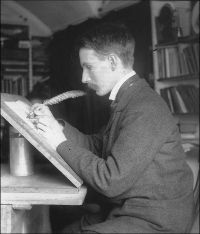
Portrait of Edward Johnston Edward Johnston,  Writing & Illuminating, & Lettering

“ The Gold-Leaf.—This is sold in books of twenty-five leaves. The ordinary leaf, about 314 inches square, consisting of gold and alloy, is said to be beaten out to less than 1200,000 inch in thickness. As gold sticks readily to gold, especially when very thin and liable to wrinkle and fold over, or to paper, red [p152] bole or ochre is scattered between the leaves of the ordinary book. This powder will come off on the work and give it an ugly colour, when burnishing, unless it is dusted off very carefully. ”
Source: Gutenberg

Portrait of Edward Johnston Edward Johnston,  Writing & Illuminating, & Lettering

“ Gold (leaf) Floral Ornament, &c.—If the stalk and leaves are both gold: they are commonly not outlined, unless on a background.
If there be a thin stalk in black or colour with gold leaves: the leaves are outlined with the stalk-colour (they were commonly furred: c, fig. 115) .
If there be a thick coloured stalk with gold leaves: both stalk and leaves commonly have a black outline, the “leaves” often being treated as spots of gold (below) .
Gold Spots or Dots are usually outlined and furred with black (fig. 115) . The effect produced is of a bright gold form on a grey background.
”
Source: Gutenberg

Get perspective with Kwize: daily news enlightened by great literature