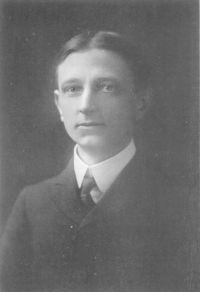
 Henry Andrews Bumstead,
Applications of the Lorentz-FitzGerald Hypothesis to Dynamical and Gravitational Problems
(1908)
Henry Andrews Bumstead,
Applications of the Lorentz-FitzGerald Hypothesis to Dynamical and Gravitational Problems
(1908)
“ The maximum effect is of the same order as would be produced by a perturbing body at a distance equal to that of the sun, and whose mass was only that of the earth. The perturbation, moreover, would be periodic, vanishing at perihelion and aphelion and accelerating the earth's motion in one-half the orbit, retarding it in the other half.When the sun is also moving, the problem becomes more complicated. For the present purpose it will be sufficient to obtain the order of magnitude of the acceleration perpendicular to the radius vector. ”