“ These facts of themselves afford an irresistible presumption that the origin of the human race must be sought much further back, and it remains to consider what positive evidence has been adduced in support of this presumption. ”
Human origins
Definition and stakes
The theme of “human origins” has been addressed by authors such as S. Laing, Lewis Henry Morgan, Franz Boas, Carveth Read and Robert Chambers. It is often associated with terms like anthropology, evolution, ethnology, race and civilization.
Quotes about “human origins”
“ In any case we may safely accept the conclusion that there is nothing in language which assists us in tracing back human origins into geological times, or indeed much further than the commencement of history. ”
Edwin Sidney Hartland, Ritual and belief (1914)
“ The mental and social development of mankind, the history of ideas and of institutions, received fresh and unexpected illumination. It began to be possible to sketch a very different outline of human origins and early history from that which had hitherto remained almost unquestioned. ”
Carveth Read, The Origin of Man and of His Superstitions
“ Considering their source, we cannot wonder that these problems remain problems, and that philosophical discussion has, of late years, turned from them to questions concerning the theory of knowledge.A student of human origins is under no obligation to predict the future. ”
“ So in speculations as to the origin and evolution of the human race, history affords the standard from which we start, through the successive 6 stages of prehistoric, neolithic, and palæolithic man, until we pass into the wider ranges of geological time. ”
“ Furnished with such a measuring-rod it becomes easier to attempt to bring into some sort of co-ordination the vast mass of facts which have been accumulated in recent years as to prehistoric, neolithic, and palæolithic man; and the glimpses of light respecting the origin, antiquity, and early history of the human race, which have come in from other sciences such as astronomy, geology, zoology, and philology. ”
“ And did the division of mankind into distinct and widely different races, which is such a prominent feature at the present day and ever since the commencement of history, exist in the case of the palæolithic man, whose remains are so widespread? ”
Robert Chambers, Vestiges of the Natural History of Creation
“ Of late years, however, the whole of this question has been subjected to a rigorous investigation, and it has been successfully shewn that the human race might have had one origin, for anything that can be inferred from external peculiarities. ”
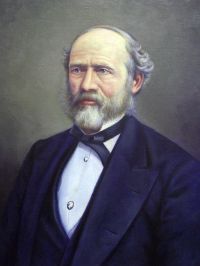 Lewis Henry Morgan,
Ancient Society
Lewis Henry Morgan,
Ancient Society
“ These results alone will in time yield convincing proofs of the unity of origin of mankind. The mental history of the human race, which is revealed in institutions, inventions and discoveries, is presumptively the history of a single species, perpetuated through individuals, and developed through experience. Among the original germs of thought, which have exercised the most powerful influence upon the human mind, and upon human destiny, are these which relate to government, to the family, to language, to religion, and to property. ”
Lewis Henry Morgan,
Ancient Society
“ The accelerated progress of human intelligence dates from this invention. This ethnical period, which is made forever memorable, was, in many respects, the most brilliant and remarkable in the entire experience of mankind. ”
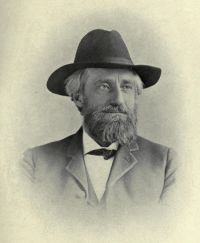 Nathaniel Southgate Shaler,
Outlines of the Earth's History…
Nathaniel Southgate Shaler,
Outlines of the Earth's History…
“ This desire to know something more than the first sight exhibits concerning the actions in the world about us is native in every human soul—at least, in all those who are born with the heritage of our race. ”
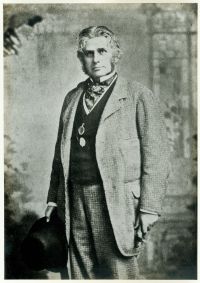 Augustus Henry Lane-Fox Pitt-Rivers,
The Evolution of Culture, and Other Essays
Augustus Henry Lane-Fox Pitt-Rivers,
The Evolution of Culture, and Other Essays
“ We shall thus be brought to the consideration of the great problem of our day, viz. the origin of mankind, or rather the origin of the human arts; for the question of man’s origin, whether he was himself created or developed from some prior form, whether since the period of his first appearance he has by variation separated into distinct races, or whether the several races of mankind were separately created, are questions which, however closely allied, do not of necessity form part of our present subject. ”
Benjamin Breckinridge Warfield, On the Antiquity and the Unity of the Human Race (1911)
“ It must be confessed, indeed, that the impression is readily taken from a prima facie view of the Biblical record of the course of human history, that the human race is of comparatively recent origin. ”
Popular Science Monthly (1881)
“ The studies of anthropology, whose final object is to solve the problems of the evolution of the human race and man's place in nature, begin with analysis, or the examination of particular characteristics. Human characteristics may be arranged, according to their bearing on anthropology and ethnography, in five orders: External physical traits ”
 Henry David Thoreau,
A Week on the Concord and Merrimack Rivers
(1849)
Henry David Thoreau,
A Week on the Concord and Merrimack Rivers
(1849)
“ These are the materials and hints for a history of the rise and progress of the race; how, from the condition of ants, it arrived at the condition of men, and arts were gradually invented. Let a thousand surmises shed some light on this story. We will not be confined by historical, even geological periods which would allow us to doubt of a progress in human affairs. ”
 Archibald Geikie,
The Story of a Boulder; or, Gleanings from the Note-book of a Field Geologist
Archibald Geikie,
The Story of a Boulder; or, Gleanings from the Note-book of a Field Geologist
“ It is something to be assured that the race of man has been preceded by many other races, lower indeed in the scale of being, but manifesting, throughout the long centuries of their existence, ideas of mechanism and contrivance still familiar to us, and serving in this way to link the human era with those that have gone before, as parts of one grand scheme carried on by one great Creator. ”
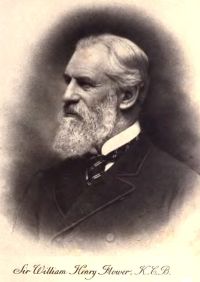 William Henry Flower,
Popular Science Monthly
(1884)
William Henry Flower,
Popular Science Monthly
(1884)
“ Ethnology thus treats of the resemblances and differences of the modifications of the human species in their relations to each other, but anthropology, as now understood, has a far wider scope. It treats of mankind as a whole. It investigates his origin and his relations to the rest of the universe. It invokes the aid of the sciences of zoölogy, comparative anatomy, and physiology ”
 Charles Kingsley,
Sanitary and Social Lectures and Essays
Charles Kingsley,
Sanitary and Social Lectures and Essays
“ I should rejoin—But they had, pre-eminently above all ancient races which we know, the scientific instinct; the teachableness and modesty; the clear eye and quick ear; the hearty reverence for fact and nature, and for the human body, and mind, and spirit; for human nature in a word, in its completeness, as the highest fact upon this earth. ”
 George Wharton James,
Delight and power in speech
(1919)
George Wharton James,
Delight and power in speech
(1919)
“ Men have been writing the different languages of widely diverse people for centuries, but never before has an attempt been made on so vast a scale to bring all this isolated knowledge to bear upon the solution of one great question—the origin of the human race. ”
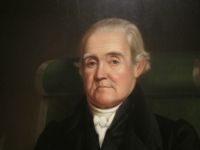 Noah Webster,
Webster's Unabridged Dictionary…
Noah Webster,
Webster's Unabridged Dictionary…
“ That branch of anthropology which treats of the actual distribution of the human race in its different divisions, as distinguished by physical character, language, institutions, and customs, in contradistinction to ethnography, which treats historically of the origin and filiation of races and nations. ”
 Andrew Dickson White,
History of the Warfare of Science with Theology in Christendom
Andrew Dickson White,
History of the Warfare of Science with Theology in Christendom
“ Thus, then, Anthropology and its handmaids, Ethnology, Philology, and History, have wrought out, beyond a doubt, proofs of the upward evolution of humanity since the appearance of man upon our planet. ”
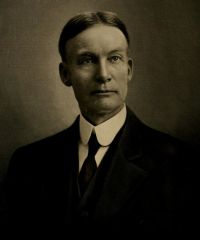 Frank W. Blackmar,
History of Human Society
Frank W. Blackmar,
History of Human Society
“ The Origin of Man Has not Yet Been Determined.—Man's origin is still shrouded in mystery, notwithstanding the accumulated knowledge of the results of scientific investigation in the field and in the laboratory. ”
 Guillermo Marín Ruiz,
Translation:True History of the Profound Mexico
(2010)
Guillermo Marín Ruiz,
Translation:True History of the Profound Mexico
(2010)
“ The myth of the origin and the creation of the world [4] are common in all cultures of the world. Each culture has its own concept of earth creation and of human beings, which is indisputably a philosophical approach. ”
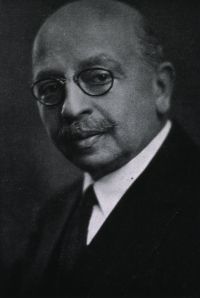 Joseph Jastrow,
Popular Science Monthly
(1904)
Joseph Jastrow,
Popular Science Monthly
(1904)
“ The sequence of culture changes and the soil of motives in which these find root remain the permanently vital sources by which to illustrate and to comprehend the nature of human endowment, striving and achievement. For only half a century have we had access to an adequate point of view that brings into the vista of the progress of the ages the nature and the scope of evolutionary forces. ”
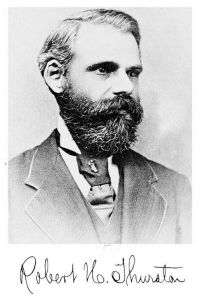 Robert Henry Thurston,
A History of the Growth of the Steam-Engine
Robert Henry Thurston,
A History of the Growth of the Steam-Engine
“ The work treats of the unity, origin, antiquity, and original localization of the human species, peopling of the globe, acclimatization, primitive man, formation of the human races, fossil human races, present human races, and the physical and psychological characters of mankind. ”
 Georg Wilhelm Friedrich Hegel,
Science of Logic
(1816)
Georg Wilhelm Friedrich Hegel,
Science of Logic
(1816)
“ By 'anthropology' is meant not the anthropology of modern writers, who use the name to denote mainly the history of human culture in its more rudimentary stages, and as exhibited chiefly in material products, but the study of those aspects of psychology which are most closely allied with physiological conditions. ”
Henry K. Rowe, Society: Its Origin and Development
“ Source Material for Study.—The source material of social life lies all about us. For its past history we must explore the primitive conduct of human beings as we learn it from anthropology and archæology, or as we infer it from the lowest human races or from animal groups that bear the nearest physical and mental resemblance to mankind. ”
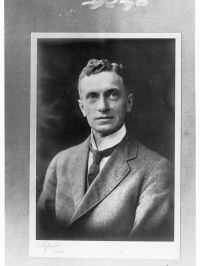 Herbert Basedow,
The Australian aboriginal
(1925)
Herbert Basedow,
The Australian aboriginal
(1925)
“ Then there are factious names, of a religious or sacred character, each of which directly relates to the accepted affinity existing between a living person and an ancestral spirit of semi-human origin. ”
Chautauqua Institution, The Chautauquan, Vol. 05, April 1885
“ Before, however, we attempt to look upon that picture, it will be necessary to establish and defend the theory of man’s condition and history upon this earth, with which it is inseparably connected.A view of human history, which has been strongly advocated of late, is that our race began physically, intellectually, and morally at the lowest possible point. ”
The Atlantic Monthly — The German Popular Legend of Doctor Faustus
“ Their connection with mankind has, in the earliest times, occupied the imagination of the most widely different races. A certain analogy we can easily explain by the affinity of human hearts and human minds. ”
George John Romanes, Mental Evolution in Man: Origin of Human Faculty
“ Lastly, it is likewise a matter of observation, as I shall fully show in the next instalment of this work, that in the history of our race—as recorded in documents, traditions, antiquarian remains, and flint implements—the intelligence of the race has been subject to a steady process of gradual development. ”
Charles James Sprague, The Atlantic Monthly (1866)
“ For a while the old influence of theological rule held even these venturous explorers to the ancient landmarks of human origin. By and by, the same impulse which had before led men to examine the proofs of physical creation induced them to consider the evidence of their own advent upon earth. ”
 Herbert Spencer,
Popular Science Monthly
(1872)
Herbert Spencer,
Popular Science Monthly
(1872)
“ What Biography is to Anthropology, History is to Sociology—History, I mean, as commonly conceived. The kind of relation which the sayings and doings, that make up the ordinary account of a man's life, bear to an account of his bodily and mental evolution, structural and functional, is like the kind of relation borne by that narrative of a nation's actions and fortunes its historian gives us, to a description of its institutions, regulative and operative, and the ways in which their structures and functions have gradually established themselves. ”
Charles Kingsley,
Lectures Delivered in America in 1874
“ What if the beginnings of true civilisation in this unique, abnormal, diseased, unsatisfied, incomprehensible, and truly miraculous and supernatural race we call man, had been literally, and in actual fact, miraculous and supernatural likewise? What if that be the true key to the mystery of humanity and its origin? What if the few first chapters of the most ancient and most sacred book should point, under whatever symbols, to the actual and the only possible origin of civilisation, the education of a man, or a family by beings of some higher race than man? ”
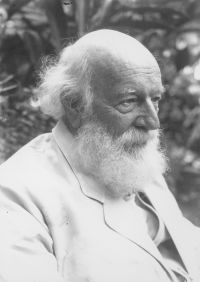 William Tufts Brigham,
Guatemala
(1887)
William Tufts Brigham,
Guatemala
(1887)
“ In an uncontroversial spirit I would accept the slight glimpses of early human races which have lived upon this continent, and leave to others the task, agreeable to their tastes, of weighing, measuring, and analyzing these stories of a simple people who can no longer speak for themselves. ”
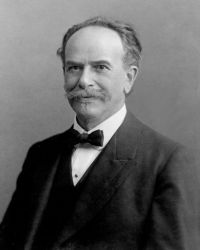 Franz Boas,
Anthropology
(1908)
Franz Boas,
Anthropology
(1908)
“ The sameness of a number of fundamental ideas and inventions has suggested to some investigators the belief that there are old cultural achievements belonging to a period previous to the general dispersion of the human race,—a theory that has some points in its favor, though its correctness cannot be proved. ”
T. Rice Holmes, Ancient Britain and the Invasions of Julius Caesar
“ If the problems of British ethnology can be solved, history, physical anthropology, archaeology, and philology must combine.II">THE METHODS OF ANTHROPOLOGYA lay reader who takes up a treatise on ethnology ought to understand the methods by which anthropologists differentiate the various human types. ”
Franz Boas,
The American Journal of Psychology
(1910)
“ The science of anthropology deals with the biological and mental manifestations of human life as they appear in different races and in different societies. The phenomena with which we are dealing are therefore, from one point of view, historical. We are endeavoring to elucidate the events which have led to the formation of human types, past and present, and which have determined the course of cultural development of any given group of men. From another point of view the same phenomena are the objects of biological and psychological investigations. ”
William A. Locy, Popular Science Monthly (1909)
“ The accounts of the discoveries of prehuman remains, connecting by gradations with races now living, are extending into remote periods our conception of the antiquity of man. These matters arouse interest and discussion, and the sweep of all these discoveries brings with it a widening of the horizon of human understanding. ”
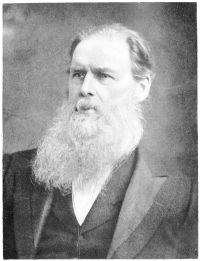 Edward B. Tylor,
Anthropology
(1881)
Edward B. Tylor,
Anthropology
(1881)
“ The student who seeks to understand how mankind came to be as they are, and to live as they do, ought first to know clearly whether men are new-comers on the earth, or old inhabitants. Did they appear with their various races and ways of life ready-made, or were these shaped by the long, slow growth of ages? In order to answer this question, our first business will be to take a rapid survey of the varieties of men, their languages, their civilization, and their ancient relics, to see what proofs may thus be had of man’s age in the world. ”
 James Russell Lowell,
The Writings of James Russell Lowell in Prose and Poetry…
James Russell Lowell,
The Writings of James Russell Lowell in Prose and Poetry…
“ We have reason to suspect, indeed, that pride of origin, whether high or low, springs from the same principle in human nature, and that one is but the positive, the other the negative, pole of a single weakness. ”

“ How many mothers have heard of the theory, formulated and vouched for by most distinguished scientists, that the individual during the normal progress of his existence passes through the whole history of the development of his race? ”
Edward B. Tylor,
Anthropology
(1881)
“ Here this sketch of Anthropology may close. The examination of man’s age on the earth, his bodily structure and varieties of race and language, has led us on to enquire into his intellectual and social history. ”
Delphian Society, The World's Progress, Vol. 01…
“ Our anthropologists, ethnologists and sociologists are just as actively and patiently inquiring into the origins of customs, institutions, law, religion, society. The historian is no longer content to rehearse a story because it is interesting ”
 Ernst Haeckel,
Last Words on Evolution: A Popular Retrospect and Summary
Ernst Haeckel,
Last Words on Evolution: A Popular Retrospect and Summary
“ We have further proof in the stem-history of the soul, which we gather from the comparative psychology of the lower and higher mammals, and of savage and civilised races. Modern ethnography shows us in actual existence the various stages through which the mind rose to its present height. ”
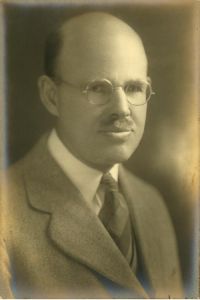 Ellsworth Huntington,
The Red Man's Continent: A Chronicle of Aboriginal America
(1919)
Ellsworth Huntington,
The Red Man's Continent: A Chronicle of Aboriginal America
(1919)
“ For the source of any characteristic so widespread and uniform as this adaptation to environment we must go back to the very beginning of the human race. ”
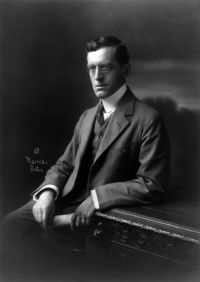 Ralph Adams Cram,
Towards the Great Peace
Ralph Adams Cram,
Towards the Great Peace
“ There are certain ethnic units or races which for periods ranging from five hundred to two thousand years have produced character, and through character the great contributions that have been made to human culture and have been expressed through men of distinction, dynamic force, and vivid personality. ”
Earl John Russell Russell, Adventures in the Moon, and Other Worlds
“ Rejecting then all such impediments, I begin by telling you that amongst every people which I have visited in my travels, I have found a great curiosity to know the origin and first condition of mankind, and to learn the changes which have made men what they now are. Accordingly in every country some person has undertaken to gratify this desire, and disclose the first beginning of man, and his progress to the present condition; so that there is not a race to be found, however savage and destitute of literature, which has not some legend of the early circumstances of the world. ”
Related terms
Authors who wrote about “human origins”
 S. LaingLewis Henry MorganFranz BoasCarveth ReadRobert ChambersNathaniel Southgate ShalerAugustus Henry Lane-Fox Pitt-RiversBenjamin Breckinridge WarfieldHenry David ThoreauArchibald GeikieWilliam Henry FlowerEdwin Sidney HartlandCharles KingsleyGeorge Wharton JamesGuillermo Marín RuizNoah WebsterRobert Henry ThurstonGeorg Wilhelm Friedrich HegelHenry K. RoweJoseph Jastrow