Periodic table

Definition and stakes

Portrait of Bertrand Russell Bertrand Russell,  The A B C of atoms (1923)

“ As we travel up the periodic table, the first element in each period, which is an alkali, has only one electron in the outermost ring; accordingly we might expect this one electron to move more or less as the hydrogen electron does, since the positive charge on the nucleus exceeds the negative charges on the inner electrons by just the amount of the charge on an electron or a hydrogen nucleus, and the inner electrons may be expected to be never very near the outer electron, as distances go within an atom. ”
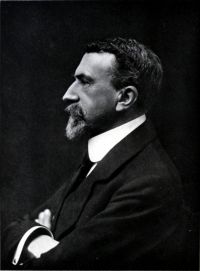
Source: Gutenberg

Portrait of Bertrand Russell Bertrand Russell,  The A B C of atoms (1923)

“ Every element has its characteristic spectrum, by which its presence may be detected. The spectrum, as we shall see, depends in the main upon the electrons in the outer ring. When an atom is positively electrified by being robbed of an electron in the outer ring, its spectrum is changed, and becomes very similar to that of the preceding element in the periodic table. Thus positively electrified helium has a spectrum closely similar to that of hydrogen—so similar that for a long time it was mistaken for that of hydrogen. ”
Source: Gutenberg

Master Tales of Mystery, Volume 3

“ Matter is simply ether in motion, is composed of corpuscles, electrically charged ions, or electrons, moving units of negative electricity about one one-thousandth part of the hydrogen atom. Matter is made up of electricity and nothing but electricity. Let us see what that leads to. You are acquainted with Mendeléeff's periodic table?"
He drew forth a huge chart on which all the eighty or so elements were arranged in eight groups or octaves and twelve series.
”
Source: Gutenberg

Get perspective with Kwize: daily news enlightened by great literature