“ The great moth, looking more than half as big as the aggressor, beat the pipit with his strong wings in his efforts to free himself; but the other had clutched the soft, stout body in its claws, and standing over it with wings half open and head feathers raised, struck repeatedly at it with the greatest fury until it was killed. Then, in the same savage hawk-like manner, the dead thing was torn {117} up, the pipit swallowing pieces so much too large for it that it had the greatest trouble to get them down. The gentle, timid, little bird had for the moment put on the "rage of the vulture." ”
Pipit
Definition and stakes
Quotes about “pipit”
William Henry Hudson,
British birds
(1921)
“ In the love season the male pipit occasionally takes his stand on a weed or low bush; but on moors, hills, and stony waste-lands he prefers a stone or mound of earth for a perch. From such an elevation he is able to keep watch on the movements of his mate, and, when the singing spirit takes him, to launch himself easily on the air. To sing he soars up to a height of forty feet or more, then glides gracefully down, with tail spread and wings half-closed and motionless, presenting the figure of a barbed arrow-head. ”
Olive Thorne Miller,
The Children's Book of Birds
“ The nest of the pipit is made by hollowing out a little place in the ground and lining it with fine grasses. Though on the ground, it is one of the hardest to find, because it is lightly covered with the dry grasses, and when the bird is sitting, she matches the grasses so well that one can hardly see her, even when looking right at her.The birds eat insects and weed seeds, and go about in flocks. Even then they are hard to see, because when they are startled they do not flutter or fly, but crouch or squat at once, and stay perfectly still. ”
W. H. Hudson,
The Land's End: A Naturalist's Impressions In West Cornwall…
“ Now, strange as all this may seem—that the pipit should live and breed just by or among the herring gulls, ready at all times to seize and devour any living creature that comes by chance in their way, and that it should go on ascending and descending, singing and singing, every day and all day long, just where the gulls are perpetually floating and flying hither and thither, always on the look-out for something to devour—it is but acting in accordance with its known character. ”
Alfred Newton, 1911 Encyclopædia Britannica (1911)
“ Pipits, of which over fifty species have been described, occur in almost all parts of the world, but in North America are represented by only two species—Neocorys spraguii, the prairie-lark of the north-western plains, and Anthus ludovicianus, the American titlark, which last is very nearly allied to the so-called water-pipit of Europe, A. spipoletta. To most English readers the best known species of pipit is the titlark or meadow-pipit, A. pratensis, a bird too common to need description, and abundant on pastures, moors, and uncultivated districts generally ”
John Hooper Bowles, The Birds of Washington (Volume 1 of 2…
“ Pipits are boreal breeders; but inasmuch as our own superb Alps claim kinship with the Arctic, there is no more favorable spot to study the nesting of the Pipits than upon the Cascades of northern Washington. At home the Pipit is a very different creature from the straggler of the long trail. On his native heather, surrounded by dwarfed fir trees, melting snow-fields, and splendid vistas of peak and cloud, he knows exactly what he wants and is quite capable of flying in a straight line. ”
Geoffrey Egerton-Warburton, In a Cheshire Garden: Natural History Notes
“ The little pipit (if it was always the same, and I never saw more than one at once) was not away for more than a minute or two, except on the third day, when it was pouring wet and food seemed harder to find. As soon as the cuckoo knew that its nurse was coming it began opening its mouth and quivering its wings, while the poor little dupe that brought the food would alight a short distance off and run along the wire to its side, then, looking ridiculously small for the job, it would manage to pop something into its mouth, not all in one go, but in two or three. ”
“ The swampy grounds in the interior of the country are peopled with legions of golden and king plovers, of snipes and red-shanks; the lakes abound with swans, ducks, and geese of various kinds; the snow-bunting enlivens the solitude of the rocky wilderness with his lively note, and, wherever grass grows, the common pipit (Anthus pratensis) builds its neat little nest, well lined with horsehair. Like the lark, he rises singing from the ground, and frequently surprises the traveller with his melodious warbling, which sounds doubly sweet in the lifeless waste. ”
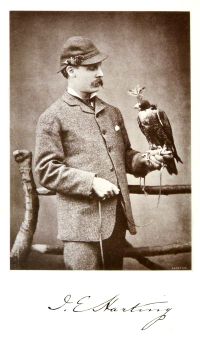
James Edmund Harting,
Our Summer Migrants
“ Gould, called attention to the fact of his having procured a Pipit at Torquay, which was subsequently identified unhesitatingly with A. aquaticus of Bechstein. Since that date, Mr. Gatcombe, of Plymouth, has noticed several other specimens in Devonshire, and a great many have been procured in Sussex, chiefly in the neighbourhood of Brighton. Thus the claim of this bird to rank as a British species has come to be pretty well established. M. Baily, in his “Ornithologie de la Savoie,” says that the Water Pipit is common at all seasons of the year both in Switzerland and Savoy. ”
W. H. Hudson,
The Land's End: A Naturalist's Impressions In West Cornwall…
“ The small bird is without fear of its big rapacious neighbours: it has its own quickness and adroitness to save it from all natural dangers of winds and waves and killing birds; it was only the rare chance of that gust of wind striking it just when it paused in mid-air before dropping, and carrying it away sideways into the midst of the herring gulls, which so nearly cost it its life. On the following morning the gulls would be there, flying about hungry as ever, and the pipit would go on with flight and song in the same old way, free as ever from apprehension. ”
James Edmund Harting,
Our Summer Migrants
“ They were replaced in the nest beside the Cuckoo, which struggled about till it got its back under one of them, when it climbed backwards directly up the open side of the nest, and hitched the Pipit from its back on to the edge. It then stood quite upright on its legs, which were straddled wide apart, with the claws firmly fixed half-way down the inside of the nest among the interlacing fibres of which the nest was woven; and, stretching its wings apart and backwards, it elbowed the Pipit fairly over the margin so far 240 that its struggles took it down the bank instead of back into the nest. ”
“ It proved to be what I had anticipated, namely the American pipit, or titlark, a slender brown bird, about the size of the sparrow, which passes through the States in the fall and spring, to and from its breeding haunts in the far north. They generally appear by twos and threes, or in small loose flocks, searching for food on banks and plowed ground. As they fly up, they show two or three white quills in the tail, like the vesper sparrow. Flying over, they utter a single chirp or cry every few rods. They breed in the bleak, moss-covered rocks of Labrador. ”
W. H. Hudson,
The Land's End: A Naturalist's Impressions In West Cornwall…
“ I was often there afterwards, spending long hours sitting on the rocks of the great head and shoulders, watching the sea and the birds that live in it; and later, when April set the tiny bell of the rock pipit tinkling, and the wheatear, hovering over the crags, dropped his brief delicious warble, and when the early delicate flowers touched the rocks and turf with tender, brilliant colour, I was more enamoured than ever of my lonely castle by the sea. ”
Cecil Smith, Birds of Guernsey (1879)
“ The Tree Pipit is mentioned in Professor Ansted's list, but no letters marking the distribution of the species amongst the Islands are given. There is no specimen of this or either of the other Pipits in the Museum.56. MEADOW PIPIT. Anthus pratensis, Linnaeus. French, "Le cujelier," "Pipit des prés," "Pipit Farlouse."—The Meadow Pipit is resident and breeds in all the Islands, but is by no means so numerous as the Tree Pipit is during the summer. I think, however, its numbers are slightly increased in the autumn, about the time of the departure of the Tree Pipits, by migrants. ”
H. G. Adams, Nests and Eggs of Familiar British Birds…
“ How many of these the bird lays no one can tell, but it has the judgment, or compassion, or whatever it may be, to give the Pipit, Hedge Sparrow, Wagtail, or other small bird so favoured, the task of rearing but one of its young, which soon grows to be quite a monster in the eyes of its foster parent, and sometimes, says the old Greek, Aristotle, eats her up ”
Norman Frederic Ticehurst and Claud Buchanan Ticehurst, The Zoologist (1902)
“ A nest found in a clearing in a wood on the far side of the fjeld on July 8th was probably of this species; it contained five well-grown young. Red-throated Pipit (A. cervinus) .—We were much disappointed at finding so few of these birds. On the fjeld we found them in scattered pairs along the edge of the tree limit, and in the islands of scrub in the hollows. A patch of birch and willows a square mile or so in extent would contain perhaps as many as three pairs. The cocks, often accompanied by their mates, were to be seen taking long flights, high in the air, singing all the time. ”
Oliver Vernon Aplin, The Zoologist (1900)
“ The Meadow Pipit is very common—among sand-hills on the coast, on the headlands, moorlands, and mountains. When alarmed for the safety of its nest or young, the note is a very sharp quick "chittick," somewhat like the sound made by a House-Cricket. Its rapid song always sounds to me very monotonous, there being usually only one change in it ”
Chester A. Reed, The Bird Book (1915)
“ This species is similar to the American Pipit and like that species nests on the ground; they are very abundant and are found in meadows, woods or thickets in the vicinity of houses. Their nests are made chiefly of grasses, lined with hair; the eggs are from four to six in number and are grayish, very heavily spotted and blotched with grayish brown. ”
The Condor (1899)
“ Plain Titmice are fast disappearing and are growing quite uncommon. Further back in the hills is where civilization has driven them. Young were found in two nests April 8. The American Pipit in winter appears to be as much at home in town as the urban English Sparrow. After a rain they can be found singly or in small bunches along the pavements in the densest part of town looking for worms. ”
John Hooper Bowles, The Birds of Washington (Volume 1 of 2…
“ The whole Pipit race seems to be struggling under a strange inhibitory spell, cast upon some ancestor, perhaps, by one knows not what art of nodding heather bells or potency of subtly distilled Arctic moonshine. As the flock comes straggling down from the northland they utter unceasing yips of mild astonishment and self-reproach at their apparent inability to decide what to do next. Their indecision is especially exasperating as one rides along a trail which is closely flanked by a primitive rail fence, as I have often done in Okanogan County. ”
William Edwin Brooks,
Stray Feathers
(1873)
“ The above measurements will give a good idea of the great difference in tarsus and hind claw between the two species. C. rufula is so much smaller than either of the others, that measurements of it are not necessary here. It generally measures about six inches in total length, and for its size has a large bill, and a singularly long strong tarsus, large foot, and hind claw for so small a pipit. It is a permanent resident from the south to the north of India and not, as far as I know, at all migratory like the other Indian pipits. ”
James Edmund Harting,
Our Summer Migrants
“ Mr. Turnbull, in his “Birds of East Lothian,” states (p. 40) that three Pennsylvanian Pipits were shot at Dunbar in East Lothian by Mr. Robert Gray, of Glasgow.Mr. Bond has a Pipit, identified as belonging to this species, which was obtained at Freshwater, in the Isle of Wight, in September, 1865; while the most recent instance of the occurrence of this Pipit in England will be found in the “Zoologist” for 1870. ”
Charles Dixon,
British Sea Birds
“ During autumn and winter Rock Pipits may generally be met with in parties, sometimes even in small flocks, congregating on the rocky beaches, the cliffs, and downs, or, at low water, searching amongst the seaweed and shingle for food. They are by no means shy birds, but, if alarmed, rise in scattered order, and, after flitting aimlessly about, again pitch a little farther on, and resume their search. In spring the Rock Pipit separates into pairs, the low-lying shores are deserted, and the birds resort to their several breeding-places. ”
Enos A. Mills, The Rocky Mountain Wonderland
“ Thus most birds met with in the heights during the summer season are the migratory ones. Among the summer residents are the American pipit, the white-crowned sparrow, and the gray-headed junco, the latter occasionally raising two broods in a summer. ”
Edward Step, Animal Life of the British Isles
“ His common diet of snails and beetles is varied by the eggs of the robin and meadow pipit, and occasionally he stumbles upon a huge store of food in the shape of a dozen or more eggs of pheasant or partridge. By depressing his spines he may even find his way between the bars of a hen-coop, but after eating a great part of the hen he may be too portly to get out, and then falls a victim to the enraged poultry-farmer. ”
Richard Manliffe Barrington, Report on the Migration of Birds in the Spring and Autumn of 1881…
“ Pipits at Whalsey Skerries, Pentland Skerries, and Isle of May (few records) . Earliest at Whalsey Skerries, Aug. 28th (following Sparrowhawk) , but all left next day; latest at Pentland Skerries, Oct. 25th (six struck at night) . Rush (on small scale) at Isle of May, Sept. 24th, 25th, and 26th. General Notes:—Mr. Agnew speaks of -7- some being always here, but additions on Sept. 24th. Possibly Mr. Agnew alludes, however, to Rock Pipits as the residents. The Meadow Pipit is probably the species first seen as additions on Sept. 24th. N.B. The Rock Pipit is a larger bird than the Meadow Pipit ”
various authors, editor W.L. Distant, The Zoologist (1901)
“ In plumage it resembled the Titlark. Whether this be a variety or no, I cannot say." This description appears to indicate that the doctor had got hold of Richard's Pipit, although the species has never been recorded in North Wales. It is unfortunate that the specimen is not, so far as I know, in existence; but the length of the bird, the shrill call-note, the Pipit-like colouring, and the very long hind claw can only apply to the species named. This note was submitted to Mr. ”
Neltje Blanchan, Bird Neighbors
“ During the migrations the pipits are abundant in salt marshes or open stretches of country inland, that, with lark-like preference, they choose for feeding grounds. When flushed, all the flock rise together with uncertain flight, hovering and wheeling about the place, calling down dee-dee, dee-dee above your head until you have passed on your way, then promptly returning to the spot from whence they were disturbed. ”
Leander S. Keyser, Birds of the Rockies
“ Most of the nests are to be found at an elevation of twelve thousand to thirteen thousand feet, the lowest known being one on Mount Audubon, discovered on the third of July with fresh eggs. During the breeding season these birds never descend below timber-line. The young birds having left the nest, in August both old and young gather in flocks and range over the bald mountain peaks in quest of such dainties as are to the pipit taste. ”
Olive Thorne Miller,
The Children's Book of Birds
“ The pipits live on the ground, and walk and run, not hop. As they go, they bob their heads, and jerk their tails. They are a little larger [47] than an English sparrow, and they go in flocks. They are never seen in the woods, but in open pastures or plains, or beside a road. ”
Jean-Henri Fabre,
Insect life: Souvenirs of a naturalist
(1913)
“ Only one other bird surpasses it in the art of fattening itself, and that is its fellow emigrant,—another voracious devourer of insects,—the bush pipit as it is absurdly styled by those who name birds, while the dullest of our shepherds never hesitate to call it Le Grasset, i.e. ”
Charles Dixon,
Among the Birds in Northern Shires
“ Almost to a bird these Pipits leave the South Yorkshire moors during September and October. We used sometimes to meet with odd birds on the rough grounds below the moors during winter, but, speaking generally, the migrational movement is [47] pretty complete. Meadow Pipits always give us the impression of being somewhat sad little birds, taking life very seriously, as even human dwellers on these moorland solitudes are apt to do. We may illustrate this by a comparison of the cheery Wren with these Pipits, and then the reader will quite understand our meaning. ”