“ Where a Federal statute does not preempt State law (as addressed in subsection (a) of this section) , agencies shall construe any authorization in the statute for the issuance of regulations as authorizing preemption of State law by rulemaking only when the exercise of State authority directly conflicts with the exercise of Federal authority under the Federal statute or there is clear evidence to conclude that the Congress intended the agency to have the authority to preempt State law. ”
Preemption law
Definition and stakes
The theme of “preemption law” has been addressed by authors such as C. C. Andrews, Stephen Johnson Field, John Law, John Marshall and Oliver Wendell Holmes, Jr.. It is often associated with terms like statute, states, exemption, contract and Constitution.
Quotes about “preemption law”
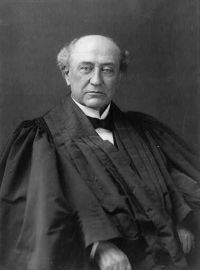 David Josiah Brewer,
Union Pacific Railroad Company v…
“ While the power of Congress over lands which an individual is seeking to acquire under either the pre-emption or the homestead law remains until the payment of the full purchase price required by the former law or the full occupation prescribed by the latter, yet, under the general land laws of the United States, one who, having made an entry, is in actual occupation under the preemption or homestead law, cannot be dispossessed of his priority at the instance of any individual. ”
A Compilation of the Messages and Papers of the Presidents…
“ The bill creates an unjust distinction between persons claiming the benefit of the preemption laws. Whilst it reduces the price of the land to existing preemptors to 62-1/2 cents per acre and gives them a credit on this sum for two years from the present date, no matter how long they may have hitherto enjoyed the land, future preemptors will be compelled to pay double this price per acre. ”
 Samuel Freeman Miller,
Atherton v. Fowler (96 U.S. 513…
“ Does the policy of the pre-emption law authorize a stranger to thrust these men out of their houses, seize their improvements, and settle exactly where they were settled, and by these acts acquire the initiatory right of pre-emption? ”
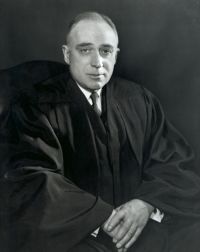 John Marshall Harlan II,
United Mine Workers of America v…
“ Mr. Justice HARLAN, whom Mr. Justice CLARK joins, concurring.I agree with and join in Part I of the Court's opinion relating to pendent jurisdiction. As to Part II, I refrain from joining the Court's speculations about the uses to which it may put the preemption doctrine in similar future cases. ”
A Compilation of the Messages and Papers of the Presidents…
“ Preemption is itself a special privilege, only authorized by its supposed public benefit in promoting the settlement and cultivation of vacant territory and in rewarding the enterprise of the persons upon whom the privilege is bestowed. "Preemption rights," as declared by the Supreme Court of the United States, "are founded in an enlightened public policy, rendered necessary by the enterprise of our citizens. The adventurous pioneer, who is found in advance of our settlements, encounters many hardships, and not unfrequently dangers from savage incursions. ”
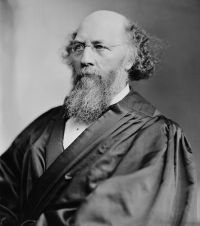 Stephen Johnson Field,
The Yosemite Valley Case — Opinion of the Court
“ The hindrance to the complete performance of everything required of the claimant could not impair his rights. And it was immediately after affirming the validity of his claim, notwithstanding this hindrance, that the court used the language upon which so much stress is placed by the defendant's counsel, to the effect that a claim of pre-emption is not a 'shadowy right,' but when covered by the law is a legal right, subject to be defeated only by a failure to perform the conditions annexed to it. ”
 Sandra Day O'Connor,
Ingersoll-Rand Company v. McClendon…
“ To discern Congress' intent we examine the explicit statutory language and the structure and purpose of the statute. See FMC Corp. v. Holliday, 498 U.S. 52, 56, 111 S.Ct. 403, 407, 112 L.Ed.2d 356 (1990) , (citing Shaw, supra, 463 U.S., at 95, 103 S.Ct., at 2898-99) . Regardless of the avenue we follow-whether explicit or implied pre-emption-this state law cause of action cannot be sustained.Where, as here, Congress has expressly included a broadly worded pre-emption provision in a comprehensive statute such as ERISA, our task of discerning congressional intent is considerably simplified. ”
Clarence Thomas, Wyeth v. Levine, 555 U.S. 555… (2009 | noyear)
“ III The origins of this Court's "purposes and objectives" pre-emption jurisprudence in Hines, and its broad application in cases like Geier, illustrate that this brand of the Court's pre-emption jurisprudence facilitates freewheeling, extra textual, and broad evaluations of the "purposes and objectives" embodied within federal law. This, in turn, leads to decisions giving improperly broad pre-emptive effect to judicially manufactured policies, rather than to the statutory text enacted by Congress pursuant to the Constitution and the agency actions authorized thereby. ”
Robert H. Jackson, Davies Warehouse Company v. Bowles…
“ It also is contended that an interpretation must prevail as matter of principle which will give the exemption a general and uniform operation in all states irrespective of local law. It is, of course, true that uniform operation of a federal law is a desirable end, and other things being equal, we often have interpreted statutes to achieve it. ”
Edward Douglass White, Berryman v. Board of Trustees of Whitman College…
“ With this concession in mind, and before coming to determine whether the exemption was valid, that is, whether, in and by virtue of the prohibition in the organic law forbidding especial privileges, the territorial legislature was incompetent to grant a contract exemption, we briefly advert to the contention made that a broad meaning must be given to the organic act for the purpose, if it can be done, of establishing that there was no limit upon the power of the territorial legislature to exempt. ”
Peter Vivian Daniel, Planters' Bank of Mississippi v…
“ The actual repeal of such a statute cannot correctly be regarded as the violation of any vested right, or the impairing of the obligation of a contract, for no one can claim to have a perfect and vested right, through all future time, in the mere capacity to do an act, from the absence of a law forbidding that act. ”
Oliver Wendell Holmes, Jr., Wright v. Central of Georgia Railway Company…
“ We cannot suppose that the legislature meant either to practise a cunning deception or to make a futile grant. Therefore, we are unable to read the charter as making the exemption vain by reserving to the state an unlimited right to impose upon the lessee all that it had renounced as against the lessor. For that was to give notice to the parties, if they were supposed to know the law, that the exemption would be lost if the income was earned in one of the contemplated ways ”
Stephen Johnson Field,
Stone v. Wisconsin/Dissent Johnson Field…
“ Of what avail is the constitutional provision that no State shall deprive any person of his property except by due process of law, if the State can, by fixing the compensation which he may receive for its use, take from him all that is valuable in the property? To what purpose can the constitutional prohibition upon the State against impairing the obligation of contracts be invoked, if the State can, in the face of a charter authorizing a company to charge reasonable rates, prescribe what rates shall be deemed reasonable for services rendered? ”
 William R. Day,
New York ex rel. Lieberman v. Van De Carr…
“ We have, then, an ordinance which, as construed in the highest court of the state, authorizes the exercise of a legal discretion in the granting or withholding of permits to transact a business which, unless controlled, may be highly dangerous to the health of the community, and no affirmative showing that the power has been exerted in so arbitrary and oppressive a manner as to deprive the appellant of his property or liberty without due process of law. ”
Stephen Johnson Field,
Pollock v. Farmers' Loan Trust Company…
“ If the exceptions are stricken out, there is nothing to be assessed and collected except what congress has otherwise affirmatively ore red. Nothing less can have the force of law. This court is impotent to pass any law on the subject. It has no legislative power. I am unable, therefore, to see how we can, by declaring an exemption or exception invalid, thereby give effect to provisions as though they were never exempted. ”
De Veau v. Braisted — Opinion of the Court
“ Just the opposite conclusion is indicated by the 1959 Act, which reflects congressional awareness of the problems of pre-emption in the area of labor legislation, and which did not leave the solution of questions of pre-emption to inference. When Congress meant pre-emption to flow from the 1959 Act it expressly so provided. Sections 205 (c) and 403, set out in the margin, [2] are express provisions excluding the operation of state law, supplementing provisions for new federal regulation. No such pre-emption provision was provided in connection with § 504 (a) . ”
David Hackett Souter, Astoria Federal Savings and Loan Association v…
“ Courts do not, of course, have free rein to impose rules of preclusion, as a matter of policy, when the interpretation of a statute is at hand. In this context, the question is not whether administrative estoppel is wise but whether it is intended by the legislature. The presumption holds nonetheless, for Congress is understood to legislate against a background of common-law adjudicatory principles. ”
Ward Hunt, Arthur v. Unkart — Opinion of the Court
“ It is not sufficient that the debtor shall claim the exemption, but he must, be proof of registry when necessary, or that the articles seized are those named in the statute, or are required to make up the amount of the exemption, or in some other mode, prove that articles were exempt, and that thus the seizure was illegal. Both the sheriff and collector have power to act in the first instance upon the question in dispute, and he who insists that such action is in violation of law must make the proof to show it. ”
C. C. Andrews, Minnesota and Dacotah
“ But no person shall be entitled to more than one preemptive right, and no person who is the proprietor of three hundred and twenty acres of land in any state or territory of the United States, and no person who shall quit or abandon his residence on his own land to reside on the public land in the same state or territory, shall acquire any right of preemption. ”
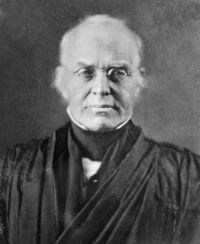 Joseph Story,
Minis v. United States — Opinion of the Court
“ But examining the clause, in its grammatical construction, brings us to the same result. It cannot be properly read as limited to a single year; the limitation is simply a reference to particular appropriations, which are included in the provision; a designation of them, not a qualification of the general and specific enactment. It says, that no officer shall receive extra compensation, on account of disbursing any public money, appropriated during the present session, for fortifications, &c.; or any other service or duty whatsoever, unless authorized by law. ”
D. C. Cloud, Monopolies and the People
“ In relation to pre-emption claims, the pre-emption law requires that a person must be over the age of twenty-one years, or the head of a family, a citizen of the United States, or a person who has filed a declaration to become such, and also that a person may file a pre-emption claim for such land as he may have settled upon, thus imposing conditions as pre-requisite to the initiation of a claim. ”
Charles Evans Hughes, Crowell v. Benson — Opinion of the Court
“ So far as the latter are concerned, full opportunity is afforded for their determination by the federal courts through proceedings to suspend or to set aside a compensation order (section 21 (b) , by the requirement that judgment is to be entered on a supplementary order declaring default only in case the order follows the law (section 18) , and by the provision that the issue of injunction or other process in a proceeding by a beneficiary to compel obedience to a compensation order is dependent upon a determination by the court that the order was lawfully made and served (section 21 (c) . ”
David Davis, Commonwealth v. Boutwell — Opinion of the Court
“ It cannot be supposed that this legislation was directed against the ultimate payment of the promised indemnity, for the repealing act did not go into operation until the 1st of July, 1871. For nearly a year, therefore, the appropriation was continued, and the constituted authorities of the States, were told to hasten their action if they wished to avail themselves of the benefits of the law. ”
Horace Gray, Vicksburg Company v. Dennis — Opinion of the Court
“ The omission of the taxing officers of the state in previous years to assess this property cannot control the duty imposed by law upon their successors, or the power of the legislature, or the legal construction of the statute under which the exemption is claimed. ”
Robert H. Jackson, Davies Warehouse Company v. Bowles…
“ The custom of resorting to them to give meaning and content to federal statutes is too old and its use too diversified to permit us to say that considerations of nationwide uniformity must prevail in a particular case over our judgment that it is out of harmony with other objective more important to the legislative purpose. [20] What content we should give to the exemption in the case of a conventional utility not subject to a state regulatory statute or subject only to partial regulation is, of course, not before us. ”
 Tom C. Clark,
Arrow Transportation Company v…
“ Section 22 (1) of the Act, 24 Stat. 387, 49 U.S.C. § 22 (1) , provides that no provision of the Act shall 'in any way abridge or alter the remedies now existing at common law or by statute, but the provisions of this act are in addition to such remedies.' The 'remedies now existing at common law' include such equitable remedies as injunctions. ”
David Josiah Brewer,
United States v. Lynah — Opinion of the Court
“ The law will imply a promise to make the required compensation, where property, to which the government asserts no title, is taken, pursuant to an act of Congress, as private property to be applied for public uses. Such an implication being consistent with the constitutional duty of the government, as well as with common justice, the claimant's cause of action in one that arises out of implied contract, within the meaning of the statute which confers jurisdiction upon the court of claims of actions founded 'upon any contract, express or implied, with the government of the United States. ”
 Hugo Black,
Davis v. Department of Labor and Industries of Washington…
“ Congress has directed that if the case is within the federal statute, the employer shall be relieved of all other obligation. But in order to relieve the employee in a doubtful case of the necessity of filing two claims, one under each act, a double burden is imposed on the employer by an inadmissible construction of the federal act. The dual system of presumptions, which are to operate in favor of the employee but apparently never against him, will serve to sustain an exercise of either state or federal jurisdiction in every case within the so-called 'twilight zone'. ”
Samuel Nelson, O'Brien v. Perry — Opinion of the Court
“ The Commissioner held, that, upon a true construction of the third section of the act of 1832, no claimant was entitled to the right of pre-emption unless he was an actual settler, being also a housekeeper, on the land at the date of the act, and that the condition applied as well to the party relinquishing his claim to the Government as to him whose claim had been rejected. ”
Oliver Wendell Holmes, Jr., Weiss v. Wiener — Opinion of the Court
“ The Act of Congress has its own criteria, irrespective of local law, that look to certain rather severe tests of liability and exemption and that do not allow the deductions demanded whatever the lessees may be called. ”
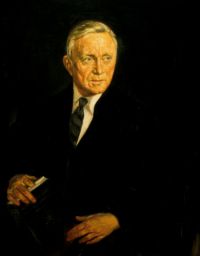 William O. Douglas,
Schwegmann Bros v. Calvert Distillers Corp…
“ The omission of the nonsigner provision from the federal law is fatal to respondents' position unless we are to perform a distinct legislative function by reading into the Act a provision that was meticulously omitted from it. ”
Edward Douglass White, Home Telephone Telegraph Company v…
“ The proposition, hence, applies to the prohibitions of the Amendment the law of principal and agent governing contracts between individuals, and consequently assumes that no act done by an officer of a state is within the reach of the Amendment unless such act can be held to be the act of the state by the application of such law of agency. ”
 Salmon P. Chase,
Thomson v. Pacific Railroad — Opinion of the Court
“ We perceive no limits to the principle of exemption which the complainants seek to establish. It would remove from the reach of State taxation all the property of every agent of the government. Every corporation engaged in the transportation of mails, or of government property of any description, by land or water, or in supplying materials for the use of the government, or in performing any service of whatever kind, might claim the benefit of the exemption. ”
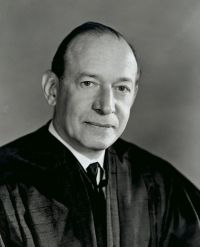 Abe Fortas,
Linn v. United Plant Guard Workers of America…
“ By narrowly restricting the permissible exceptions to the general rule of preemption and by excluding generally the right to compensation for purely private wrongs, the Court has contributed to the Nation's success in domesticating the potentially explosive warfare between labor and management. ”
Related terms
Authors who wrote about “preemption law”
C. C. AndrewsStephen Johnson Field John Law
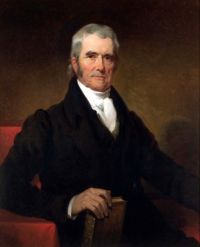 John MarshallOliver Wendell Holmes, Jr.Alexander Hamilton
 Harlan F. StoneDavid Josiah BrewerEdward Douglass WhiteSamuel Freeman Miller
 Edmund BurkeByron WhiteSandra Day O'ConnorPeter Vivian DanielJohn Marshall Harlan IIRobert H. JacksonWard HuntClarence ThomasWilliam R. DayCharles Evans Hughes
Stephen Johnson FieldJohn LawJohn MarshallOliver Wendell Holmes, Jr.Alexander HamiltonHarlan F. StoneDavid Josiah BrewerEdward Douglass WhiteSamuel Freeman MillerEdmund BurkeByron WhiteSandra Day O'ConnorPeter Vivian DanielJohn Marshall Harlan IIRobert H. JacksonWard HuntClarence ThomasWilliam R. DayCharles Evans Hughes