Radioactive element

Definition and stakes

Bernard Keisch,  The Mysterious Box: Nuclear Science and Art

“ It is, but we’re talking about such small quantities that its difficult for scientists using the most sensitive equipment to detect it. The uranium in the rock decays to another radioactive element and that one decays to another, and another, and another, and so 12 forth, in a series of elements that results in lead, which is not radioactive. In this series are two radioactive elements, radium and a radioactive isotope of lead, that help us to date paintings. ”
Source: Gutenberg

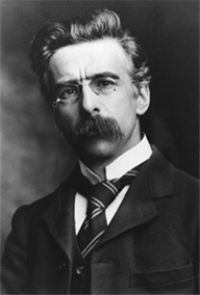
Portrait of John Joly John Joly,  The Birth-Time of the World and Other Scientific Essays

“ The length of its path is therefore different
according to the radioactive element from which it proceeds. The
retardation which it experiences in its path depends entirely
upon the atomic weight of the atoms which it traverses. As it
advances in its path its effectiveness in ionising the atom
rapidly increases and attains a very marked maximum. In a gas the
ions produced being much crowded together recombine rapidly; so
rapidly that the actual ionisation may be quite concealed unless
a sufficiently strong electric force is applied to separate them.
”
Source: Gutenberg

Henry Faul,  Nuclear Clocks

“ All natural radioactivity in the heavy elements proceeds by such a series of steps, and the series finally ends with a stable form of lead as its end product. In other words, any naturally radioactive heavy element eventually becomes nonradioactive lead.
The nucleus of every atom (except hydrogen) contains one or more neutrons and one or more protons. The instability of the nuclei of the heavy atoms is related to the ratio of the number of neutrons to the number of protons in the nuclei. Radioactive decay is, in fact, a way of adjusting these ratios. The adjustment can occur in various ways.
”
Source: Gutenberg

Get perspective with Kwize: daily news enlightened by great literature