The Art of Music. Vol. 01 (of 14…
“ It must not be forgotten, on the other hand, that secular music exerted a vigorous influence upon ecclesiastical music, an influence constantly combatted by the church authorities, yet constantly triumphant. ”
The Art of Music. Vol. 01 (of 14…
“ It must not be forgotten, on the other hand, that secular music exerted a vigorous influence upon ecclesiastical music, an influence constantly combatted by the church authorities, yet constantly triumphant. ”
H. Fielding, The Hearts of Men
“ The Salvation Army had to borrow secular music to make its hymns attractive. Striking an average, which is best—secular or religious literature, art, music, and architecture? Without a doubt secular art is the best all round. ”
Edward Dickinson, Music in the History of the Western Church
“ This ideal is found in the distinction of the church style from the secular style, the expression of the universal mood of prayer, rather than the expression of individual, fluctuating, passionate emotion with which secular music deals—that rapt, pervasive, exalted tone which makes no attempt at detailed painting of events or superficial mental states, but seems rather to symbolize the fundamental sentiments of humility, awe, hope, and love which mingle all particular experiences in the common offering that surges upward from the heart of the Church to its Lord and Master. ”
The Art of Music. Vol. 01 (of 14…
“ Just as the artist ‘humanized the altar pieces and the cloister frescoes upon which he worked’ and so ‘silently substituted the love of beauty and the interest of actual life for the principles of the church,’ so the musician ‘humanized’ the service of the church, brought beauty, expression and emotion into his masses and motets, imbuing them with the dramatic spirit, the spirit of passion, which had never been absent from the secular music of the people, the music that is always indigenous to the soil. ”
W. J. Henderson, How Music Developed
“ This period also saw secular music taken into the fold of art, and began the production of madrigals and other secular songs. In the fourth period the dry old science of counterpoint was so completely conquered that the composers of the time were able to make it the vehicle of the purest expression of religious devotion the world has yet found, and church music passed through its golden age. ”
The Art of Music. Vol. 01 (of 14…
“ But, when we turn to the question of secular song at the beginning of our era, we are baffled by an utter lack of tangible material. For the same monks to whom we are indebted for the early examples of sacred music were religious fanatics who looked with hostile eyes upon the profane creations of their lay contemporaries. Yet we may be confident of the continued and uninterrupted existence not only of some sort of folk music, but also of the germs at least of an art music, however crude, throughout that period of confusion incident to, and following, the crumbling of the Roman empire. ”
 E. T. A. Hoffmann,
The Serapion Brethren, Vol. I
“ Passing thence onwards into life, ever richer and mightier, music poured forth its inexhaustible treasures over mankind, so that even the secular (or, as it is sometimes styled, the 'profane') might, in childlike delight, adorn itself in that splendour wherewith music illuminated life, through and through, even in all its little, petty, mundane relations. But, when thus adorned, even the secular appeared to be longing for the heavenly, higher realm, and striving to enter in amidst its phenomena. ”
Edward Dickinson, Music in the History of the Western Church
“ There would be a much nearer approach to a reconcilement of all these differences, and the cause of church music would be in a far more promising condition, if there were a closer sympathy between the standard of music within the Church and that prevailing in educated society outside. There is certainly a diversity of purpose between church music and secular music, and corresponding distinctions must be preserved in respect to form and expression. A secularized style of church music means decadence. ”
Carl Engel, Musical Myths and Facts, Volume 1…
“ It is a very different thing to apply to sacred words a modern secular tune the secular words of which are well known. Still, something similar was done by the Netherlandish composers of church music even long before chorales were constructed from secular tunes. These composers introduced the airs of popular songs into their Masses, to render their labours in counterpoint more attractive to the multitude. ”
Karl Wilson Gehrkens, Essentials in Conducting
“ All kinds of music are suitable for sacred use that do not raise secular associations. A Largo, an Adagio, a Grave, an Andante, an Allegro, a fugal or a non-fugal composition can all be performed in the Church but should one and all be of a staid and dignified character throughout, elevated and sober, and of such a nature that any preacher of note could say: "This splendid music is a fitting introduction to my discourse"; or "After such singing my lips had better be closed, and the spirit left to its own silent worship." ”
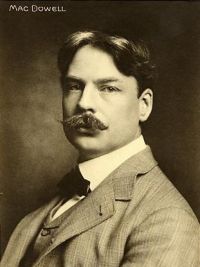 Edward MacDowell,
Critical and Historical Essays
“ The attempt to emancipate music from the dance commenced very early; in fact, most of the earliest secular music we know already shows the tendency towards programme music, for, from an emotional standpoint, secular music began at the very bottom of the ladder. It was made to express things at first, just as in learning any new language we naturally first acquire a vocabulary of nouns to express things we see, such as table, chair, etc., in the same way that in written language the symbols first take the shape of animals or other things they are meant to represent. ”
The Art of Music. Vol. 01 (of 14…
“ It is true that secular music was the first to benefit by the advance, for it preserved naturally all the elements which the new law purposed to regulate. Hence the first form—that which constitutes the first ground of interaction, the transition to the polyphonic form of church music—was the popular chanson, an elementary form of song, evidently developed from the canson and the ballad of the Troubadours, etc., which, as we know, were composed for a solo voice with an improvised instrumental accompaniment. ”
Robert Bridges, A Practical Discourse on Some Principles of Hymn-Singing
“ Besides, the main fault of these books, from which we should have to quote, is the association of the music, and this is really an accident, the question before us being the character of the music; so that we should require musical illustration, for though the common distinction between sacred and secular music is in the main just, yet the line cannot be drawn at the original intention, or historical origin of the music: the true differentiation lies in the character of the music, the associated sentiment being liable to change. ”
Various, The Catholic World, Vol. 19, April 1874‐September 1874
“ These characteristics of secular music, due to the influence first of Mozart and afterwards of Rossini more than to that of any other composers, have been too long felt in the music of the church, and to be rid of them we must lean more towards the past, and return to the study of those grave and solemn forms which existed prior to their day, and in which the instrumental accompaniment contained no suggestion of levity, and was used to support and enrich the vocal harmony without drawing attention from it. ”
Louis C. Elson, Chief Editor, University Musical Encyclopedia
“ In spite of the new departure which music took in the early years of the seventeenth century, the old school lived on under the wing of the Church for many years, at first untouched by the revolutionary ideas of secular composers and afterward only gradually affected by them. But the rise of opera, of instrumental music, and in fact of secular music as a separate entity gave a new complexion to the whole world of music. ”
James J. Walsh, The Thirteenth, Greatest of Centuries
“ Before the end of the century the interaction of church and secular music had given rise to many of the modes of modern musical {208} development, and the musical movement was as substantially begun as were any of the other great artistic and intellectual movements which this century so marvelously initiated. ”
Famous Composers and Their Works…
“ The development of secular music at this time is even more interesting and instructive than that of religious music, but it would require a chapter for its proper treatment; and as it was not long in abandoning the basis of counterpoint and entering: upon the free arioso style of the opera (in 1600) , it may be dismissed briefly. The reader must understand that popular music in the form of folk-songs has existed from time immemorial. ”
A Dictionary of Music and Musicians (1900)
“ The first objection was not a strong one, for the church had sanctioned the use of the secular melodies as the foundation of masses for more than a century, and some of the melodies had become almost hallowed to their purpose. The singing of the secular words might have been easily given up without forsaking the music. ”
Edward Dickinson, Music in the History of the Western Church
“ The powerful movement in the direction of secular music which emanated from Italy began to turn the minds of composers toward experiments which promised greater artistic satisfaction than could be found in the plain congregational choral. The rationalism of the eighteenth century, accompanying a period of doctrinal strife and lifeless formalism in the Church, repressed those unquestioning enthusiasms which are the only source of a genuinely expressive popular hymnody. ”
 W. E. B. Du Bois,
The Souls of Black Folk
“ Purely secular songs are few in number, partly because many of them were turned into hymns by a change of words, partly because the frolics were seldom heard by the stranger, and the music less often caught. ”
Recent Developments in European Thought
“ The supposed interests, I say; for the whole point of the third stage of development, the conflict in which English church music is now involved, is the denial by one of the opposing parties that the interests of religion are in any way served by such a sacrifice. It is a very keen conflict, in which the sympathies of the musician qua musician naturally lean towards those who uphold the inalienable dignity of his art: and even if he feels that ecclesiastical music, qua ecclesiastical, is outside his personal concern, influences from it are bound to radiate into the secular departments. ”
Edward Dickinson, Music in the History of the Western Church
“ As the sturdy inventive power of conservative church musicians was no longer available or desired, recourse was had, as in old times, to secular material, but not as formerly to the song of the people,—honest, sincere, redolent of the soil,—but rather to the light, artificial strains of the fashionable world, the modish Italian opera, and the affected pastoral poesy. It is the old story of the people’s song declining as the art-song flourishes. ”
W. J. Baltzell, A Complete History of Music
“ Secular Art Song.—The secular life of the 15th and 16th centuries, as well as the Church, had an art music, which, like the other music of the period was vocal, not solos with accompaniments, but choral, consisting of three or more parts ”
W. J. Baltzell, A Complete History of Music
“ Fortunately for the good of the art, the trained musicians of the Church took it up, and, calling to their aid the resources of their art as used in the music of the Church, applied them all to secular melodies, the songs of the people. ”
 Gustav Karpeles,
Jewish Literature and Other Essays
“ That is the ever-recurring motif of the Jewish music of the middle ages. But the blending of widely different emotions is not favorable in the creation of melody. Secular occurrences set their seal upon religious music, of which some have so high a conception as to call it one of the seven liberal arts, or even to extol it beyond poetry. ”
Various, The art of music, Vol. 04 (of 14… (1915)
“ We have among our church musicians a certain few who write the sober and so-called ecclesiastical style which the canons of the English schools have laid down as being the fitting adjunct of the church's service, while, again, particularly in America, a large amount of church music is couched in an idiom somewhat more secular in tone, in which a more popular melodic treatment lends so-called 'human interest' to the work. ”
 Rosa Newmarch,
The Russian Opera
“ Whether from a desire to be faithful to oriental asceticism, and to the austere spirit which animated the Church during the first centuries which followed the birth of Christ, or because of the need to keep a nation so recently converted, and still so deeply impregnated with paganism, fenced off from all contaminating influences, the Church soon waged relentless war upon every description of profane recreation. The Orthodox{5} clergy were not only opposed to music, but to every form of secular art. ”
Famous Composers and Their Works…
“ These writers not only made use of secular tunes, in order, as they thought, to give more variety to their music, but they often gave these tunes undue prominence, and thus rendered impossible a really artistic performance. We meet with innumerable masses based on secular themes, such as the first line of a well-known romance. "L'homme armé," for instance, a very popular song of the period, was thus used. ”
Various, The Catholic World, Vol. 19, April 1874‐September 1874
“ As Holy Writ forms the invariable foundation of the religious and moral principles of the true Christian, so the Gregorian chant ought to form the ground and invariable theme of the true church composer; and as long as composers understood and valued this inestimable, noble, and really sacred practice their works composed for the church truthfully and appropriately fulfilled their solemn office; these works were thus imbued with the sacred character derived from the themes of the sacred songs; then necessarily a distinct line of demarcation was drawn between secular and sacred music. ”
W. J. Henderson, How Music Developed
“ The more frequently the composers undertook to set to music dramatic libretti, even of the simplest nature, the more firmly they became convinced that their music was not the right kind. The musical artists of the time had followed the methods of the religious drama, described in the chapter on the birth of oratorio, and were now gradually awakening to the fact that its style of music was incapable of illustrating the human passions and emotions of the secular drama. ”
 W. S. B. Mathews,
A Popular History of the Art of Music
“ The voice of these masses stood to the Hebrews' mind as the feeble type of the great song which should go up from the entire Israel of God when the scattered members of the cult were gathered in their time of fullness and glory. For us also the same image stands. And while the art of this venerable and singularly gifted people did not attain a place of commanding influence upon the tonal side of music, it nevertheless has borne no small part in affording a vantage ground for later art in the line of noble conceptions, inspiring motives and brilliant suggestions. ”
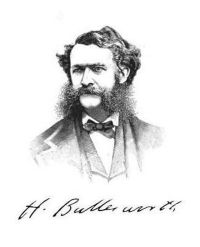 Hezekiah Butterworth,
Zigzag Journeys in Northern Lands…
“ A German poet calls the “Messiah” “a Christian epic in musical sounds.” The expression is a felicitous description of its theme and style. It celebrates the grandest of events with the sublimest strains that music may utter. The great composer commanded, and all the powers of music hastened with song and instrument to praise the life, death, and triumph of the Christ. No human composition ever voiced, in poetry or prose or music, such a masterly conception of the Virgin’s Son as that uttered by this magnificent oratorio. ”
Carl Engel, Musical Myths and Facts, Volume 1…
“ The admission of secular tunes into the hymnology, which in the Anglican Church finds advocates even in the present century, has caused the publication of several curious collections of sacred poetry set to melodies taken from secular compositions of Haydn, Mozart, Beethoven, and other celebrated musicians, and often painfully distorted to adapt them to the metre of the verses. True, the adaptation of secular melodies for sacred songs is not a new expedient. It was resorted to by our estimable composers of chorales and promoters of congregational singing at the time of the Reformation. ”
Various, The Catholic World, Vol. 07, April 1868 to September…
“ Has eloquence sought to nerve men for the grand conflicts of life? the church of Christ has touched the lips of eloquence with living fire from her altar, until have sprung forth words that flamed with love to man and love to God. Has music sought to weave her entrancing spells around the ear and heart and soul? the church of Christ has breathed into music her own divine being, until the music of the church seems like beatific worship, and worship on earth like beatific music. ”
W. S. B. Mathews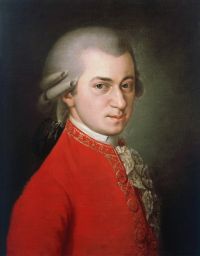 Wolfgang Amadeus MozartW. J. BaltzellW. J. Henderson
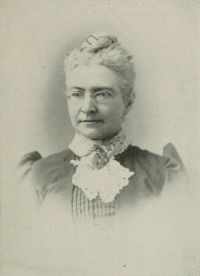 Aubertine Woodward Moore
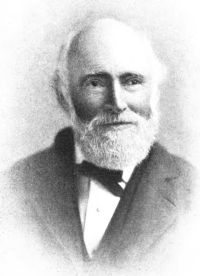 John Sullivan DwightEdward MacDowell
 Marion BauerLouis C. Elson, Chief Editor
 Frederick Bridge
 James Alphonsus VölkerRobert BridgesE. T. A. HoffmannEmma SeilerKarl Wilson GehrkensRosa Newmarch
 Charles Ives
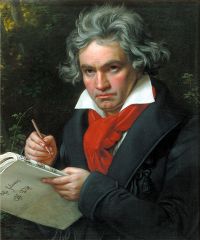 Ludwig van Beethoven
