Statistical ensemble

Definition and stakes

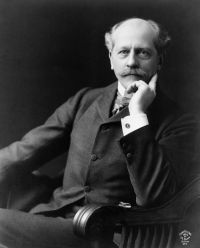
Portrait of Josiah Willard Gibbs Josiah Willard Gibbs,  Elementary Principles in Statistical Mechanics (1902)

“ It would seem, therefore, that we might find a sort of measure of the deviation of an ensemble from statistical equilibrium in the excess of the average index above the minimum which is consistent with the condition of the invariability of the distribution with respect to the constant functions of phase. But we have seen that the index of probability is constant in time for each system of the ensemble. The average index is therefore constant, and we find by this method no approach toward statistical equilibrium in the course of time. ”

Source: Wikisource

Portrait of Josiah Willard Gibbs Josiah Willard Gibbs,  Elementary Principles in Statistical Mechanics (1902)

“ Theorem VII. If a system which in its different phases constitutes an ensemble consists of two parts, and we consider the average index of probability for the whole system, and also the average indices for each of the parts taken separately, the sum of the average indices for the parts will be either less than the average index for the whole system, or equal to it, but cannot be greater. The limiting case of equality occurs when the distribution in phase of each part is independent of that of the other, and only in this case. ”
Source: Wikisource

Portrait of Josiah Willard Gibbs Josiah Willard Gibbs,  Elementary Principles in Statistical Mechanics (1902)

“ Hence also, if the change in the external coördinates of an ensemble initially in statistical equilibrium consists in successive very small changes separated by very long intervals of time in which the disturbance of statistical equilibrium becomes sensibly effaced, the final diminution in the average index of probability will in general be negligible, although the total change in the external coördinates is large. ”
Source: Wikisource

Get perspective with Kwize: daily news enlightened by great literature