Steam gauge

Definition and stakes

Archibald Williams,  Things To Make

“ In order to carry out the test without risk, one needs to be able to watch the steam-gauge from a considerable distance, and to have the fire under control. My own method is to set the boiler out in the open, screw down the safety-valve so that it cannot lift, and raise steam with the help of a blow-lamp, to which a string is attached wherewith to pull it backwards along a board. If the boiler is to be worked at 50 lbs., I watch the steam gauge through a telescope until 100 lbs. ”

Source: Gutenberg

James H. Maggard,  Rough and Tumble Engineering

“ In selecting a new gauge you will be better satisfied with a gauge having a double spring or tube, as they are less liable to freeze or become strained from a high pressure, and the double spring will not allow the needle or pointer to vibrate when subject to a shock or sudden increase of pressure, as with the single spring. A careful engineer will have nothing to do with a defective steam gauge or an unreliable safety valve. ”
Source: Gutenberg

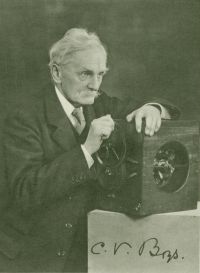
Portrait of Robert Henry Thurston Robert Henry Thurston,  A History of the Growth of the Steam-Engine

“ One leg, B D, of this U-tube was connected with the steam-pipe, or with the boiler by a small steam-pipe; the other end, C, was open to the atmosphere. The pressure of the steam on the mercury in B D caused it to rise in the other “leg” to a height exactly proportioned to the pressure, and causing very nearly two inches difference of level to the pound, or one inch to the pound actual rise in the outer leg. The rude sketch from Farey, here given (Fig. 30) , indicates sufficiently well the form of this gauge. It is still considered by engineers the most reliable of all forms of steam-gauge. ”
Source: Gutenberg

Get perspective with Kwize: daily news enlightened by great literature