“ I figure it as one would see it at night, a band a hundred yards perhaps in width, the footpath on either side shaded with high trees and lit softly with orange glowlights; while down the centre the tramway of the road will go, with sometimes a nocturnal tram-car gliding, lit and gay but almost noiselessly, past. Lantern-lit cyclists will flit along the track like fireflies, and ever and again some humming motor-car will hurry by, to or from the Rhoneland or the Rhineland or Switzerland or Italy. Away on either side the lights of the little country homes up the mountain slopes will glow. ”
Tram car
Definition and stakes
The theme of “tram car” has been addressed by authors such as Arthur H. Beavan, Department of Transport , Department for Regional Development, Ford Madox Hueffer, J. Irwin Brown and D. H. Lawrence. It is often associated with terms like tramway, railway, traffic, vehicle and motor.
Quotes about “tram car”
 William Dean Howells,
Familiar Spanish Travels
“ We preferred, after the Barmecide lunch at our hotel, taking the tram-car that noisily and more noisily clambers up and down, and descending into the town by it. The ascent is so steep that at a certain point the electric current no longer suffices, and the car bites into the line of cogs with its sort of powerful under-jaw and so arrives. Yet it is a kindly little vehicle, with a conductor so affectionately careful in transporting the stranger that I felt after a single day we should soon become brothers, or at least step-brothers. ”
Christmas Stories from French and Spanish Writers
“ A tram-car runs along from one extremity of the landscape to the other, just exactly as it does in the Salamanca quarter; and as it has wheels and real tracks, it is kept going from east to west, much to the surprise of the black Magi, who cannot make out what sort of a machine it can possibly be. ”
 D. H. Lawrence,
England, My England
“ To be sure, a tram often leaps the rails—but what matter! It sits in a ditch till other trams come to haul it out. It is quite common for a car, packed with one solid mass of living people, to come to a dead halt in the midst of unbroken blackness, the heart of nowhere on a dark night, and for the driver and the girl conductor to call, “All get off—car’s on fire!” ”
 Arnold Bennett,
Paris Nights, and Other Impressions of Places and People
“ All those tram-cars roll up over the horizon of Westminster Bridge, and cross the flood and run for a mile on its bank, and not one man in every tenth tram-car gives the faintest attention to the state of the river. ”
Various, Scientific American Supplement…
“ The Rowan tram-car consists of a body 31 feet long and 7 feet wide, resting on a two-wheeled bogie behind and on a four-wheeled bogie in front, this front bogie being the motor, and the whole has the appearance of a long railway carriage, somewhat in the form of an omnibus with a platform at each end, of which the front platform is occupied by the engine. ”
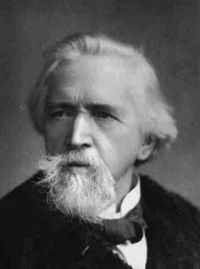 George Jacob Holyoake,
Bygones Worth Remembering, Vol…
“ One Sunday I rode in a Miles Platting tram car, amid decorous, well-dressed chapel-going people—several of them young and active. A child fell out of the tram, whose mother was too feeble to follow it. No one moved, save a woman of repulsive expression, with whom any one might suppose her neighbours had a bad time. ”
Various, Scientific American Supplement…
“ The general conclusion to which these experiments bring us is that, undoubtedly, if it could certainly be relied upon, the electric car would be the preferable form of tramway motor in towns, because it is simply a self-contained ordinary tram-car, and in a town the service requires a number of separate cars, occupying as small a space each as is compatible with accommodating the passengers, and which follow each other at rapid intervals. ”
William Hemingway Mills, Railway Construction
“ As a rule, these tramways are laid down on streets or roads previously constructed for the ordinary road traffic, where all the preliminary work of earth filling, bridges, drainage, etc., has already been accomplished, and there only remains the selection and laying down of the rails or permanent way over which the tram-cars will have to run. The description and weight of permanent way to be adopted will depend largely upon the weight of the cars to be used and the system of motive-power decided upon for the haulage—whether horses, steam, cable, or electricity. ”
Arnold Bennett,
The Matador of the Five Towns and Other Stories
“ Nearly opposite the stable-yard the electric trams started for Hanbridge, Bursley and Turnhill, and for Longshaw. Here the crowd was less dangerous, but still very formidable—to my eyes. Each tram as it came up was savagely assaulted, seized, crammed and possessed, with astounding rapidity. Its steps were the western bank of a Beresina. At a given moment the inured conductor, brandishing his leather-shielded arm with a pitiless gesture, thrust aspirants down into the mud and the tram rolled powerfully away. ”
Edward Money, The Truth About America
“ Of course on rails they travel smoothly, but they and the rails greatly increase the difficulty for cabs and carriages. The traffic in a New York street in no way resembles that in [Pg 21] a London one. Where there is one tram-car in London there are fifty in New York, and fifty cabs here to one there. The same as to carriages. Nearly the whole of the passenger traffic is done in the tram-cars and elevated railroads, and no wonder it is so, for to traverse the streets on wheels in any other way is very painful. ”
 Benito Pérez Galdós,
The Novel on the Tram
“ And meanwhile the vehicle, an imitation of life, keeps going, always receiving and letting go, uniform, indefatigable, majestic, oblivious to what is happening inside it, without being moved very much by the barely stifled passions of dumb show. The tram is running, always running over the two interminable iron tracks, wide and slippery as centuries. I was thinking about this while the tram was going up the calle de Alcalá until the noise of my bundle of books falling on the floor pulled me back from the gulf of so many mixed up ruminations. ”
William Hemingway Mills, Railway Construction
“ As the portion of the streets or public roads along which the tramway has to be laid will, in all probability, have to be occupied and traversed by all kinds of vehicles besides the tram-cars, it is absolutely necessary that the permanent way for the tramway should be of such description as to require the least possible amount of adjustment of fastenings or opening out of the roadway for repairs. ”
C. K. Shepherd, Across America by Motor-cycle
“ In a way, the presence of that track was comforting, particularly when some new noise or rattle emanated from my thrice-weary steed. On the other hand it is distinctly humiliating to be astride a 10 h.p. motor-cycle de luxe, jogging along side-saddle (to ease the growing soreness!) at fifteen or twenty miles per hour on three crotchety cylinders, when a tram-load of disinterested Americans flies past with a shriek at forty or fifty. Generally the driver realized the position and sounded a piercing whistle with a supercilious air, as if to say: "Make way for the fast traffic, please!" ”
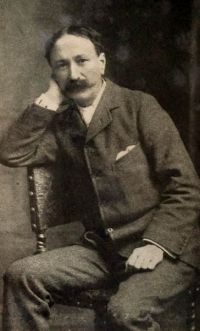 Morley Roberts,
A Tramp's Notebook
“ A DAY IN CAPETOWNI went across the Parade, which every morning is full of cheap-jack auctioneers selling all things under the sun to Kaffirs, Malays, coolies, towards Rondebosch and Wynberg. At the Castle the electric tram passed me, and I jumped on board and went, at the least, as fast as an English slow train. The wind was blowing and the dust flew, but ahead of us ran a huge electricity-driven water-cart, a very water tram, which laid the red clouds for us. Yet in London we travel painfully in omnibuses and horse-trams, and the rare water-cart is still drawn by horses. ”
Horace Wyatt, Motor Transports in War
“ The inflexible nature of a tramway system has been the principal factor in securing the popularity of a free road vehicle, and at the present moment the motor omnibus is able to compete directly with great success against the electric tram car. So it came about that passenger transport was very rapidly converted to mechanical power. If London is taken as an example, we find that at the present moment over 95 per cent. of passenger transport is carried on by mechanical vehicles, while certainly not more than 15 per cent. ”
Arthur H. Beavan, Tube, Train, Tram, and Car; or…
“ MOTOR-CARS AND PUBLIC HIGHWAYSWho can place a limit to the development of motors! The time may arrive when tram lines will disappear, the roads themselves being of steel and forming a broad rail upon which self-propelled coaches, omnibuses, cabs, and cars will ply in every direction, and far and wide into the suburbs. ”
“ What if an electric tram starts from the foot of Giotto's tower, or if four-and-twenty Cook's tourists invade the inn and streets of Verona? If you cannot extract some satisfaction from the thought that there may be intelligent people even in a Cook's party, and that the ugly tram takes hundreds of people up Fiesole hill without martyrizing cab-horses—if you cannot do this (which still is worth doing) , overlook the Cook's tourists and the tram, blot them out of your thoughts and feelings. ”
D. H. Lawrence,
England, My England
“ The reason for this reluctance to dismount is that the nights are howlingly cold, black, and windswept, and a car is a haven of refuge. From village to village the miners travel, for a change of cinema, of girl, of pub. The trams are desperately packed. Who is going to risk himself in the black gulf outside, to wait perhaps an hour for another tram, then to see the forlorn notice “Depot Only,” because there is something wrong! Or to greet a unit of three bright cars all so tight with people that they sail past with a howl of derision. Trams that pass in the night. ”
Arthur H. Beavan, Tube, Train, Tram, and Car; or…
“ There are many trams going everywhere within a reasonable distance—Streatham, Greenwich, Tooting, New Cross. Now, however hard or however fast you rush at a tram, it is not to be bullied into holding more than a certain number. If, however, you rush sufficiently{139} fiercely and with sufficient violence, you may either knock or frighten out of the way a girl who has been waiting longer than you. ”
Frederick John Jervis-Smith, 1911 Encyclopædia Britannica, Volume 6… (1911)
“ A carriage or tram furnished with three grooved wheels runs on the rails, and a slightly smoked glass plate is attached to its vertical side. The tram in the original instrument was propelled by a falling weight, but in an improved form one or more spiral springs are employed. All time traces are made immediately after the propelling force has ceased to act. The tram is brought to rest by a gradually applied brake, consisting of two crossed leather bands stretched by two springs; a projection from the tram runs between the bands, and brings it to rest with but little lateral pressure. ”
Alfred Charles William Harmsworth, Motors and Motor-Driving (1902)
“ When a road is given over to a tramway company without any increase in its metalled surface, it becomes at once distinctly less valuable for ordinary traffic. By allowing tram-lines to be laid without any corresponding widening of the roads, as has been done hitherto on our suburban roads, we are positively going back, actually making our roads less open to traffic than they were. No doubt it will be said that to demand this increase of the metalled road surface is to lay on the tramways a burden greater than they can bear. ”
“ Imagine my joy; there were tramlines, and better still, a tram approaching. I tumbled in, gave the conductor a penny, and got a workman's ticket in exchange. Ten minutes later we reached the terminus.I had wondered where we should arrive, but didn't much mind so long as I was again within reach of a cab. However, as soon as I stepped [Pg 118] out of the tram, I knew at once where I was."Tell me," I said to the conductor, "do you now go back again?""In ten minutes. There's a tram from here every half-hour.""When is the last?""There's no last. Backwards and forwards all night." ”
 Joshua Rose,
Modern Machine-Shop Practice, Volumes I and II
“ It is obvious that any other resting place may be used instead of the floor for the tram; thus in a locomotive the wheel guard may be used, the tram t being used to mark lines on the upper part of the wheel rim, instead of opposite the crank. To set the valve, place the fly-wheel on its dead centre, moving the fly-wheel as directed until one of the points (e or l, say e) comes fair with the point of the tram; then move the eccentric on the shaft until the steam port is open to the required amount of lead, and fasten the eccentric to the main shaft. ”
 William John Locke,
The Mountebank
“ From my room in the Royat Palace Hotel I had a view across the Park, beyond which I could see the black crowds pouring out of the Clermont-Ferrand trams. The reason for this frenzied going and coming of human beings between Clermont-Ferrand and Royat, I could never understand. I believe tram-riding is a hideous vice. Just connect up by tramlines a place no one ever wants to go to with another no one ever wants to go from, and in a week you will have the inhabitants of those respective Sleepy Hollows running to and fro with the strenuous aimlessness of ants. ”
Arthur H. Beavan, Tube, Train, Tram, and Car; or…
“ Motor-omnibuses, besides working on the regular routes, can be run on the tramway time-table system on tramway sections where there is little traffic; while for developing scantily-populated districts and accustoming people to travel, automobile public conveyances are perfect agencies, the very fact that they can choose their own route accentuating this great advantage ”
Mrs. Pember Reeves, Round about a Pound a Week
“ The railway arch roofs in a din which reduces the roar of trains continually passing overhead to a vibrating, muffled rumble. From either end of the arch comes a close procession of trams, motor-buses, brewers’ drays, coal-lorries, carts filled with unspeakable material for glue factory and tannery, motor-cars, coster-barrows, and people. It is a stopping-place for tramcars and motor-buses; therefore little knots of agitated persons continually collect on both pathways, and dive between the vehicles and descending passengers in order to board the particular bus or tram they desire. ”
Arthur H. Beavan, Tube, Train, Tram, and Car; or…
“ On studying a tramway map, one is struck by the fact that, starting from the central area of London, all the tram-lines meander towards the Council’s boundaries, where they will eventually no doubt join and interchange through traffic with the vast light railway or rural tramway systems of various companies in the direction of north and south, north-east, south-east, north-west, and south-west ”
Archibald Williams, The Romance of Modern Mechanism
“ Even were they laid, the trouble would not cease, for a tram is confined to its track, and cannot make way for other traffic. This inadaptability has been the cause of the great outcry lately raised against the way in which tram-line companies have monopolised the main streets and approaches to many of our largest towns. While the electric tram is beneficial to a large class of people, as a cheap method of locomotion between home and business, it sadly handicaps all owners of vehicles vexatiously delayed by the tram. ”
Helen C. Knight, The Rocket: The Story of the Stephensons…
“ Build a tram-road, or rail-road. Nobody, however, but a very fast man would risk his good sense by seriously advising a rail-road. Solid men would certainly shun him. A tram-road was a better understood thing. The collieries had used small pieces of them for years. A tram-road then. Business men put their heads together and began earnestly to talk of a tram-road.William James, a rich and enterprising man, entered heartily into the project, and undertook to make surveys for a suitable route. And not long after a party of surveyors was seen in the fields near Liverpool. ”
J. Irwin Brown, The Further Adventures of O'Neill in Holland
“ If the bye-laws of this particular tramway allowed the tram to stop and pick up pedestrians anywhere all along the line, we were quite safe; we should just sit down on the roadside and rest. We shouldn’t walk another step.The men were shovelling away at fallen leaves, so I accosted them in my friendliest Dutch and said: “Stop de tram overal?” As this was greeted with the customary “blief?” I tried to be more explicit. “Stop de tram op een wenk of een uitroepteeken? Of stopt hij alleen op de halten?” ”
Department of Transport , Department for Regional Development, Traffic Signs Manual/Chapter 5… (2009)
“ If trams are running with other vehicles but not segregated from them with a physical refuge, the Stop line to diagram 1001 should be used from the kerb to the centre line. The tram Stop line may be used in addition, either just in front of or just beyond the Stop line; this might be necessary to facilitate swept paths or where primary tram and other traffic signals are not co-located. If the tram route is segregated from other traffic by a refuge, the respective Stop line is used on each side. 18.13 At priority junctions, roads carrying tramways should always be treated as the major road. ”
Related terms
Authors who wrote about “tram car”
Arthur H. BeavanDepartment of Transport , Department for Regional Development Ford Madox HuefferJ. Irwin BrownD. H. LawrenceFrederick John Jervis-SmithVariousWilliam Hemingway Mills
 A. A. MilneArchibald WilliamsArnold BennettAlfred Charles William HarmsworthWilliam Dean HowellsMorley Roberts
 Vernon LeeBenito Pérez GaldósC. K. Shepherd
 H. G. WellsGeorge Jacob HolyoakeEdward Money
Ford Madox HuefferJ. Irwin BrownD. H. LawrenceFrederick John Jervis-SmithVariousWilliam Hemingway MillsA. A. MilneArchibald WilliamsArnold BennettAlfred Charles William HarmsworthWilliam Dean HowellsMorley RobertsVernon LeeBenito Pérez GaldósC. K. ShepherdH. G. WellsGeorge Jacob HolyoakeEdward Money