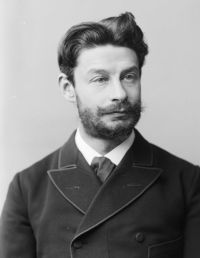
Irving Babbitt

Biographical details

Portrait of Irving Babbitt Irving Babbitt Rousseau and Romanticism

The genius sets out not merely to be unique but unique in feeling, and the sense uniqueness in feeling speedily passes over into that of uniqueness in suffering—on the principle no doubt laid down by Horace Walpole that life, which is a comedy for those who think, is a tragedy for those who feel. To be a beautiful soul, to preserve one’s native goodness of feeling among men who have been perverted by society, is to be the elect of nature and yet this election turns out as Rousseau tells us to be a “fatal gift of heaven.”
Source: Gutenberg

Portrait of Irving Babbitt Irving Babbitt Rousseau and Romanticism

Instead of seeing human nature through an Arcadian haze he saw it without any illusion at all. His irony is like that of Socrates, the irony of intellect. Its bitterness and cruelty arise from the fact that his intellect does not, like the intellect of Socrates, have the support of insight. Pascal would have said that Swift saw man’s misery without at the same time seeing his grandeur. For man’s grandeur is due to his infinitude and this infinitude cannot be perceived directly, but only through a veil of illusion; only, that is, through a right use of the imagination.
Source: Gutenberg

Portrait of Irving Babbitt Irving Babbitt Rousseau and Romanticism

The romanticist would break up the smooth and tiresome surface of artificial decorum by the pursuit of strangeness. If he can only get his thrill he cares little whether it is probable, whether it bears any relation, that is, to normal human experience. This sacrifice of the probable to the surprising appears, as I said at the outset, in all types of romanticism—whether of action or thought or feeling. The genuine classicist always puts his main stress on design or structure; whereas the main quest of every type of romanticist is rather for the intense and vivid and arresting detail.
Source: Gutenberg

Get perspective with Kwize: daily news enlightened by great literature