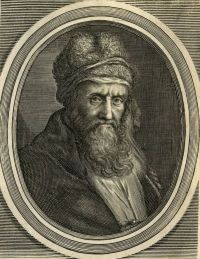
Diogenes Laërtius

Diogenes Laërtius

Summary

Portrait of Diogenes Laërtius Diogenes Laërtius Lives of the Eminent Philosophers… (1925)

All things are composed of fire, and into fire they are again resolved; further, all things come about by destiny, and existent things are brought into harmony by the clash of opposing currents; again, all things are filled with souls and divinities. He has also given an account of all the orderly happenings in the universe, and declares the sun to be no larger than it appears. Another of his sayings is: "Of soul thou shalt never find boundaries, not if thou trackest it on every path; so deep is its cause."
Source: Wikisource

Portrait of Diogenes Laërtius Diogenes Laërtius Lives of the Eminent Philosophers… (1925)

All things happen by virtue of necessity, the vortex being the cause of the creation of all things, and this he calls necessity. The end of action is tranquillity, which is not identical with pleasure, as some by a false interpretation have understood, but a state in which the soul continues calm and strong, undisturbed by any fear or superstition or any other emotion. This he calls well-being and many other names. The qualities of things exist merely by convention; in nature there is nothing but atoms and void space.
Source: Wikisource

Portrait of Diogenes Laërtius Diogenes Laërtius Lives of the Eminent Philosophers… (1925)

A cause is something relative; for it is relative to what can be caused, namely, the effect. But things which are relative are merely objects of thought and have no substantial existence. 98. Therefore a cause can only be an object of thought; inasmuch as, if it be a cause, it must bring with it that of which it is said to be the cause, otherwise it will not be a cause. Just as a father, in the absence of that in relation to which he is called father, will not be a father, so too with a cause.
Source: Wikisource

Get perspective with Kwize: daily news enlightened by great literature