“ From north to south, six thousand miles heave white with ocean foam, Between the dear old land we've left and this our new-found home; Yet what though ocean stretch between—though here this hour we stand! Our hearts, thank God! are English still; God bless the dear old land! "To England!" men, a bumper brim; up, brothers, glass in hand! "England!" I give you "England!" boys; "God bless the dear old land!" ”
Quotes about “Anglophones”
Anna Benneson McMahan, Shakespeare's Christmas Gift to Queen Bess
“ Of England, is the picture of the hounds with "ears that sweep away the morning dew"; from England, all this out-door woodland life, the clown's play and the clowns themselves,--Bottom with his inimitable conceit, and his fellows, Snug, Quince, and the rest. English is all Puck's fairy lore, the cowslips tall, the red-hipt humble-bee, Oberon's bank, the pansy love-in-idleness, and all the lovely imagery of the verse. ”
H. E. Marshall, English Literature for Boys and Girls
“ When, then, after nearly four hundred years the Romans went away, the people of Britain were still British. But soon another people came. These were the Anglo-Saxons, the English, who came from over the sea. And little by little they took possession of Britain. They drove the old dwellers out until it was only in the north, in Wales and in Cornwall, that they were to be found. Then Britain became Angleland or England, and the language was no longer Celtic, but English. And although there are a few words in our language which can be traced to the old Celtic, these are very few. ”
 Fanny Kemble,
Journal of a Residence in America
“ I not only hear the voice of England in the language of this people, but I recognise in all their best qualities, their industry, their honesty, their sturdy independence of spirit, the very witnesses of their origin—they are English; no other people in the world would have licked us as they did; nor any other people in the world built up, upon the ground they won, so sound, and strong, and fair an edifice. ”
Anna Carolina Paues and Herbert Hensley Henson, 1911 Encyclopædia Britannica, Volume 3… (1911)
“ The 13th century, from the point of view of Biblical renderings into the vernacular, is an absolute blank. French—or rather the Anglo-Norman dialect of the period—reigned supreme amongst the upper classes, in schools, in parliament, in the courts of law and in the palace ofAnglo-Norman Period. the king. English lurked in farms and hovels, amongst villeins and serfs, in the outlying country-districts, in the distant monasteries, amongst the lower clergy, amongst the humble and lowly and ignorant. ”
Louis Maurice Brandin, 1911 Encyclopedia Britannica (1911)
“ ANGLO-NORMAN LITERATURE.—The French language (q.v.) came over to England with William the Conqueror. During the whole of the 12th century it shared with Latin the distinction of being the literary language of England, and it was in use at the court until the 14th century. It was not until the reign of Henry IV. that English became the native tongue of the kings of England. After the loss of the French provinces, schools for the teaching of French were established in England, among the most celebrated of which we may quote that of Marlborough. ”
Charles Robert Leslie Fletcher, A School History of England (1911)
“ When, in the eighth and ninth centuries, we begin to see a little into the darkness, we find that England has become a purely English country, with a purely English and rather absurd system of law, and a purely English language ”
 Edward A. Freeman,
The Chief Periods of European History
“ A fragment of the English folk, a fragment of the British, a fragment of the Irish, joined together to make for us that people of the Northern England which, among its other merits, has kept alive, under another name, the purest form of the English tongue. ”
 Grant Allen,
Post-Prandial Philosophy
“ You think because I see some spots on the sun of the English character, I don't love Englishmen. Why, how can any man who speaks the English tongue, and boasts one drop of English blood in his veins, not be proud of England? England, the mother of poets and thinkers; England, that gave us Newton, Darwin, Spencer; England, that holds in her lap Oxford, Salisbury, Durham; England of daisy and heather and pine-wood! Are we hewn out of granite, to be cold before England? ”
 Ralph Waldo Emerson,
English Traits — Ability
(1856)
“ But in England, the language of the noble is the language of the poor. In Parliament, in pulpits, in theatres, when the speakers rise to thought and passion, the language becomes idiomatic; the people in the street best understand the best words. And their language seems drawn from the Bible, the common law, and the works of Shakspeare, Bacon, Milton, Pope, Young, Cowper, Burns, and Scott. The island has produced two or three of the greatest men that ever existed, but they were not solitary in their own time. ”
“ The irresistible genius and propagation of the English race are fast Anglicizing the world, and thus centering it around the heart of civilization and commerce. Under the sceptre of England alone, there live, it is said, one hundred and forty million of human beings, embracing all races of men, dwelling between every two degrees of latitude and longitude around the globe. And there is the Anglo-American hemisphere of the English race, doubling its population every twenty-five years, and propelling its propagation through the Western World. ”
William Swinton, New Word-Analysis
“ II. The term "Anglo-Saxon" is derived from the names Angles and Saxons, two North German tribes who, in the fifth century A.D., invaded Britain, conquered the native Britons, and possessed themselves of the land, which they called England, that is, Angle-land. The Britons spoke a Celtic language, best represented by modern Welsh. Some British words were adopted into Anglo-Saxon, and still continue in our language. 6. The Latin element in the English vocabulary consists of a large number of words of Latin origin, adopted directly into English at various periods. ”
John R. Dos Passos, The Anglo-Saxon Century and the Unification of the English-Speaking People
“ Let us take up together the work so magnificently performed by the United States and by England down to the commencement of this century. Once for all let prejudices be cast aside. Let us unite in a great English-speaking family. Let us be content to learn from each other. And when the curtain of the twenty-first century is raised, may the successful anglicisation of the world be revealed; may the real spirit of our institutions and laws prevail everywhere, and the English language have become the universal dialect of mankind. ”
 Albert Bigelow Paine,
Mark Twain: A Biography. Complete
“ An Englishman may write with the most brutal frankness about any man or institution among us and we republish him without dreaming of altering a line or a word. But England cannot stand that kind of a book written about herself. It is England that is thin-skinned. It causeth me to smile when I read the modifications of my language which have been made in my English editions to fit them for the sensitive English palate. Now, as I say, I have taken laborious pains to so trim this book of offense that you'll not lack the nerve to print it just as it stands. ”
 Edward Augustus Freeman,
Prose Masterpieces from Modern Essayists…
(1891)
“ In the like sort, if we turn to our own country, whenever within the bounds of Great Britain we find any tongue spoken other than English, we at once ask the reason and we learn the special historic cause. In a part of France and a part of Great Britain we find tongues spoken which differ alike from English and from French, but which are strongly akin to one another. We find that these are the survivals of a group of tongues once common to Gaul and Britain, but which the settlement of other nations, the introduction and the growth of other tongues, have brought down to the level of survivals. ”
Popular Science Monthly (1879)
“ Two purposes are intended by the author of this work: first, to set forth a history of the English language and literature; and, second, to show the fitness of the English to become the universal language of civilized man. The Anglo-Saxon, the source from which English has sprung, was a composite language, consisting of three principal Gotho-Germanic elements, viz., the slightly variant dialects of the three northern nations which in the fifth century established themselves in Britain—the Jutes, the Saxons, and the Angles. ”
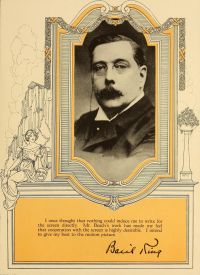
“ He has none of that facility for discounting gossip on the great which the Englishman learns with his mother tongue. The American heard it greedily; he was avid for more. He retailed it at dinners and teas, and in that Reading-room which is really a club. Naturally enough! From what our English visitors told us about themselves, their statesmen, their generals, their admirals were footlers at the best, and could, moreover, be described by a vigorous compound Anglo-Saxon word in the Book of Revelations. ”
 Karel Čapek,
Letters from England — First Impressions
(1925)
“ There are two impressions which are completely fantastic: to discover something unexpected, and to discover something altogether familiar. One is always taken aback to meet an old acquaintance unawares. Well, in the same way I was astonished when I discovered the Houses of Parliament by the Thames, gentlemen in grey top-hats in the streets, two-metre bobbies at the cross roads, and so on. It was astonishing to find that England is really so English. But to begin actually from the beginning I will draw a little picture of how England looks when you approach it from the English Channel. ”
Anonymous, Outline of the history of the English language and literature
“ But, in the eleventh and twelfth centuries—and even much later—travelling was very difficult and expensive; working-men could not travel at all; there was little motive to travel for any one; and generations were born and died within the same village, or on one farm, or at least in one part of the ‘country-side.’ Thus different parts of this island pronounced their English in their own way; had their own grammar—that is, their own inflections; and each division of England looked upon itself as the right and correct speakers of the English tongue. ”
Various, Popular Science Monthly (1898)
“ Through these Anglicized Celts, the English language has taken possession of North America, South Africa, and Australasia; not only is it swallowing up the French of Canada or Louisiana, the Spanish of California or New Mexico, and the Dutch of the Cape, but in the New World it has blotted out the African and Indian tongues, and is assimilating in the second generation the German, Scandinavian, Russian, and Italian immigrants. Your true New-Englander is not a prolific father, like the German or the Irishman ”
“ I think that nowhere so much as in London do people wear—to the eye of observation—definite signs of the sort of people they may be. If you like above all things to know the sort, you hail this fact with joy; you recognise that if the English are immensely distinct from other people, they are also socially—and that brings with it, in England, a train of moral and intellectual consequences—extremely distinct from each other. ”
Various, The Continental Monthly, Vol. 1…
“ While a popular French author sums up the elements of life in England as being la vie de famille, la politique, et les affaires,—'domestic life, politics, and business,'—he complacently infers that le fond du caractère Anglais, 'the basis of the English character,' is nothing more nor less than le manque de bonheur—'a want of anything like happiness.' An English thinker, on the other hand, finds in the very language of France the evidence of superficial emotion and unaspiring, irreverent intelligence. ”
 Brander Matthews,
Parts of Speech: Essays on English
(1901)
“ Every language in Europe has been put under contribution at one time or another for one purpose or another. The military vocabulary, for instance, reveals the former superiority of the French, just as the naval vocabulary reveals the former superiority of the Dutch. And as modern science has extended its conquests, it has drawn on Greek for its terms of precision.Under this influx of foreign words, old and new, the framework of the original London dialect stands solidly enough, but it is visible only to the scholarly specialist in linguistic research. ”
Ian Hay, The Oppressed English
“ To the average Englishman it seems simpler to say "England."But there are other and deeper reasons. England is a big nation, while the others are small. There are more people in London than in the whole of Scotland, or Ireland, or, until recent years, Canada. And a small nation is always intensely sensitive, and assertive, of its own nationality. The English, too, are an exceedingly placid nation. Their enemies call them self-satisfied, but this is hardly just. ”
Robert Bell, Once a Week (1860)
“ Five or six hundred years ago it was as well known to the English as any spot on the globe to which they adventured for trade or pleasure; and at this present time the advent of an Englishman is so rare in the place that, when such an apparition appears, the worthy people collect at their shop-doors to gaze at him, and the little children gather about him with gaping eyes, and examine him from head to foot, with an expression of mixed curiosity and fear. ”
Grant Allen,
Anglo-Saxon Britain
“ It must never be forgotten, however, that the whole framework of our language still remains, in every case, purely English—that is to say, Anglo-Saxon or Low Dutch—however many foreign elements may happen to enter into its vocabulary. We can frame many sentences without using one word of Romance or classical origin: we cannot frame a single sentence without using words of English origin. ”
 Daniel Defoe,
The Complete English Tradesman…
“ What is the reason that we see numbers of French, and of Scots, and of Germans, in all the foreign nations in Europe, and especially filling up their armies and courts, and that you see few or no English there? ”
 Karl Philipp Moritz,
Travels, chiefly on Foot, through several parts of England in 1782…
“ You can immediately distinguish Englishmen when they speak German, by their pronunciation according to the English manner; instead of Ich befinde mich wohl, they say Ich befirmich u'hol (I am very well) , the w being as little noticed as u quickly sounded.I have often heard, when directing any one in the street, the phrase, "Go down the street as far as ever you can go, and ask anybody." Just as we say, "Every child can direct you."I have already noticed in England they learn to write a much finer hand than with us. ”
 James Fenimore Cooper,
Recollections of Europe
“ The English differ from us, only, in carrying their scale both higher and lower than ourselves; in being sometimes magnificent, and sometimes impoverished; but, rarely, indeed, do they equal the French in the light, classical, and elegant taste that so eminently distinguishes these people. There is something ponderous and purse-proud about the magnificence of England, that is scarcely ever visible here; though taste is evidently and rapidly on the increase in England on the one hand, as comfort is here on the other. ”
William Stevens Balch, Lectures on Language, as Particularly Connected with English Grammar
“ As England was possessed by different nations at different periods, so different dialects were introduced, and we can trace our language to as many sources, German, Danish, Saxon, French, and Roman, which were the different nations amalgamated into the British empire. We retain little of the real old english—few words which may not be traced to a foreign extraction. Different people settling in a country would of course carry their ideas and manner of expressing them; and from the whole compound a general agreement would, in process of time, take place, and a uniform language be established. ”
Sir Charles Wentworth Dilke, Greater Britain: A Record of Travel in English-Speaking Countries During 1866-7
“ America is becoming not English merely, but world-embracing in the variety of its type; and, as the English element has given language and history to that land, America offers the English race the moral directorship of the globe, by ruling mankind through Saxon institutions and the English tongue. Through America, England is speaking to the world. ”
Brander Matthews,
Parts of Speech: Essays on English
(1901)
“ Just as the Angles and the Saxons and the Jutes had mingled in Great Britain to make the Englishman, and had been modified by Celtic and Norman and Latin influences, so here in the United States the Puritan and the Cavalier, the Dutchman and the Huguenot and the German, the Irish and the Scotch and the Scotch-Irish, have all blended to make the American. ”
