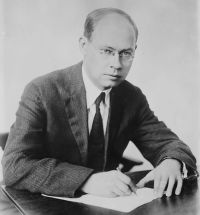
Mendeleev

Definition and stakes

Various,  Popular Science Monthly (1906)

“ If we are not to throw over the periodic law, we must either split other so-called elements into groups of elements or we must show that certain groups of elements alone are possible. To succeed in the first would be to revolutionize chemistry. To succeed in the second would be to explain the reason for the periodic law—which would also revolutionize chemistry. Whatever the outcome, Mendeléeff's law will be for many years one of the dominant factors in chemical progress. ”
Source: Wikisource

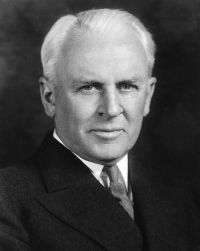
Portrait of Robert Andrews Millikan Robert Andrews Millikan,  The electron, its isolation and measurement and the determination of some of its properties (1924)

“ Through creating what we call “hot sparks” in extreme vacuum we have succeeded in stripping in succession, 1, 2, 3, 4, 5, and 6 of the valence, or outer, electrons from the atoms studied. In going from lithium, through beryllium, boron and carbon to nitrogen, we have thus been able to work with stripped atoms of all these substances.
Now these stripped atoms constitute structures which are all exactly alike save that the fields in which the single electron is radiating as it returns toward the nucleus increase in the ratios 1, 2, 3, 4, 5, as we go from stripped lithium to stripped nitrogen.
”
Source: Gutenberg

Arthur Bower Griffiths,  Biographies of Scientific Men (1912)

“ The work of the Russian savant on the periodic law has been severely criticized; but what great discovery has not had fault-finders? "They wholly mistake the nature of criticism who think its business is principally to find fault" (Dryden) . The law deals with atomic volumes, atomic weights, specific gravities, melting-points, magnetic properties, hydrocarbon radicles, etc.; in fact, a full list is to be found in the index of the Principles of Chemistry—a book which gives the views of Mendeléeff on most subjects. ”
Source: Wikisource

Get perspective with Kwize: daily news enlightened by great literature