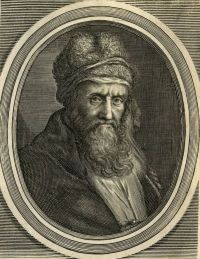
Paulus Diaconus

Definition and stakes

1911 Encyclopædia Britannica, Volume 20… (1911)

“ About 776 his brother Arichis had been carried as a prisoner to France, and when five years later the Frankish king visited Rome, Paulus successfully wrote to him on behalf of the captive. His Uterary attainments attracted the notice of Charlemagne, and Paulus became a potent factor in the Carolingian renaissance. In 787 he returned to Italy and to Monte Cassino, where he died on the 13th of April in one of the years between 794 and 800. ”
Source: Wikisource

J. N. Larned,  History for ready reference, Volume 5… (1895)

“ Paulus Diaconus gives a different explanation, founded on the supposed expulsion of the Etruscans in fulfilment of an oracle ('vatum responso expulsis Etruscis') ; and from this Niebuhr and Bunsen, following him, have supposed that an Etruscan city existed here in ancient times. There appears to be no sufficient evidence of such a settlement." R. Burn, Rome and the Campagna, chapter 11. ”
Source: Gutenberg

Various,  The Catholic World, Vol. 11, April…

“ Paulus, buried in thought, stole a look full of pity toward the further end of the apartment. "Slaves, women, laws, gladiators," he muttered, "and brute power prevalent as a god. Every day, noble Athenian, I learn something which fills me with hatred and scorn for the system amid which we are living." He then told Dion the story of Thellus and Alba; he next laid before him the exact circumstances of Benigna and Claudius ”
Source: Gutenberg

Get perspective with Kwize: daily news enlightened by great literature