T-square

Definition and stakes

Portrait of Robert S. Ball Robert S. Ball,  Experimental Mechanics

“ It is easy, by the application of a set square, to prove that in this case the cords attached to the 3 lb. and 4 lb. weights are at right angles to each other. We could have inferred, from the parallelogram of force, that this must be the case, for the sides of the triangle o p r are 3, 4, and 5 respectively, and since the square of 5 is 25, and the squares of 3 and of 4 are 9 and 16 respectively, it follows that the square of one side of this triangle is equal to the sum of the squares of the two opposite sides, and therefore this is a right-angled triangle (Euclid, i. 48) . ”
Source: Gutenberg

Hugo B. Froehlich,  Text books of art education, v…

“ You can draw an oblong with your test square in the same way that you drew a square, measuring the sides to get the length you wish. In Sketch A the semi-diameters are bisected and the points connected, forming a diamond-shaped space, something like a square on its diagonals. In making the unit used in the upper half of this space, the lines of the triangle are changed very slightly, but this change makes an interesting decoration. In Sketch B the sides are quadrisected, and the space is divided by connecting some of the opposite points, making an oblong on its diameters for the middle space. ”
Source: Gutenberg

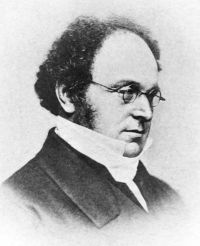
Portrait of Augustus De Morgan Augustus De Morgan,  A Budget of Paradoxes, Volume II

“ I do not think I have mentioned the bright form of quadrature in which a square is made equal to a circle by making each side equal to a quarter of the circumference. The last squarer of this kind whom I have seen figures in the last number of the Athenæum for 1855: he says the thing is no longer a problem, but an axiom. He does not know that the area of the circle is greater than that of any other figure of the same circuit. ”
Source: Gutenberg

Get perspective with Kwize: daily news enlightened by great literature