“ In some substances the limit is reached with slight distortion, while others are perfectly elastic even when greatly stretched. India rubber is an example of a body having perfect elasticity through wide limits. Glass has great elastic force but its limit of elasticity is soon reached. Substances like India rubber may be said to have great "stretchability," but little elastic force. In physics, elasticity refers to the elastic force rather than to ability to endure stretching. ”
Elasticity (physics)
Definition and stakes
Quotes about “elasticity (physics)”
Horace Lamb,
The Evolution Of Mathematical Physics
“ The question could not [Pg 17] be satisfactorily treated until the general theory of Elasticity had been further developed, and the relations between stresses and strains established. An additional impulse to the subject came from the wave-theory of Light which was growing rapidly at the hands of Young and Fresnel. The first essays at a general theory of elastic solids were made by Navier, Poisson, and Cauchy. Their investigations are noteworthy as including the first systematic attempts to deduce the properties of a body from the explicit hypothesis of a molecular structure. ”

Wilhelm Ostwald,
Natural Philosophy
“ The energy of form is manifested in bodies (solid or rigid bodies) that maintain a definite shape because every change of shape is connected with work or with the expenditure of some other energy. If the changes are small, the bodies are of such a nature that they return to their former condition of their own accord after the force exerted upon them has ceased to act. This property is called elasticity. However, the theory of elasticity, which has been extensively and rationally developed, is regarded as belonging rather to mathematical physics in general than to mechanics in particular. ”
“ The word elastic, in physics, is the name given to the tendency which a body exerts, when distorted, to return to its original shape. Rubber possesses more elasticity than any other material known, it being possible to stretch a piece of rubber cord to eight or nine times its original length without fracture. Rubber also possesses the added requisite of lightness and will store up more energy than any form of steel spring. ”
Lucien Poincaré, The New Physics and Its Evolution
“ Thus the definition of a solid cannot be drawn from its mechanical properties. It cannot be said, after what we have just seen, that solid bodies retain their form, nor that they have a limited elasticity, for M. Spring has made known a case where the elasticity of solids is without any limit. ”
William Whewell,
Astronomy and General Physics Considered with Reference to Natural Theology
“ The hypothesis which he thus suggests is, that there is an elastic medium pervading all space, and increasing in elasticity as we proceed from dense bodies outwards: that this “causes the gravity of such dense bodies to each other: every body endeavouring to go from the denser parts of the medium towards the rarer.” ”
“ Tests of elasticity are made by subjecting wire of different materials but of the same dimensions to the same tension. The one changing least is said to have the greatest elastic force or elasticity. If greater forces are applied to the wire and then removed, one will finally be found that will permanently stretch the wire so that it will not return exactly to the former length. ”
William Bower Taylor, Kinetic Theories of Gravitation… (1876)
“ Whereas the main business of natural philosophy is to argue from phenomena without feigning hypotheses, and to deduce causes from effects, till we come to the very first cause, which certainly is not mechanical." [8] It has already been noticed that elasticity has proved a stumblingblock to every kinetic hypothesis. A system of molecular physics without this property would represent a chaos ; but a chaos destitute of energy. As Lam6 has well observed in his admirable treatise on the subject, " The role of Elasticity in nature is as important as that of Gravitation!" ”
Various, Scientific American Supplement…
“ As a step toward kinetic theory of matter, it is certainly most interesting to remark that in the quasi-elasticity, elasticity looking like that of an India-rubber band, which we see in a vibrating smoke-ring launched from an elliptic aperture, or in two smoke-rings which were circular, but which have become deformed from circularity by mutual collision, we have in reality a virtual elasticity in matter devoid of elasticity, and even devoid of rigidity, the virtual elasticity being due to motion, and generated by the generation of motion. ”
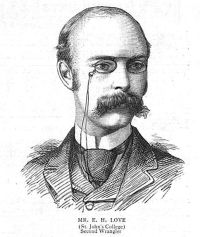
Augustus Edward Hough Love,
1911 Encyclopædia Britannica
(1911)
“ The result indicates that, when forces which produce any kind of strain are applied to a solid body and are gradually increased, the strain at any instant increases proportionally to the forces up to a stage beyond that at which, if the forces were removed, the body would completely recover its original size and shape, but that the increase of strain ceases to be proportional to the increase of load when the load surpasses a certain limit. There would thus be, for any type of strain, a limit of linear elasticity, which exceeds the limit of perfect elasticity. ”
Samuel Tolver Preston, Comparative Review of some Dynamical Theories of Gravitation (1895)
“ It seems, however, to have been overlooked that elasticity (at the encounters of molecules) is already demonstrated to exist by the principle of the conservation of energy, and of the centre of mass. The explanation of elasticity is a deeper one than the explanation of gravitation: therefore let us advance from step to step forward in the elucidation, without pushing on in too great a hurry. ”
Sir J. A. Fleming, Waves and ripples in water, air… (1912)
“ It possesses so-called elasticity of bulk. In the case of water having a free surface there is, as we have seen, a resistance to any change of level in the surface. This may be called an elasticity of surface form. Whenever an elastic material is strained or deformed, energy has to be expended on it to create the deformation. Thus to wind up a watch-spring, stretch a piece of indiarubber, compress some air, or bend a bow, requires an energy expenditure. ”
Félix Savart,
Scientific Memoirs
(1837)
“ The elastic state of these plates cannot present such remarkable differences as those we have observed in the preceding series; for, being all cut round the axis of greatest elasticity, they can only contain in their plane that of least or that of mean elasticity, or lastly, those intermediate between these limits, which do not vary greatly from each other. ”
Carleton Washburne, Common Science
“ If you make a dent in rubber, it springs right back to the shape it had before. Elasticity of volume is the tendency of a substance to go back to its original size, as lead does. If you manage to squeeze lead into a smaller space, it will spring right back to the same size as soon as you stop pressing it on all sides. But a dent in lead will stay there; it has little elasticity of form.Air and water—all liquids, in fact—have a great deal of elasticity of volume, but practically no elasticity of form. ”
Antoine Laurent Lavoisier,
Elements of Chemistry,
“ Nothing is more readily conceived, than that one body should become elastic by entering into combination with another body possessed of that quality. We must allow that this is only an explanation of elasticity, by an assumption of elasticity, and that we thus only remove the difficulty one step farther, and that the nature of elasticity, and the reason for caloric being elastic, remains still unexplained. Elasticity in the abstract is nothing more than that quality of the particles of bodies by which they recede from each other when forced together. ”
William George Hooper, Aether and Gravitation
“ The elasticity is essential in order for the medium to store up energy, and also to enable it to resume its original shape after deformation, while the inertia is necessary in order that the medium may transmit the impulse, and oscillate to and fro until the impulse received has been passed on. ”
Leslie Stephen,
Dictionary of National Biography…
(1900)
“ He was the first to use the term ‘energy’ for the product of the mass of a body into the square of its velocity, and the expression ‘labour expended’ (work done) for the product of the force exerted on a body into the distance through which it is moved, and to state that these two products were proportional to each other (Lectures, i. 78–9) . He introduced absolute measurements in elasticity by defining the ‘modulus’ (Young's modulus) as the weight which would double the length of a rod of unit cross-section to which it was hung (Lectures, i. 137) . ”
E. J. Marey, Popular Science Monthly (1879)
“ At the moment when the weight falls and the cord is stretched, the balance inclines, stretching the elastic spring, but the mass of one hundred grammes does not yet move; it is only when this spring is stretched that the mass, obedient to the prolonged action of this elastic spring, begins to move and rises, representing a certain amount of work accomplished. Thus the suppression of shock in traction economizes a certain part of the moving labor; it is then advantageous to give to the traces of a carriage a certain elasticity. ”
Augustus Edward Hough Love,
1911 Encyclopædia Britannica
(1911)
“ The behaviour of an elastic solid body, strained within the limits of its elasticity, is entirely determined by the constants and if the body is isotropic, that is to say, if it has the same quality in all directions around any point. ”
D'Arcy Wentworth Thompson,
On Growth and Form
“ To represent all the correlated quantities we should have to construct not only a diagram of moments but also a diagram of elastic deflexion and its so-called “curvature”; and the engineer would want to know something more about the material of the ligamentous tension-member—its modulus of elasticity in direct tension, its elastic limit, and its safe working stress.In various ways our structural problem is beset by “limiting conditions.” Not only must rigidity be associated with flexibility, but also stability must be ensured in various positions and attitudes ”
Various, Scientific American Supplement…
“ Possibly the different forms of matter may be due to a single cause--polymerization. The limit of elasticity of a solid body is the critical moment when the matter begins to flow under the action of the pressure to which it is submitted, just as, e.g., ice at or below 0° may be liquefied by strong pressure. ”
Samuel Tolver Preston, Comparative Review of some Dynamical Theories of Gravitation (1895)
“ All the consequences of the kinetic theory of gases are already built on the assumption of elasticity: the application of this principle to the smaller particles is therefore to be viewed as a perfectly natural and logical consequence. In fact the gravitation pressure by the encounters of elastic [158] particles is explained quite as completely as the air-pressure is explained by the encounters of such particles (molecules) . ”
Thomas P. Jones,
Conversations on Natural Philosophy…
“ Of all bodies, the air is the most eminent for this property, and it has thence obtained the name of an elastic fluid. Hard bodies are in the next degree elastic; if two ivory, or hardened steel balls are struck together, the parts at which they touch, will be flattened; but their elasticity will make them instantaneously resume their former shape. ”
Various, The New Gresham Encyclopedia. Ebert to Estremadura
“ The equations of vibration are therefore found [188] by writing - d2u/dt2 instead of X, in the first body equation of equilibrium, and similarly with the others. The surface conditions will usually be that F, G, H are zero. The problem has been completely solved by H. Lamb for a solid or hollow sphere. For the elastic solid theory of the luminiferous ether, see Ether; for some practical solutions of the general equations of equilibrium, see Strength of Materials.—Bibliography: A. E. H. Love, Mathematical Theory of Elasticity; Lord Kelvin and Tait, Natural Philosophy ”
Félix Savart,
Scientific Memoirs
(1837)
“ The elasticity of all the diameters of any plane perpendicular to the axis of a prism of rock crystal, may be considered as being sensibly the same. 2nd. All the planes parallel to the axis are far from possessing the same elastic state; but if any three of these planes be taken, restricting ourselves only to this condition, that the angles which they form with each other are equal, then their elastic state is the same. ”
Fleeming Jenkin,
The Atomic Theory of Lucretius
(1868)
“ We moderns jump out of the difficulty at once by saying that the hard bodies are elastic, and elasticity is a form of energy, so that the energy or vis viva which at one time was represented by the body in motion, is at another time represented by the potential energy of elasticity. ”
Henry Pemberton, A View of Sir Isaac Newton's Philosophy
“ If the bodies are elastic, so that they shall separate after the stroke, A must lose a greater part of its motion, and the subsequent motion of B will be augmented by this elasticity, as much as the motion of A is diminished by it. The elasticity acting equally between both the bodies, it will communicate to each the same degree of motion ”
Augustus Edward Hough Love,
1911 Encyclopædia Britannica
(1911)
“ Hooke’s law of proportionality of stress and strain leads to the introduction of important physical constants: the moduluses of elasticity of a body. Let a bar of uniform section (of area ) be stretched with tension which is distributed uniformly over the section, so that the stretching force is and let the bar be unsupported at the sides. The bar will undergo a longitudinal extension of magnitude where is a constant quantity depending upon the material. ”
Joseph Larmor,
On a Dynamical Theory of the Electric and Luminiferous Medium…
(1897)
“ A medium, in order to be available at all, must transmit actions across it in time ; therefore there must be postulated for it the property of inertia, — of the same kind as ordinary matter possesses, for there can hardly be a more general kind, — and also the property of elasticity or statical resistance to change either of position or of form. In ordinary matter the elasticity has reference solely to deformation; while in the constitution here assumed for the æther there is perfect fluidity as regards form, but elastic resistance to rotational displacement. ”
William Garnett, Heroes of Science: Physicists
“ The modulus of the elasticity of any substance is a column of the same substance capable of producing a pressure on its base which is to the weight causing a certain degree of compression as the length of the substance is to the diminution of its length. ”
Robert S. Ball,
Experimental Mechanics
“ Reasoning from this experiment, we might infer that the elasticity of a beam is not affected by a weight which is less than half that which would break it, and that, therefore, it may bear without injury a weight not exceeding this amount. ”
A. M. Worthington, The Splash of a Drop
“ Now this argument from analogy with a solid is rather misleading, for the forces that operate in the case of a solid sphere that flattens itself and rebounds, are due to the bodily elasticity which enables it not only to resist, but also to recover from any distortion of shape or shearing of its internal parts past each other. ”
Balfour Stewart,
The conservation of energy
(1881)
“ It therefore requires energy to bend a bow, just as truly and visibly as it does to raise a weight above the earth, and elasticity is, therefore, as truly a species of force as gravity is. We shall not here attempt to discuss the various ways in which this force may act, or in which a soUd elastic substance will resist all attempts to deform it; but in all cases it is clearly manifest that work must be spent upon the body, and the force of elasticity must be encountered and overcome throughout a certain space before any sensible deformation can take place. ”
James Alfred Ewing,
1911 Encyclopædia Britannica
(1911)
“ In the case of a uniformly distributed stress, ab is a plane surface parallel to AB, and c is the centre of gravity of the surface AB. When a bar is subjected to simple pull applied axially—that is to say, so that the resultant stress passes through the centre of gravity of every cross-section —the stress may be taken as (sensibly) uniformly distributed over any section not near a place where the form of the cross-section changes, provided the bar is homogeneous in respect of elastic quality and is initially in a state of ease and the stress is within the limits of elasticity. ”
James Clerk Maxwell,
A Dynamical Theory of the Electromagnetic Field
(1865)
“ Such a body, when subjected to pressure, is compressed by degrees on account of the gradual yielding of the thick fluid; and when the pressure is removed it does not at once recover its figure, because the elasticity of the substance of the body has gradually to overcome the tenacity of the fluid before it can regain complete equilibrium. ”