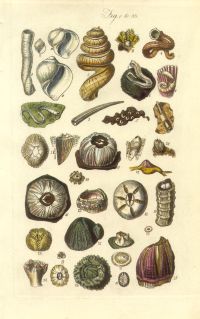
Shell (zoology)

Definition and stakes

John Harper,  Glimpses of Ocean Life; Or, Rock-Pools and the Lessons they Teach

“ Testacea (L. testa, a shell) . Molluscs with a shelly covering, as the Oyster, Whelk, &c.
Univalve (L. unus, one; valvæ, doors) . A shell composed of one calcareous piece, as the Periwinkle.
Umbones. The base of a shell about the hinge.
Viviparous (L. vivus, alive; pario, I bring forth) . The animals which bring forth their young alive. See Oviparous.
Whorl. The spiral turn of a shell.
Zoology (Gr. zoon, animal; logos, a discourse) . That branch of science that treats of the habits, structure, and classification of animals.
Zoologist. One who is acquainted with the science of Zoology.
”

Source: Gutenberg

Portrait of Albert Freeman Africanus King Albert Freeman Africanus King,  Popular Science Monthly (1909)

“ The protective shells of some animals, the epidermal appendages (horns, tusks, hoofs, claws, nails, hair, wool, etc.) , of others, are only alive at their proximal ends—their "roots" so-called. Their distal extremities are not living. They are products of life, but so are our coal beds, chalk cliffs, coral reefs and tortoise shell combs, but they are not alive. ”
Source: Wikisource

Portrait of Henry Scherren Henry Scherren,  Through a pocket lens (1897)

“ Some or other of the members of this class are well known to everybody, if only in the shape of toothsome food—the Prawn, the Shrimp, the Lobster, the Crayfish, and the Crab. The great characteristic of this class of the Arthropod phylum is the so-called ‘shell,’ which differs greatly from true shell in being composed of chitine, hardened with salts of lime. Most of the species live in the water and breathe by means of gills or through the skin. In dealing with these creatures, some long words must be employed, if our present work on them is to be a stepping-stone to something more advanced. ”
Source: Gutenberg

Get perspective with Kwize: daily news enlightened by great literature