Three-dimensional space

Definition and stakes

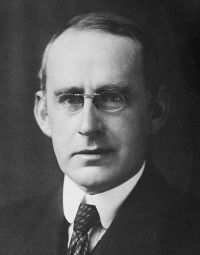
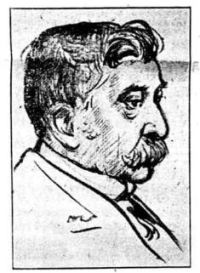
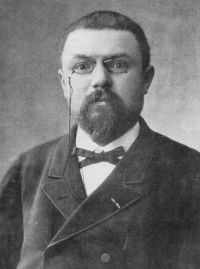
Portrait of Bertrand Russell Bertrand Russell,  The A B C of Relativity (1925)

“ There is no reason why we should not have the same circumstances in three-dimensional space as we have, for example, on the surface of a sphere. It might happen that the angles of a triangle would always add up to more than two right angles, and that the excess would be proportional to the size of the triangle. It might happen that the distance between two points would be given by a formula analogous to what we have on the surface of a sphere, but involving three quantities instead of two. ”
Source: Gutenberg

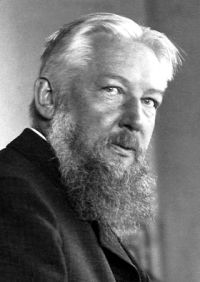
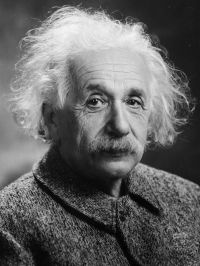
Portrait of Albert Einstein Albert Einstein,  Relativity: The Special & the General Theory

“ A four-dimensional continuum described by the "co-ordinates" , , , , was called "world" by Minkowski, who also termed a point-event a "world-point." From a "happening" in three-dimensional space, physics becomes, as it were, an "existence" in the four-dimensional "world."
This four-dimensional "world" bears a close similarity to the three-dimensional "space" of (Euclidean) analytical geometry. If we introduce into the latter a new Cartesian co-ordinate system (', ', ')
”
Source: Gutenberg

Claude Fayette Bragdon,  Four-Dimensional Vistas

“ Because we lack the sense of four-dimensional space, we must here have recourse to analogy, and assume three-dimensional space to be the unsensed higher region encompassing a world of two dimensions, To a hypothetical flat-man of a two-space, any portion of his plane surrounded by an unbroken line would constitute an enclosure. ”
Source: Gutenberg

Get perspective with Kwize: daily news enlightened by great literature