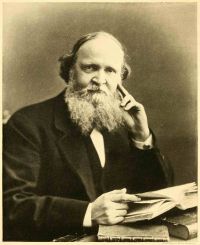
William Dwight Whitney

William Dwight Whitney

Sanskrit Grammar (This republication 1950, original 1889)

Summary

Portrait of William Dwight Whitney William Dwight Whitney Sanskrit Grammar (This republication 1950, original 1889)

Whatever, namely, may have been originally and strictly the mode of production of the derivatives with prefixes, it is throughout the recorded life of the language as if the root and its prefix or prefixes constituted a unity, from which a derivative is formed in the same manner as from the simple root, with that modification of the radical meaning which appears also in the proper verbal forms as compounded with the same prefixes.
Source: Wikisource

Portrait of William Dwight Whitney William Dwight Whitney Sanskrit Grammar (This republication 1950, original 1889)

It is by no means to be expected of beginners in the language that they will attempt to master the rules of euphonic combination in a body, before going on to learn the paradigms of inflection. On the contrary, the leading paradigms of declension may best be learned outright, without attention, or with only a minimum of attention, to euphonic rule. In taking up conjugation, however, it is practically, as well as theoretically, better to learn the forms as combinations of stem and ending, with attention to such laws of combination as apply in the particular cases concerned.
Source: Wikisource

Portrait of William Dwight Whitney William Dwight Whitney Sanskrit Grammar (This republication 1950, original 1889)

Certain derivative adjectives (for the most part more or less clearly secondary derivatives) have acquired in the language a value as qualifying something which is to, or which ought to, suffer the action expressed by the root from which they come; and they are allowed to be made from every verb. Hence they are, like more proper participles, sometimes treated as a part of the general verbal system, and called future passive participles, or gerundives (like the Latin forms in ndus, to which they correspond in meaning) .
Source: Wikisource

Get perspective with Kwize: daily news enlightened by great literature