
“ He saw that while they were of an obvious type one was insipid, and the other rather pretty, dark with Irish black eyes."Ladies, I wish to make you acquainted with my friends," said Schley, as he might speak to a duchess. "The ill-favored gent with the vermilion hair is the Reverend Doctor Balmfinder; the one with the padded shoulders is Binks, my trainer. Now what is this little girl's name?""Muriel," said the blonde, "Muriel Stacey." ”
Quotes about “William T. Schley”
 Robert Hichens,
The Woman with the Fan
Robert Hichens,
The Woman with the Fan
“ She is in a continual flutter of movement, as if her body were threaded with trembling wires. She uses a great deal of gesture. She is noisy about nothing. She is vivacious at all costs, and would rather suggest hysteria than British phlegm. Miss Schley’s calm was therefore in no danger of being drowned in any pervasive calm about her. On the contrary, it stood out. It became very individual. Her composed speechlessness in the midst of uneasy chatter—the Englishwoman is seldom really self-possessed—carried with it a certain dignity which took the place of breeding. ”
Robert Hichens,
The Woman with the Fan
“ Only when she thought of what her husband had said about the American’s desire for her presence did she hesitate again. Her suspicions were aroused. Miss Schley was not anxious that she should be conspicuously in the theatre merely because she was the smartest woman in London. That was certain. Besides, she was not the smartest woman in London. She was far too well-born to be that in these great days of the demi-mondaine. She remembered Robin Pierce’s warning at the Arkell House ball—“Consider yourselves enemies for no reasons or secret woman’s reasons. It’s safer.” ”
 William Michael Rossetti,
1911 Encyclopædia Britannica, Volume 24…
(1911)
William Michael Rossetti,
1911 Encyclopædia Britannica, Volume 24…
(1911)
“ In his own dayan alien in the world of mind and invention, and in our day but partially a denizen of it, he appears destined to become, in the long vista of years, an informing presence in the innermost shrine of human thought. Shelley appeared at the time when the sublime frenzies of the French revolutionary movement had exhausted the elasticity of men's thought—at least in England—and had left them flaccid and stolid; but that movement prepared another in which revolution was to assume the milder guise of reform, conquering and to conquer. ”
 Elizabeth A. Sharp,
William Sharp (Fiona Macleod): A Memoir Compiled by His Wife Elizabeth A. Sharp
Elizabeth A. Sharp,
William Sharp (Fiona Macleod): A Memoir Compiled by His Wife Elizabeth A. Sharp
“ The most important undertaking after the long illness was the monograph on Shelley written for Great Writers’ Series (Walter Scott) and published in the autumn of 1887. It was a work of love, for Shelley had been the inspiring genius of his youth, the chief influence in his verse till he knew Rossetti. He was in sympathy with much of Shelley’s thought: with his hatred of rigid conventionality, of the tyranny of social laws; with his antagonism to existing marriage and divorce laws, with his belief in the sanctity of passion when called forth by high and true emotion. ”
Robert Hichens,
The Woman with the Fan
“ Here, before her friends, was set a woman strangely like her, but evidently a bad woman. Lady Holme was certain that the result of Miss Schley’s performance would be that were she to do things now which, done before the Arkell House ball and this first night, would not have been noticed, or would have been merely smiled at, they would be commented upon with acrimony, exaggerated, even condemned. Miss Schley was turning upon her one of those mirrors which distorts by enlarging. Society would be likely to see her permanently distorted, and not only in mannerisms but in character. ”
William Michael Rossetti,
1911 Encyclopædia Britannica, Volume 24…
(1911)
“ Shelley was a shy, sensitive, mopish sort of boy from one point of view—from another a very unruly one, having his own notions of justice, independence and mental freedom; by nature gentle, kindly and retiring—under provocation dangerously violent. He resisted the odious fagging system, exerted himself little in the routine of school-learning, and was known both as “Mad Shelley” and as “Shelley the Atheist.” Some writers try to show that an Eton boy would be termed atheist without exhibiting any propensity to atheism, but solely on the ground of his being mutinous. ”
 Edward Stratemeyer,
Fighting in Cuban Waters; Or, Under Schley on the Brooklyn
Edward Stratemeyer,
Fighting in Cuban Waters; Or, Under Schley on the Brooklyn
“ For this Congress voted him a medal, and President Arthur raised him to the full rank of captain and made him Chief of the Bureau of Equipment, a very important office in the Naval Department. But Schley couldn't stand it on land, he must have the rolling ocean under him, and so he gave up his berth ashore and took command of the Baltimore.""I remember about that," put in Walter. "I was reading about John Ericsson, the inventor of the monitor. When Ericsson died, the body was sent to Sweden, his fatherland, on the Baltimore under Schley." ”
Robert Hichens,
The Woman with the Fan
“ MRS. WOLFSTEIN was right. There was money in Miss Schley’s performance. Her sly impropriety appealed with extraordinary force to the peculiar respectability characteristic of the British temperament, and her celebrity, hitherto mainly social, was suddenly and enormously increased. Already a popular person, she became a popular actress, and was soon as well-known to the world in the streets and the suburbs as to the world in the drawing-rooms of Mayfair. And this public celebrity greatly increased the value that was put upon her in private—especially the value put upon her by men. ”
John Cordy Jeaffreson, The Real Shelley. New Views of the Poet's Life…
“ The Squire of Field Place, Dr. Greenlaw, Dr. Keate, Mr. Bethell, the Master and Tutors of University College, Hogg, William Godwin, Lord Eldon, Peacock, William Jerdan, Sir John Taylor Coleridge, Byron, were all odious in different ways. The only good and true men, of all the many notable men, Shelley encountered on his way through life, were Dr. Lind and Leigh Hunt. Surely there must be something wrong in the story, that slays so many reputations, whilst it selects Dr. Lind and Leigh Hunt for approval. ”
Robert Hichens,
The Woman with the Fan
“ What men said women began to think, and it was not an assertion wholly without foundation. At a little distance there was an odd resemblance in the one white face and fair hair to the other. Miss Schley’s way of moving, too, had a sort of reference to Lady Holme’s individual walk. There were several things characteristic of Lady Holme which Miss Schley seemed to reproduce, as it were, with a sly exaggeration. Her hair was similar, but paler, her whiteness more dead, her silence more perpetual, her composure more enigmatically serene, her gait slower, with diminished steps. ”
Robert Hichens,
The Woman with the Fan
“ Bry.” “Mr. Bry is the least short-sighted man I know. That’s why he always wears an eyeglass.” “To create an illusion?” “Who knows?” She looked down the long room. Between the heads of innumerable men and women she could see Miss Schley. Her husband was hidden. She would have preferred to see him. Miss Schley’s head was by no means expressive of the naked truth. It merely looked cool, self-possessed, and—so Lady Holme said to herself—extremely American. ”
 Thomas Mayo Brewer,
Popular Science Monthly
(1877)
Thomas Mayo Brewer,
Popular Science Monthly
(1877)
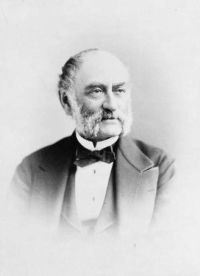
“ Schlegel, though of mature years, is still in vigorous health, a most charming old man, bright, cheerful, and affable, possessing an inexhaustible fund of conversation and knowledge, enriched by the careful observation of a long and well-spent life. ”
Robert Hichens,
The Woman with the Fan
“ She asked herself whether the angel were spreading her wings at last. All the small, sordid details of which lives lived in society, lives such as hers, are full, details which assume often an extraordinary importance, a significance like that of molecules seen through a magnifying glass, had suddenly become to her as nothing. A profound indifference had softly invaded her towards the petty side of life. Miss Schley, Leo Ulford, even Fritz in his suppressed rage and jealousy of a male animal openly trampled upon, had nothing to do with her, could have no effect on her at this moment. ”
Robert Hichens,
The Woman with the Fan
“ Mrs. Wolfstein began to introduce Miss Schley to her guests, none of whom, it seemed, knew her. She bowed to each of them, still with the vestal virgin air, and said, “Glad to know you!” to each in turn without looking at anyone. Then Mrs. Wolfstein led the way into the restaurant. Everyone looked at the party of women as they came in and ranged themselves round a table in the middle of the big room. Lady Cardington sat on one side of Mrs. Wolfstein and Lady Holme on the other, between her and Mrs. Trent. Miss Schley was exactly opposite. ”
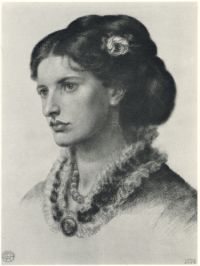 Lucy Madox Brown Rossetti,
Mrs. Shelley
Lucy Madox Brown Rossetti,
Mrs. Shelley
“ The wording in some passages caused grave anxiety to Shelley and Mary (as shown in their letters) as to whether they would be deprived of their own children; and they were prepared to abandon everything, property, country, all, and to escape with the infants. The poem "To William" was written under this misapprehension, although when he left England in 1818, Shelley's chief reason, as given in his letter to Godwin, was on account of his health. ”
William Hazlitt, The Collected Works of William Hazlitt…
“ They are most at home, accordingly, in matters of fact, and learned inquiries. In art they are hard, forced, and mechanical; and, generally, they may be said to have all that depends on strength of understanding and persevering exertion,—but to want ease, quickness 79and flexibility. We should not have made these remarks, if the work before us had formed an absolute exception to them.William Schlegel has long been celebrated on the Continent as a philosophical critic, and as the admirable translator of Shakespear and Calderon into his native tongue. ”
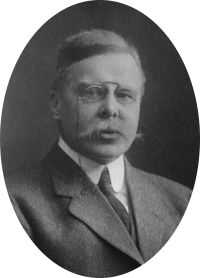 Kuno Francke,
../../
(1913)
Kuno Francke,
../../
(1913)
“ There we find in the Schlegels a weakness which we think may also be detected in Lessing; for the latter is as weak in affirming as he is strong in denying. He rarely succeeds in laying down a fundamental principle, still more seldom a correct one. He wants the firm basis of a philosophy or of a philosophical system. And this is still more sadly the case with the brothers Schlegel. Much is fabled as to the influence of Fichtean Idealism and Schelling's Philosophy of Nature on the Romantic school, which is even declared to have sprung from it. ”
William Michael Rossetti,
1911 Encyclopædia Britannica, Volume 24…
(1911)
“ The chief original authorities for the life of Shelley (apart from his own writings, which contain a good deal of autobiography, if heedfully sifted and collated) are— (1) the notices by Mrs Shelley interspersed in her edition of the Poems; (2) Hogg’s amusing, discerning and authentic, although in some respects exaggerated, book; (3) Trelawny’s Records; (4) the Life by Medwin; and (5) the articles written by Peacock. Some other writers, especially Leigh Hunt, might be mentioned, but they come less close to the facts. ”
The German Classics of the Nineteenth and Twentieth Centuries…
“ In these last decades of his life Schlegel turned, as had his younger brother, to the inviting field of Sanskrit literature and philology, and extracted large and important treasures which may still be reckoned among mankind's valued resources. When all discount has been made on the side of a lack of specific gravity in Wilhelm Schlegel's character, it is only just to assert that throughout his long and prolific life he wrought with incalculable effect upon the civilization of modern Europe as a humanizer of the first importance. ”
Arabella Jane Duffy, Madame de Staël (1887)
“ Schlegel, Constant, Sismondi, were all there, as well as Bonstetten, himself, and Madame Necker de Saussure, now more than ever devoted to her cousin. Madame de Staël had also a new visitor, Müller the historian, whose learning was stupendous, and who wrangled from morning till night on subjects of amazing erudition with Schlegel. The mistress of the house, although far from being the equal of the two combatants in learning, sometimes rushed between them with her fiery eloquence, like an angel with a flaming sword; but most of the society were reduced to silence. ”
William Hazlitt, The Collected Works of William Hazlitt…
“ Shelley’s productions pointedly tend. He makes no account of the opinions of others, or the consequences of any of his own; but proceeds—tasking his reason to the utmost to account for every thing, and discarding every thing as mystery and error for which he cannot account by an effort of mere intelligence—measuring man, providence, nature, and even his own heart, by the limits of the understanding—now hallowing high mysteries, now desecrating pure sentiments, according as they fall in with or exceeded those limits ”
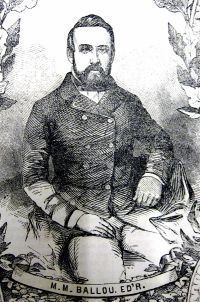 Maturin M. Ballou,
Genius in Sunshine and Shadow
Maturin M. Ballou,
Genius in Sunshine and Shadow
“ In his last days he committed many manuscript poems to the flames. [136] Shelley's favorite amusement had been boating and sailing. While returning one day—July 8, 1822—from Leghorn, whither he had been to welcome Leigh Hunt to Italy, his boat was struck by a squall and he was drowned. Thus he met the same fate as his deserted wife. [137] As to Shelley's mode of composition, he said: "When my brain gets heated with thought, it soon boils and throws off images and words faster than I can skim them off. ”
William Michael Rossetti,
1911 Encyclopædia Britannica, Volume 24…
(1911)
“ Shelley was its prophet. As an iconoclast and an idealist he took the only position in which a poet could advantageously work as a reformer. To outrage his contemporaries was the condition of leading his successors to triumph and of personally triumphing in their victories. Shelley had the temper of an innovator and a martyr; and in an intellect wondrously poetical he united speculative keenness and humanitarian zeal in a degree for which we might vainly seek his precursor. We have already named ideality as one of his leading excellences. ”
Robert Hichens,
The Woman with the Fan
“ I’m a horrible bore in a house—the lazy man who does nothing and knows a lot. Casa Felice—Casa Felice. You won’t alter the name?” “Would you advise me to?” “I don’t know. To keep it is to tempt the wrath of the gods, but I should keep it.” He poured out another whisky-and-soda and suddenly began to curse Miss Schley. Sir Donald had spoken to her after Mrs. Wolfstein’s lunch. “She’s imitating Lady Holme,” said Carey. “I cannot see the likeness,” Sir Donald said. “Miss Schley seems to me uninteresting and common.” “She is.” ”
Robert Hichens,
The Woman with the Fan
“ But at this point she recognised a fact recognised by thousands of women with exasperation, sometimes with despair—that men would often hate in their wives the thing that draws them to women not their wives. The Pimpernel Schleys of the world know this masculine propensity of seeking different things—opposites, even—in the wife and the woman beyond the edge of the hearthstone, a propensity perhaps more tragic to wives than any other that exists in husbands. And having recognised this fact, Lady Holme knew that it would be worse than useless for her to imitate Miss Schley’s imitation of her. ”
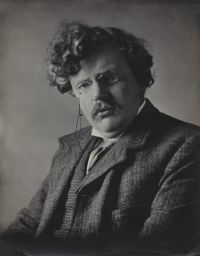 Gilbert Keith Chesterton,
The Apostle and the Wild Ducks…
(1975)
Gilbert Keith Chesterton,
The Apostle and the Wild Ducks…
(1975)
“ We can compare him with another poet, another democratic idealist, another man moved by the French Revolution, living almost in Shelley's time, and almost in Shelley's country, a man who differed from Shelley in nothing except that he was really a man of the people. To think of him after Shelley is like swallowing fire after swallowing water. It is not so easy to get out of one's mouth the stinging taste of the sweetness and bitterness of Burns. ”
William Michael Rossetti,
1911 Encyclopædia Britannica, Volume 24…
(1911)
“ He respected the truth, such as he conceived it to be, in spiritual or speculative matters, and respected no construction of the truth which came to him recommended by human authority. No man had more hatred or contempt of custom and prescription; no one had a more authentic or vivid sense of universal charity. The same radiant enthusiasm which appeared in his poetry as idealism stamped his speculation with the conception of perfectibility and his character with loving emotion. In person Shelley was attractive, winning and almost beautiful, but not to be called handsome. ”
William Michael Rossetti,
1911 Encyclopædia Britannica, Volume 24…
(1911)
“ Shelley, it will be seen, was not only a prolific but also a versatile poet. Works so various in faculty and in form as The Revolt of Islam, Julian and Maddalo, The Cenei, Prometheus Unbound, Epipsychidion, and the grotesque effusions of which Peter Bell the Third is the prime example, added to the consummate array of lyrics, have seldom to be credited to a single writer one, moreover, who died before he was thirty years of age. In prose Shelley could be as admirable as in poetry. ”
