Axis (geometry)

Definition and stakes

Various,  Encyclopaedia Britannica, 11th Edition…

“ Axes.—Conjugate diameters perpendicular to each other are called axes, and the points where they cut the curve vertices of the conic.
In a circle every diameter is an axis, every point on it is a vertex; and any two lines at right angles to each other may be taken as a pair of axes of any circle which has its centre at their intersection.
”
Source: Gutenberg

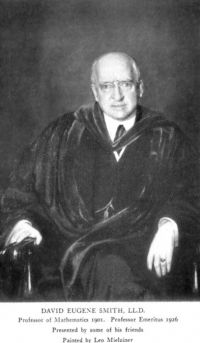
Portrait of David Eugene Smith David Eugene Smith,  The Teaching of Geometry

“ In plane geometry it is easily proved that if two circles intersect, the tangents from any point on their common chord produced are equal. For if the common chord is AB and the point P is taken on AB produced, then the square on any tangent from P is equal to PB × PA. The line PBA is sometimes called the radical axis.
Similarly in this proposition concerning spheres, if from any point in the plane of the circle formed by the intersection of the two spherical surfaces lines are drawn tangent to either sphere, these tangents are equal.
”
Source: Gutenberg

Various,  Encyclopaedia Britannica, 11th Edition…

“ An important metrical property of conjugate diameters is the sum of their squares equals the sum of the squares of the major and minor axis.
In analytical geometry, the equation ax2 + 2hxy + by2 + 2gx + 2fy + c = 0 represents an ellipse when ab > h2; if the centre of the curve be the origin, the equation is a1x2 + 2h1xy + b1y2 = C1, and if in addition a pair of conjugate diameters are the axes, the equation is further simplified to Ax2 + By2 = C. The simplest form is x2/a2 + y2/b2 = 1, in which the centre is the origin and the major and minor axes the axes of co-ordinates.
”
Source: Gutenberg

Get perspective with Kwize: daily news enlightened by great literature