“ Center of Gravity.—A body is composed of a great many particles each of which is pulled toward the center of the earth by the force of gravity. A single force that would exactly equal the combined effect of the pull of the earth for all the particles of a body would be their resultant. The magnitude of this resultant is the weight of the body. ”
Body (physics)
Definition and stakes
The theme of “body (physics)” has been addressed by authors such as Thomas P. Jones, Richard Feynman, Robert Boyle, Bertrand Russell and Ernst Mach. It is often associated with terms like force, gravity, mass, motion and matter.
Quotes about “body (physics)”
 Edgar Allan Poe,
The Purloined Letter
(1844)
“ The principle of the vis inertiæ, for example, seems to be identical in physics and metaphysics. It is not more true in the former, that a large body is with more difficulty set in motion than a smaller one, and that its subsequent momentum is commensurate with this difficulty, than it is, in the latter, that intellects of the vaster capacity, while more forcible, more constant, and more eventful in their movements than those of inferior grade, are yet the less readily moved, and more embarrassed and full of hesitation in the first few steps of their progress. ”
 Robert Ellis Dudgeon,
Colymbia
(1873)
“ The body, being of the same specific gravity as the medium in which it was suspended, was not subject to the laws of gravitation, and no force had to be expended in supporting the weight of, or lifting the body, as must be done at every step and every movement we perform in air. ”
 Herbert Spencer,
First Principles
“ Units of matter, solid, liquid, aëriform, or ethereal, filling the space which any moving body traverses, offer to such body the resistance consequent on their cohesion, or their inertia, or both. In other words, the denser or rarer medium which occupies the places from moment to moment passed through by such moving body, having to be expelled from them, as much motion is abstracted from the moving body as is given to the medium in expelling it from these places. ”
Gilbert Newton Lewis, The Principle of Relativity, and Non-Newtonian Mechanics (1909)
“ Let us emphasize once more, that these changes in the units of time and length, as well as the changes in the units of mass, force, and energy which we are about to discuss, possess in a certain sense a purely factitious significance; although, as we shall show, this is equally true of other universally accepted physical conceptions. We are only justified in speaking of a body in motion when we have in mind some definite though arbitrarily chosen point as a point of rest. The distortion of a moving body is not a physical change in the body itself, but is a scientific fiction. ”
Aram D'Abro, The evolution of scientific thought from Newton to Einstein (1927)
“ It became, then, highly probable, for a number of reasons, that what we called the mass of a body at rest was itself due to the contained energy of the body. In a general way, therefore, a body, when heated or electrified or compressed, would increase in mass. ”
 Isaac Newton,
The Mathematical Principles of Natural Philosophy…
“ If the forces of the particles of which an attractive body is composed, decrease, in the recess of the attracted body, in a triplicate or more than triplicate ratio of the distance from the particles; the attraction will be vastly stronger in the point of contact than when the attracting and attracted bodies are separated from each other though by never so small on interval. ”
 Alfred North Whitehead,
Science and the modern world
(1925)
“ Bodies which are apparently identical in substance, shape, and size have very approximately the same mass: the closer the identity, the nearer the equality. The force acting on a body, whether by touch or by action at a distance, was [in effect] defined as being equal to the mass of the body multiplied by the rate of change of the body’s velocity, so far as this rate of change is produced by that force. In this way the force is discerned by its effect on the motion of the body. ”
John Bernhard Stallo, Popular Science Monthly (1874)
“ On the remaining pages of this paper I desire to direct attention to some of the facts connected with the main subject of my present inquiry—the concept force. Physical forces are distributed by modern science into two classes, molecular and molar forces. Molecular forces are those which determine the internal changes of a body, while molar forces cause the motion of the entire mass. ”
 John Ayrton Paris,
Philosophy in Sport Made Science in Earnest
“ The philosophy of the fact is simply this--while a body revolves on its axis, the component particles of its mass move in circles, the centres of which are placed in the axis; a centrifugal force therefore is generated, which is resisted by the cohesion of the parts of the mass, and this tendency of each particle to fly off is expended in exciting a pressure upon the axis ”
 Thomas P. Jones,
Conversations on Natural Philosophy…
“ In order to obtain the specific gravity of a body which is lighter than water, you must attach to it a heavy one, whose specific gravity is known, and immerse them together; the specific gravity of the lighter body, may then be easily calculated from observing the loss of weight it produces, in the heavy body. ”
Willis Duff Piercy, Great Inventions and Discoveries
“ Further investigation brought him to the unfolding of this general law of gravitation: "Every body in nature attracts every other body with a force directly as its mass, and inversely as the square of its distance." ”
Henry Kater, A Treatise on Mechanics
“ Solid bodies are coherent masses, the particles of which are firmly bound together, so that any force which affects one, being modified according to circumstances, will be transmitted through the whole body. ”
Robert Hunt, The Poetry of Science; or, Studies of the Physical Phenomena of Nature
“ Every form, whether inorganic or organic, which we can discover within the limits of human search, is composed of atoms, which are capable of assuming, under the influence of certain physical forces, conditions essential to the physical state of that body of which they constitute a part. [1] The known forces, active in pro [Pg 5] ducing these conditions, are modes of motion; gravitation and aggregation, heat, light; and associated with these, actinism or chemical radiation; electricity, under all its conditions, whether static or dynamic ”
Thomas P. Jones,
Conversations on Natural Philosophy…
“ Now since we have observed that one of the general properties of bodies is inertia, that is, an entire passiveness, either with [Pg 33] regard to motion or rest, it follows that a body cannot move without being put into motion; the power which puts a body into motion is called force; thus the stroke of the hammer is the force which drives the nail; the pulling of the horse that which draws the carriage, &c. Force then is the cause which produces motion.Emily. And may we not say that gravity is the force which occasions the fall of bodies? ”
A. G. H. Thatcher, Scaffolding (1907)
“ This process is continued until all the bodies have been considered, care being taken that all the units of weight in the bodies which have been considered are added to the units of weight in the body under consideration when dividing the line in which the centre of gravity is found. ”
Isaac Newton,
The Mathematical Principles of Natural Philosophy
(1729)
“ And therefore the same law takes place in a system consisting of many bodies as in one single body, with regard to their persevering in their state of motion or of rest. For the progressive motion, whether of one single body, or of a whole system of bodies, is always to be estimated from the motion of the centre of gravity. ”
Mrs. Bloomfield H. Moore, Keely and His Discoveries: Aerial Navigation
“ And thus, under a logical analysis, which must be admitted to be legitimate, it may be maintained that a body or chemical element resolves itself into a system of centres of force balancing each other at certain distances, and thus rendering the whole molecule or mass extended, as body is known to be. ”
Isaac Newton,
The Mathematical Principles of Natural Philosophy
(1846)
“ Every tremulous body in an elastic medium propagates the motion of the pulses on every side right forward; but in a non-elastic medium excites a circular motion. Case. 1. The parts of the tremulous body, alternately going and returning, do in going urge and drive before them those parts of the medium that lie nearest, and by that impulse compress and condense them; and in returning suffer those compressed parts to recede again, and expand themselves. ”
Thomas Commerford Martin, The inventions, researches and writings of Nikola Tesla
“ The reason why no pain in the body is felt, and no injurious effect noted, is that everywhere, if a current be imagined to flow through the body, the direction of its flow would be at right angles to the surface; hence the body of the experimenter offers an enormous section to the current, and the density is very small, with the exception of the arm, perhaps, where the density may be considerable. ”
John Platts, The Book of Curiosities
“ Take a rod, or stick, and find that place about the middle of it, under which the finger being placed, it will be balanced; that is the centre of gravity. The moment the centre of gravity ceases to be supported, the whole body falls. ”
Jaime Luciano Balmes, Fundamental Philosophy, Vol. 1…
“ If the gravitation of the body A towards the body B, depends only on the motion of the retiring medium, the gravitation will not be in the right line AB, but will follow the undulations described by the medium. ”
Thomas P. Jones,
Conversations on Natural Philosophy…
“ Remember that bodies have no natural tendency to fall, any more than to rise, or to move laterally, and that they will not fall unless impelled by some force; now this force must be proportioned to the quantity of matter it has to move: a body consisting of 1000 particles of matter, for instance, requires ten times as much attraction to bring it to the ground in the same space of time as a body consisting of only 100 particles. ”
Isaac Newton,
The Mathematical Principles of Natural Philosophy
(1846)
“ If two bodies attract each other mutually with forces of any kind, and in the mean time revolve about the common centre of gravity; I say, that, by the same forces, there may be described round either body unmoved a figure similar and equal to the figures which the bodies so moving describe round each other mutually. ”
 Ernst Mach,
Popular scientific lectures
“ Almost of necessity, therefore, motion appears to us as the most important physical factor. Moreover, mechanical properties may be discovered in all physical events. The sounding bell trembles, the heated body expands, the electrified body attracts other bodies. Why, therefore, should we not attempt to grasp all events under their mechanical aspect, since that is so easily apprehended and most accessible to observation and measurement? ”
 David Brewster,
The Life of Sir Isaac Newton
“ If the body is compact, and bends or yields inward to pression, without any sliding of its parts, it is hard and elastic, returning to its figure with a force rising from the mutual attraction of its parts. ”
A. E. Dolbear, The Machinery of the Universe: Mechanical Conceptions of Physical Phenomena
“ If this be granted, then our philosophy agrees with our experience, and every body moves because it is pushed, and the mechanical antecedent of every kind of phenomenon is to be looked for in some adjacent body possessing energy—that is, the ability to push or produce pressure. ”
Isaac Newton,
The Mathematical Principles of Natural Philosophy
(1846)
“ Therefore a body that is specifically heavier than a fluid contiguous to it will sink; and that which is specifically lighter will ascend, and attain so much motion and change of figure as that excess or defect of gravity is able to produce. For that excess or defect is the same thing as an impulse, by which a body, otherwise in equilibrio with the parts of the fluid, is acted on ”
John Bernhard Stallo, Popular Science Monthly (1874)
“ And, in the second place, physiologists, like Du Bois-Reymond, recognize force as the invariable concomitant, if not the essential attribute of matter, and assume that to every constant primordial mass belongs a constant primordial quantity of force, so that the problem of physics, chemistry, and physiology, resolves itself into the quantitative determination of the mechanical interactions of material constants primarily endowed with forces acting equally in all directions, or, as they express it, constant central forces. ”
Gisbert Johann Eduard Kapp, Electricity (1912)
“ We can then use the small body to investigate the properties of the space surrounding the large body. In this investigation the only variables are the force and the distance from the active centre of , the force being always directed either towards or from that point. ”
Max Planck, Translation:Uniform Rotation and Lorentz Contraction (1910)
“ Because the volume change of a body element in any change of state is always very much conditioned by the external forces that are exerted on its surface, particularly by the behavior of pressure and heat supply. ”
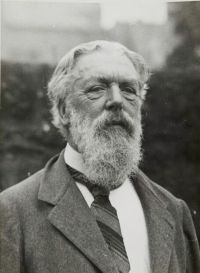 D'Arcy Wentworth Thompson,
On Growth and Form
“ One and the same system of lines of force may appear in a field of magnetic or of electrical energy, of the osmotic energy of diffusion, of the gravitational energy of a flowing stream. In short, we may expect to learn something of the pure or abstract dynamics, long before we can deal with the special physics of the cell. ”
“ In this Proposition I suppose the transparent Bodies to be thick; because if the thickness of the Body be much less than the Interval of the Fits of easy Reflexion and Transmission of the Rays, the Body loseth its reflecting power. For if the Rays, which at their entering into the Body are put into Fits of easy Transmission, arrive at the farthest Surface of the Body before they be out of those Fits, they must be transmitted. ”
Isaac Newton,
The Mathematical Principles of Natural Philosophy
(1846)
“ In a system of bodies whose forces decrease in the duplicate ratio of the distances, if the lesser revolve about one very great one in ellipses, having their common focus in the centre of that great body, and of a figure exceedingly accurate; and moreover by radii drawn to that great body describe areas proportional to the times exactly; the absolute forces of those bodies to each other will be either accurately or very nearly in the ratio of the bodies. ”
William Bower Taylor, Kinetic Theories of Gravitation… (1876)
“ The two facts of experience, that the weight of a body remains invariable whatever its position, and that all bodies fall with the same velocity in a vacuum, prove that ponderable atoms are spherical, having an equal superficial density in all directions, and that all ponderable atoms are alike, or that there is ultimately but a single elementary substance. ”
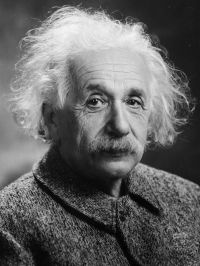 Albert Einstein,
Relativity : the Special and General Theory
(1924)
“ If he releases a body which he previously had in his land, the accelertion of the chest will no longer be transmitted to this body, and for this reason the body will approach the floor of the chest with an accelerated relative motion. ”
Isaac Newton,
The Mathematical Principles of Natural Philosophy…
“ In the second case, the nearer the very great body approaches to the system of two or more revolving bodies, the greater will the perturbation be of the motions of the parts of the system among themselves ”
Isaac Newton,
The Mathematical Principles of Natural Philosophy
(1846)
“ Every body, that by a radius drawn to the centre of another body, how soever moved, describes areas about that centre proportional to the times, is urged by a force compounded out of the centripetal force tending to that other body, and of all the accelerative force by which that other body is impelled. ”
Related terms
Authors who wrote about “body (physics)”
Thomas P. Jones Richard Feynman
 Robert Boyle
 Bertrand RussellErnst MachIsaac NewtonLucien Poincaré
 William John Macquorn RankineAlbert Einstein
 Leonardo da VinciVarious
 Mary Baker G. EddyJohn Bernhard StalloAram D'Abro
 Henry David Thoreau
 John Tyndall
 Thomas Henry Huxley
 Nikola TeslaRobert Ellis DudgeonAlfred North Whitehead
