Carrier (transportation)

Definition and stakes

J. Y. Brinton,  The Law of the Sea

“ The common carrier is one who offers to carry for all who may choose to employ him. The private carrier is one who transports by virtue of a special agreement. The private carrier appears more frequently in water carriage than in land transportation. Most ships, for example, carrying bulk cargoes by special arrangement are private carriers. Most passenger ships are common carriers of passengers. Ships carrying miscellaneous or package freight, and running over regular routes, are common carriers. ”
Source: Gutenberg

Nathan Clifford,  The Maggie Hammond — Opinion of the Court

“ Whenever the goods intended for transportation are shipped on board, or delivered to the carrier or his agent for that purpose, it is the duty of the master, in the absence of any stipulation as to the period of sailing, to commence the voyage within a reasonable time, and he must proceed on the voyage in the direct and usual route to the port of delivery without any unnecessary deviation. ”
Source: Wikisource

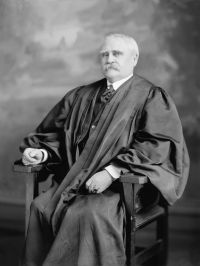
Portrait of Harlan F. Stone Harlan F. Stone,  Barringer Company v. United States…

“ A carrier which is loading in Oklahoma one car of cotton for a southeastern mill and another car of cotton for a Gulf port is certainly performing a 'like and contemporaneous service in the transportation of a like kind of traffic under substantially similar circumstances and conditions.' A carrier which is loading two cars at the same time, on the same siding, with the same commodity is indeed performing the same service under the same circumstances and conditions. ”
Source: Wikisource

Get perspective with Kwize: daily news enlightened by great literature