Flow velocity

Definition and stakes

William Cawthorne Unwin,  1911 Encyclopædia Britannica (1911)

“ In all actual streams the different fluid filaments have different velocities, those near the surface and centre moving faster than those near the bottom and sides. The ordinary formulae for the flow of streams rest on a hypothesis that this variation of velocity may be neglected, and that all the filaments may be treated as having a common velocity equal to the mean velocity of the stream. On this hypothesis, a plane layer abab (fig. 102) between sections normal to the direction of motion is treated as sliding down the channel to a′a′b′b′ without deformation. ”
Source: Wikisource

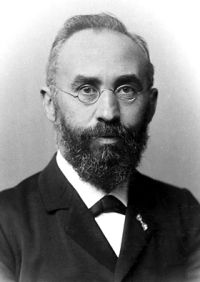
Portrait of Hendrik Lorentz Hendrik Lorentz,  The theory of electrons and the propagation of light

“ The velocity of propagation relative to the wall of the tube can be found by adding the velocity of propagation in the water to the rate of flow of the water, just as, if a ball is rolling along the deck of a ship in the direction in which it is travelling, the ball moves relative to an observer on the shore at the sum of two speeds - the speed of the ship and the speed at which the ball is rolling on it. ”
Source: Wikisource

Albert Francis Zahm,  Aërial Navigation

“ When estimated straight across from surface to surface, that is, in the direction of the liveliest change of pressure, it is the maximum pressure gradient. Along this normal direction the air tends to flow with an acceleration proportional to the gradient. The velocity thus acquired by any portion of air in being pushed along the line of falling pressure, combined with its velocity due to other causes, gives its true velocity. ”
Source: Gutenberg

Get perspective with Kwize: daily news enlightened by great literature