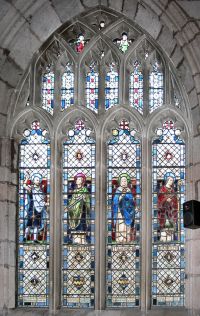
Glassmaking

Definition and stakes

Anonymous,  The Useful Arts Employed in the Construction of Dwelling Houses… (1851)

“ The glass with which windows are generally glazed, is called Crown glass. It is formed of different materials in different manufactories. In some instances the materials consist of fine white sand, carbonate of lime, carbonate of soda, and clippings or waste pieces of old glass; while in other cases they consist of white sand, pearl-ash, saltpetre, borax, and arsenic, in certain proportions. On this point we shall not dwell, for almost every manufacturer has a favourite receipt of his own. Whatever substances are employed, they are intimately mixed before being melted. ”

Source: Gutenberg

Léon Arnoux,  British Manufacturing Industries…

“ But I must strongly advise that all those who are connected with the making of fluxes in any glass painting establishment, should master sufficient chemical knowledge to enable them to ascertain the behaviour of the materials, with respect to one another, as well as of the nature of the glass upon which they are employed; for very much indeed depends upon a correct knowledge of the character of the glass as to whether it be hard or soft, what it contains, and of the temperature at which the glass becomes sufficiently soft to form a firm and enduring union with the colours fluxed upon it. ”
Source: Gutenberg

Sara Ware Bassett,  The Story of Glass

“ Although glass-making is an old story to us scarce a day passes that some one does not visit us to whom the process is entirely new; and it certainly is interesting if a person has never seen it. Suppose we begin at the very beginning. In this bin, or trough, you will see the mixture or batch of which the glass is made. It is composed of red lead and the finest of white beach sand. The lead is what gives the inside of the trough its vermilion color. ”
Source: Gutenberg

Get perspective with Kwize: daily news enlightened by great literature