Hard palate

Definition and stakes

Portrait of Harry L. Hollingworth Harry L. Hollingworth,  The Sense of Taste

“ To “tickle the palate” with delicious food, to make food “palatable,” are very common, though misleading, expressions. However, two very careful investigators have reported that the lining of the whole mouth cavity, including gums, the lining of the cheeks, the hard palate, and even the teeth, are sensitive to sour stimuli. Acetic acid of full strength was used as a stimulus in these experiments.
5. The epiglottis, parts of the larynx, and the vocal cords are sensitive to taste stimuli.
”
Source: Gutenberg

Frank E. Miller,  The Voice: Its Production, Care and Preservation

“ The faulty use of the respiratory muscles directs the vibrating air-column to the soft palate, where the tone is so smothered that the singer has to over-exert himself to be heard, instead of directing it against the hard palate, where it would gain vibrance and carrying quality."
The faulty use of the muscles of articulation is disclosed when the back of the tongue rises like a flabby partition between the opening of the mouth and the pharynx, the consonants being formed thereby far back in the mouth, instead of forward with the tip or middle of the tongue leaning against the hard palate.
”
Source: Gutenberg

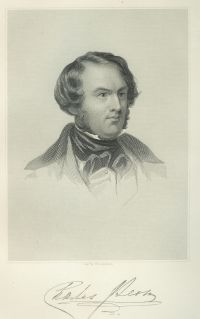
Portrait of Charles Wesley Emerson Charles Wesley Emerson,  Psycho Vox; or, The Emerson System of Voice Culture

“ Every pitch in the human voice has its corresponding chamber of resonance, formed by the nares, by the trachea, by the pharynx, or by the mouth, and sometimes by more than one of these. The transient resonant chambers are formed by the adjustment of the lips, and by the relation of the tongue to the upper gum, the hard palate, the soft palate, and the pharynx. ”
Source: Gutenberg

Get perspective with Kwize: daily news enlightened by great literature