“ The Market Square is populous with a chatting, sauntering crowd of people, who enjoy the luxury of using their limbs without being called on to displays of acrobatic agility in dodging trundling shell. ”
Market square
Definition and stakes
A market square is an open urban space traditionally set aside for trading, often functioning as a town’s commercial and social center. Central to many communities, it usually encircles key structures such as town halls, churches, and market halls, illustrating both economic activity and civic life. Authors such as H. R.
Wilton Hall stressed its historical continuity, pointing out how centuries-old marketplaces retain traces of the past, while Stephen Graham emphasized their vibrant, multifaceted energy, where bartering and daily exchanges occur at the same time. Richard Dehan depicted the lively atmosphere, portraying the square as a dynamic area where people gather not only for commerce but also for social engagement. These viewpoints highlight the market square’s dual function as a place of exchange and communal identity, connecting practical needs with cultural importance.
Quotes about “market square”
 Stephen Graham,
A Tramp's Sketches
Stephen Graham,
A Tramp's Sketches
“ The market square is vast. It is wonderful the number of scenes enacting themselves at the same time. All the morning in another quarter men were trying on old hats and overcoats, and having the most amazing haggling over articles which are sold in London streets for a pot of ferns or a china butter-dish. ”
 Zona Gale,
Neighborhood Stories
Zona Gale,
Neighborhood Stories
“ The market square is a wonderful, big open place to have in the middle of a town. It had got set aside years ago to be a park some day, and while it was a-waiting for parkhood, the town used the edge of it for a market and wood-yard. ”
H. R. Wilton Hall, Our English Towns and Villages
“ One of the pleasantest sights, to a Londoner at any rate, is the market-place of an old-fashioned country town on a market-day. In many such towns the weekly market is held, in the open air, in the same place where it has been held for centuries. Probably none of the houses round the market square are as old as the market, but the buildings, altered and rebuilt as they have been, take us back several centuries, and speak of days long gone by. ”
 Charles G. Harper,
The Great North Road, the Old Mail Road to Scotland…
Charles G. Harper,
The Great North Road, the Old Mail Road to Scotland…
“ In this Square, on a plinth, stands the “Bread Stone,” or “Broad Stone,” a seventeenth century Plague Stone with a hollow at that time filled with vinegar and water for the immersion of coins passing in the market against infection. The town centres in its Market Square, in which the old Town Hall stood. When that building was pulled down a great amount of additional room was obtained at the cost of a certain picturesqueness, to which quality the town can now scarcely lay claim. The “White Hart,” standing at this corner of the Market Square, is the only relic of old coaching days. ”
Joachim John Monteiro, Angola and the River Congo, vol… (1875)
“ A square at the back of the custom-house is the general market of Loanda, and presents a curious scene, from the great variety of articles sold, and the great excitement of buyers and sellers crying out their wares and making their purchases at the top of their voices. ”
 Albert S. Evans,
Our Sister Republic
(1870)
Albert S. Evans,
Our Sister Republic
(1870)
“ The main market is held in an open square, where the more common articles of coarse food, green corn, fruit, etc., and the light, strong, red earthen ware of the country are exposed for sale in the morning. ”
Benjamin Moore Norman, Rambles in Yucatan; or, Notes of Travel Through the Peninsula
“ The market occupies a large square, in a central position, having two sides devoted to the sale of meats, and the other two remaining open. The interior is provided with accommodations for the venders of fruits and vegetables. ”
James Croston, Historic Sites of Lancashire and Cheshire
“ The market place, which, with one or two straggling streets, constitutes what there is of town, is an irregular square with a tall stone obelisk that serves the double purpose of market cross and lamp-post standing in the middle ”
 Annie S. Peck,
The South American Tour
Annie S. Peck,
The South American Tour
“ The fine new Public Market occupying a whole square, about two and a half acres, deserves a visit. The building which cost $280,000 is of a pink and white volcanic stone locally called sillar, with a roof of corrugated iron arranged to give good ventilation. At the four corners are four buildings, one a hotel and restaurant, the other three for storage of surplus stocks of fish, meat, and vegetables. ”
“ Sunday is the principal market-day, when the country people for miles around bring in fruit, vegetables, flowers, pottery, and home-woven articles for sale. Men and women, sitting on the ground, patiently wait for hours to make trifling sales, the profit on which cannot exceed a few pennies, and often the poor creatures sell little or nothing. The principal market is a permanent building, occupying a whole block, or square. The area about which it is built is open in the centre ”
John Duncan, Travels in Western Africa in 1845 & 1846… (1847)
“ The outer market is outside of the walls, under the shade of large trees, but when a town or city has two walls, the public market is held within the outer walls. This market is often attended by strangers from a great distance. The private market is invariably held within the walls ”
 Henry Clews,
Fifty years in Wall Street
(1908)
Henry Clews,
Fifty years in Wall Street
(1908)
“ No one is taught that Wall Street is merely a central market for capital, just as Chicago is for wheat, Boston for wool, New Orleans for cotton, etc. How many appreciate the fact that Wall Street is as essential to the business life of the country as is the Legislature at Washington to our political life? How many realize that Wall Street is the primary nerve center of the American business world ”
Ernest W. Burgess, The city (1925)
“ Out of this necessity there have grown up a number of special organizations which exist for the special purpose of facilitating these readjustments. The market which brought the modern city into existence is one of these devices. More interesting, however, are the exchanges, particularly the stock exchange and the board of trade, where prices are constantly being made in response to changes, or rather the reports of changes, in economic conditions all over the world. ”
Henry George Davis, The Memorials of the Hamlet of Knightsbridge
“ Till about 1835, a watch-house and pound remained at the east end of Middle Row; and the stocks were to be seen at the end of Park-side, almost opposite the Conduit, as late as 1805. A magistrate sat once a week at the Fox and Bull, and a market was held every Thursday. ”
Charles Duguid, The Stock Exchange
“ THE MARKET-PLACE The market-place, where the dealing in this mass of securities is carried on, is by no means of imposing appearance from the exterior point of view. Of all the Stock Exchanges, Bourses, and Bolsas throughout the country and the world, the London Stock Exchange makes, perhaps, the least exterior show. The tourist often seeks it in vain, and thousands of Londoners pass it every day without knowing that behind the suites of offices, with their Portland-stone walls relieved by granite, is hidden the mighty market-place. ”
Charles Whiting Baker, Monopolies and the People
“ The price at which a single block of land near Wall Street, in New York City, was recently sold was so great that, at the same price, the value of a square mile would be equal to half the whole estimated wealth of every sort in the United States. ”
Freiherr von Karl Ludwig Pöllnitz, The Memoirs of Charles-Lewis, Baron de Pollnitz…
“ After I had been at the Town-House, I went to visit the Square where the Merchants assemble about the Affairs of their Trade from Noon till half an Hour past one o'clock. This Square, which is longer than 'tis broad, is surrounded136 with a large open Gallery or Corridor, supported by Free-stone Pillars, for shelter in case of Rain; and is call'd the Bourse or Exchange. Here are Merchants of all Nations, the diversity of whose Habits and Languages is as pleasing as the Beauty of the Place ”
Alexander Andrew Knox, Once a Week (1860)
“ A steady old merchant who had been in the habit of making his appearance on ’Change some forty years ago would be not a little surprised with new London Bridge, and King William Street, and the new Exchange, and the new Fish Market, and new Cannon Street, and the removal of the market from the middle of Farringdon Street opposite the Debtors’ Prison, and more recently of that abominable old nuisance, Smithfield Cattle Market. ”
 Arthur Latham Perry,
Principles of Political Economy
Arthur Latham Perry,
Principles of Political Economy
“ When merchants export goods, say from New York to London, or vice versa, they do not wait for their pay till the goods be actually marketed abroad, but draw at once Bills of Exchange to the amount of the home value of the goods on the parties to whom the goods are sent, and then put these bills on present sale with brokers or middlemen at home. There thus becomes a market or prices current in New York for commercial bills drawn on London, and similarly a market in London for bills drawn on New York. ”
 Charles Dickens,
Our French Watering-Place
Charles Dickens,
Our French Watering-Place
“ In the Place d'Armes of this town, a little decayed market is held, which seems to slip through the old gateway, like water, and go rippling down the hill, to mingle with the murmuring market in the lower town, and get lost in its movement and bustle. It is very agreeable on an idle summer morning to pursue this market-stream from the hill-top. ”
William Shuler Harris, Life in a Thousand Worlds (1905)
“ For instance, one can go to the trade centers for meats and vegetables, and purchase what he wishes or give his order. At the time corresponding to six o'clock of our time in the morning the meat and vegetable cars start on their respective routes, while the trade centers are open for personal callers. Marketing goes on at the market center while the cars are selling throughout the city. At nine o'clock the delivery cars leave the trade centers. Similar to the manner of our world, each home is numbered in such a way that no two houses have the same designation. ”
William T. Davis, Plymouth memories of an octogenarian (1906)
“ Having examined every land title from Wellingsley to Cold Spring, and found no mention of a market anywhere except under the town house, I am satisfied that the basement of both the old and new building contained a market from 1722 to the time of its comparatively recent abandonment in 1858. The tradition therefore concerning the change of the entrance to admit of the establishment of a market probably refers, not to the present building, but to the old one in which a change of plan may have been made to admit of the establishment of a market in 1722. ”
 Joel Cook,
America, Volume 2 (of 6)
Joel Cook,
America, Volume 2 (of 6)
“ The Union Stock Yards make a complete town, with its own banks, hotels, Board of Trade, Post-office, town-hall, newspaper and special Fire Department. The extensive enclosure is entered by a modest, gray sandstone turreted gateway, surmounted by a carved bull's head, emblematic of its uses. The Horse Market is a large pavilion, seating four thousand people. ”
Daniel Joseph Kirwan, Palace and Hovel; Or, Phases of London Life
“ The upper market is open to the public through two large arched apertures, 400 feet wide, and below it is bounded by eighteen dark arches which are used by the salesmen as depositories for their goods. These arches are entirely without ventilation and even the market itself, thronged as it is for twelve hours of the day, receives no air but that which comes in a chance way from the already vitiated atmosphere of the neighborhood. The market is covered on the side next to London Bridge by a roof of rough glass. ”
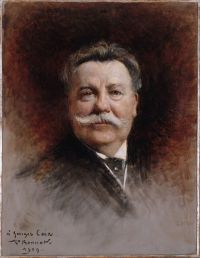 Georges Cain,
Nooks & Corners of Old Paris
Georges Cain,
Nooks & Corners of Old Paris
“ In the Central Market quarter, where every one works, where each shop offers to Paris gourmands the best victuals, the freshest vegetables, the daintiest fruits, where, every night, long files of market gardeners' carts bring in loads of provisions of all sorts, each street has, so to speak, its speciality. ”
Johan Amos Comenius, The Labyrinth of the World and the Paradise of the Heart (1901)
“ The central market-place is for all; for here men of all classes meet, and discuss what is necessary. In the middle of the market-place is, as it were, the centre of everything—that is the residence of Wisdom, the queen of the world. ”
H. R. Wilton Hall, Our English Towns and Villages
“ Some places had, and still have, more than one market a week. In many places the market has quite died out now, but in the early days one of the first steps of a "tun" towards becoming a "town" was to obtain the right to hold a market. ”
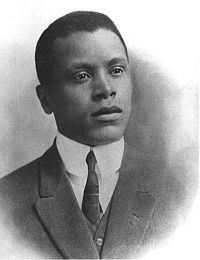 Oscar Devereaux Micheaux,
The Conquest; the Story of a Negro Pioneer
(1913)
Oscar Devereaux Micheaux,
The Conquest; the Story of a Negro Pioneer
(1913)
“ This market house, or place, as it is often called, was an open building, except one end enclosed by a meat-market, and was about forty by one hundred feet with benches on either side and one through the center for the convenience of those who walked, carrying their produce in a home-made basket. Those in vehicles backed to a line guarded by the city marshall, forming an alleyway the width of the market house for perhaps half a block, depending on how many farmers were on hand. There was always a rush to get nearest the market house ”
Charles Duguid, The Stock Exchange
“ We struggle by Banks and come into the cosmopolitan waters of the Foreign Market, where may be heard half a dozen different languages all being spoken at the same time. The Foreign Market is in shape like a sleeve, and the cuff end of it leads out to the main door of the Stock Exchange in Throgmorton Street, so that we have traversed, roughly speaking, the north-west quarter of the Stock Exchange. ”
H. R. Wilton Hall, Social Life in England Through the Centuries
“ There are many of our modern 112 towns which have grown up in manufacturing districts, near great railway centres, or near docks and railway stations, which have no market. Nearly all of our old towns have, or at one time had, the right of holding markets.Nobody can set up a stall in a market as he pleases. On the market-day you will see the beadle going about from stall to stall taking the toll from each stall-holder. In many cases he wears an old-fashioned dress trimmed with gold lace. He reminds us of the time when no one except a freeman of the town could trade freely. ”
Charles Duguid, The Stock Exchange
“ Even after the Stock Exchange is closed, of course, business is transacted in what is called the Street Markets. Generally speaking, business in only the most speculative securities is transacted in the street after hours. Dealers in South African mining shares block Throgmorton Street itself for a couple of hours, more or less, according to the activity of business; and dealers in American railroad shares occupy Shorter's Court, a diminutive square just off Throgmorton Street, with which it is connected by a covered way, an entrance to the Stock Exchange being situated in the square. ”
Edward Davis Mathews, Up the Amazon and Madeira rivers… (1879)
“ These markets are held in the open air, and almost everything that can be named is to be bought. Bread, meat, general provisions and stores, drugs, dyes, woollens, calicoes, and other stuffs of all kinds, pots, pans, and household implements, the stalls being all mixed up together, so that the market has a look as though the tradesmen of the town had emptied the contents of their shops out into the plaza. ”
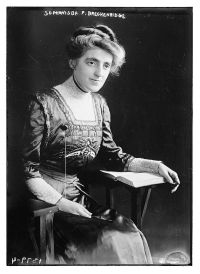 Sophonisba Preston Breckinridge,
New Homes for Old
Sophonisba Preston Breckinridge,
New Homes for Old
“ This may be illustrated by a description of the markets in one Lithuanian neighborhood back of the stockyards, where men are working at low-grade labor in the yards, and the women are keeping lodgers, where few speak English and not many ever go more than a few blocks from home. The typical market in this neighborhood—and there are sometimes as many as ten in a block—is a combined meat market and grocery store. Such stores are found in the poorer neighborhoods of every settlement. ”
 John Stuart Mill,
Principles of Political Economy
(1871)
John Stuart Mill,
Principles of Political Economy
(1871)
“ When indeed the market, being that of a great city, holds out a sufficient inducement to large capitalists to engage in retail operations, it is generally found a better speculation to attract a large business by underselling others, than merely to divide the field of employment with them. This influence of competition is making itself felt more and more through the principal branches of retail trade in the large towns ”
Daniel Joseph Kirwan, Palace and Hovel; Or, Phases of London Life
“ The light iron columns which serve to support the roof, also serve to divide the market into a series of narrow gangways, and within these gangways the dealers take their stand to vend and auction the fish every morning, book and pencil in hand, and their aprons hanging from their chests to their knees. There is a clock tower on the building and a bell which is rung at five o'clock every morning to announce the opening of the market, and then is witnessed a general rush like the retreat of an army. ”
Daniel Joseph Kirwan, Palace and Hovel; Or, Phases of London Life
“ The site of the New Market which was opened a year ago, was formerly covered by the Cattle Market, which is now removed to Islington, in the suburbs. The building is of mixed stone and brick, and the cost was about half a million pounds. The ground on which it is built is also nearly as valuable as the building. The market is about four hundred feet in length and a hundred and fifty in width. The roof is of iron, and a vast avenue, high, broad, and spacious in every way, runs through the entire building. ”
the Elder Pliny, The Boys' and Girls' Pliny
“ Because they collect their stores from different quarters, in ignorance of the proceedings of one another, they have certain days set apart for holding a 251 kind of market, on which they meet together and take stock. What vast throngs are then to be seen hurrying together, what anxious enquiries appear to be made, and what earnest parleys are going on among them as they meet! We see even the very stones worn away by their footsteps, and roads beaten down by being the scene of their labors. ”
Related terms
Authors who wrote about “market square”
H. R. Wilton HallMadeleine BlackWynnard HooperCharles DuguidJohn DuncanDaniel Joseph Kirwan Howard StauntonHenry Clews
 Frank Chodorov
 David RicardoArthur Latham PerryBenjamin Moore NormanWilliam Budington DuryeeFreiherr von Karl Ludwig Pöllnitz
 Theodore RooseveltCharles Dickens
 Edmund Burke
 Karl MarxHenry James
 Robert Ezra Park
Howard StauntonHenry ClewsFrank ChodorovDavid RicardoArthur Latham PerryBenjamin Moore NormanWilliam Budington DuryeeFreiherr von Karl Ludwig PöllnitzTheodore RooseveltCharles DickensEdmund BurkeKarl MarxHenry JamesRobert Ezra Park