Repeating pattern

Definition and stakes

Viscountess Marianne Margaret Compton Cust Alford,  Needlework As Art

“ He reduces ornamental design to five principles, Repetition, Alternation, Symmetry, Progression, and Confusion.
Fig. 5.
Wave Pattern.
First, Repetition. “You may act on the mind, through sight, by the same means as those that will excite physical sensations. A single prick of a pin is nothing, but a hundred such will be intolerably painful. Repetition produces pleasurable sensations, as well as painful ones.” An insignificant form can become interesting by repetition, and by the suggestion which, singly, it could not originate.
”
Source: Gutenberg

Portrait of E. M. Forster E. M. Forster,  Aspects of the novel (1927)

“ Here, here is the point where the aspect called pattern is most closely in touch with its material; here is our starting point. It springs mainly from the plot, accompanies it like a light in the clouds, and remains visible after it has departed. Beauty is sometimes the shape of the book, the book as a whole, the unity, and our examination would be easier if it was always this. But sometimes it is not. When it is not I shall call it rhythm. For the moment we are concerned with pattern only. ”
Source: Gutenberg

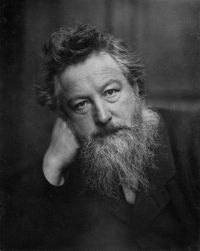
Portrait of William Morris William Morris,  Hopes and Fears for Art

“ At the same time in all patterns which are meant to fill the eye and satisfy the mind, there should be a certain mystery. We should not be able to read the whole thing at once, nor desire to do so, nor be impelled by that desire to go on tracing line after line to find out how the pattern is made, and I think that the obvious presence of a geometrical order, if it be, as it should be, beautiful, tends towards this end, and prevents our feeling restless over a pattern. ”
Source: Gutenberg

Get perspective with Kwize: daily news enlightened by great literature