
“ And there, a field rat, startled, squealing bleeds,His belly close to ground. I see the blade,Blood-stained, continue cutting weeds and shade. ”
Quotes about “squeal”
 Upton Sinclair,
The Jungle — Chapter 3
(1906)
Upton Sinclair,
The Jungle — Chapter 3
(1906)
“ "They use everything about the hog except the squeal." ”
 Adam Smith,
The Essays of Adam Smith
Adam Smith,
The Essays of Adam Smith
“ EVERY sound is naturally felt as in the Ear, the organ of Hearing. Sound is not naturally felt as resisting or pressing upon the organ, or as in any respect external to, or independent of, the organ. We naturally feel it as an affection of our Ear, as something which is altogether in our Ear, and nowhere but in our Ear, or in the principle of perception which feels in our Ear. We soon learn from experience, indeed, that the sensation is frequently excited by bodies at a considerable distance from us; often at a much greater distance, than those ever are which excite the sensation of Smelling. ”
Emma Seiler, The Voice in Singing
“ The cavity of the mouth must be large enough to allow of the largest possible wave of sound, since upon the size of that, as we know, the strength of the tone depends. When the pupil, after some practice, has learned to give the right direction to the stream of sound, he must be required gradually to form the other vowels like the soo in the front part of the mouth, passing from this syllable immediately to the other vowels, as, for example, soo-a, soo-o, soo-e, soo-o-e-ah, &c. Only care must be taken that the course of the air preserves its right direction. ”
 George Orwell,
Animal Farm
(1945)
George Orwell,
Animal Farm
(1945)
“ This, said Squealer, was something called tactics. He repeated a number of times, 'Tactics, comrades, tactics!' skipping round and whisking his tail with a merry laugh. The animals were not certain what the word meant, but Squealer spoke so persuasively, and the three dogs who happened to be with him growled so threateningly, that they accepted his explanation without further questions. ”
 Aesop,
The Fables of Æsop
(1922)
Aesop,
The Fables of Æsop
(1922)
“ The audience laughed, but next day, sure enough, the Countryman appeared on the stage, and putting his head down squealed so hideously that the spectators hissed and threw stones at him to make him stop. "You fools!" he cried, "see what you have been hissing," and held up a little pig whose ear he had been pinching to make him utter the squeals. Men often applaud an imitation, and hiss the real thing. ”
 Jeffery Farnol,
Black Bartlemy's Treasure
Jeffery Farnol,
Black Bartlemy's Treasure
“ I awoke with a sound in my ears like the never-ceasing surge and hiss of waters, a sound that waxed ever louder. Hearkening to this, I presently sought to move and wondered, vaguely uneasy, to find this impossible: I strove now to lift my right hand, found it fast held, tried my left and found it in like case, and so became conscious of something that gripped me about the throat, and ever my wonder and unease grew. ”
 Milicent Washburn Shinn,
The biography of a baby
(1900)
Milicent Washburn Shinn,
The biography of a baby
(1900)
“ But when she had not been making it for some hours, she was apt to forget just how, and to get it too high or low in the throat, producing an extraordinary collection of squeaks and grunts. She usually hit it at last; but after repeated losings, it became quite dissolved away among the many new ones it had apparently given rise to.Later, she took much pains over some imperfect lip sounds; she would lie looking earnestly at me, draw her breath, gather her lips into shape, and finally explode the sound with a great expenditure of breath. ”
 Philip Schaff,
Nicene and Post-Nicene Fathers…
(1885)
Philip Schaff,
Nicene and Post-Nicene Fathers…
(1885)
“ And the cheeks, too, are aids to speech, contracting and expanding in accordance with their structural arrangement, or propelling the voice through a narrow passage by various movements of the tongue, which it effects now with one part of itself now with another, giving hardness or softness to the sound which passes over it by contact with the teeth or with the palate. ”
James Law, Text book of veterinary medicine… (1902)
“ There is no sense of fire or life, but the face is like a dull sculptured mass. The immobile face finds a sharp contrast in the alertness of the ears, which may be carried one forward and another back, but fixed and yet ready to turn to catch every sound. ”
Emma Seiler, The Voice in Singing
“ I omit both here, for, since this publication of Garcia’s, the movements of the breath generating sound in expiration have been thoroughly investigated and determined by Prof. Helmholtz; and in the physical section of the present work all may be found that is of value in the culture of the singing voice. Whatever can be definitely communicated in regard to the working of the muscles of the larynx may likewise be found in any anatomical work. An acquaintance, however, with the action of these muscles is not directly necessary to our purpose, and is of interest only to the physiologist. ”
 Thomas Hobbes,
The English Works of Thomas Hobbes…
(1839)
Thomas Hobbes,
The English Works of Thomas Hobbes…
(1839)
“ For when we hear, the drum of the ear, which is the first organ of hearing, is stricken; and the drum being stricken, the pia mater is also shaken, and with it the arteries which are inserted into it; by which the action being propagated to the heart itself, by the reaction of the heart a phantasm is made which we call sound; and because the reaction tendeth outwards, we think it is without. ”
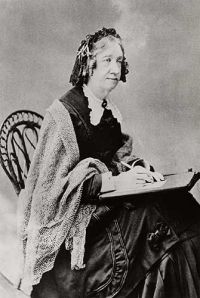 Catharine Esther Beecher,
Common Sense Applied to Religion…
Catharine Esther Beecher,
Common Sense Applied to Religion…
“ This cavity is filled with a liquid, and when the drum of the ear is caused to vibrate by the air which is set in motion by sonorous bodies, it produces undulations of this liquid upon these nerves, and thus the sensation of sound is produced. By the expansion of other nerves, the sense of feeling is extended all over the body, excepting the nails and the hair. ”
Annette M. B. Meakin, Galicia, the Switzerland of Spain
“ By eleven o’clock most of the pigs have arrived, and the space allotted to them presents a lively spectacle: a fearful squeaking and squealing prevails. Proud mother pigs stand surrounded by enormous litters. ”
 Arthur Hugh Clough,
The Poems and Prose Remains of Arthur Hugh Clough
(1869)
Arthur Hugh Clough,
The Poems and Prose Remains of Arthur Hugh Clough
(1869)
“ By death or distance parted will descend, Severing, in crowded rooms ablaze with light, As by a magic screen, the seer from the sight (Palsying the nerves that intervene The eye and central sense between) ; So may the ear, Hearing not hear, Though drums do roll, and pipes and cymbals ring ”
Popular Science Monthly (1879)
“ For since each terminal nerve, of the thousands in the cochlea, responds to a given simple tone, the group of such tones forming a musical sound will excite a corresponding group of nerves, which will of course be related among themselves, as are the exciting tones among themselves ”
Various, Eclectic Magazine of Foreign Literature…
“ They learn to vary the pitch of their voices partly by feeling with the hand the vibrations of the throat and chest,—quick and in the throat for high tones, slow and in the chest for low ones—partly by help of Bell’s written signs, which represent the position peculiar to each sound of the various organs of speech—throat, tongue, lips, back of the mouth, &c. ”
Emma Seiler, The Voice in Singing
“ The quicker and the more easily these movements take place, and the farther forward in the mouth the vibrating column of air is reflected, the more beautiful, full and telling is the tone. If the air rebounds farther back in the mouth from any part of the roof of the mouth, then the high inharmonic over-tones are prominent, and there arises either one or the other of those hollow, disagreeable colorings of timbre which are known as throat and nasal tones. ”
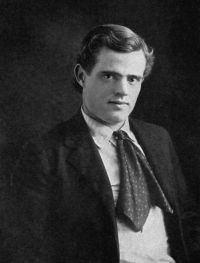 Jack London,
The Cruise of the Snark
(1913)
Jack London,
The Cruise of the Snark
(1913)
“ The squall that rose up, covering half the heavens, and swept down upon us, as likely as not split into two squalls which passed us harmlessly on either side while the tiny, innocent looking squall that appeared to carry no more than a hogshead of water and a pound of wind, would abruptly assume cyclopean proportions, deluging us with rain and overwhelming us with wind. ”
Earl H. Reed, Sketches in Duneland
“ The loud dissonant sounds are produced by friction of the wings, which have hard, drumlike membranes and edges like curved files. He shuffles them with a continuity that is nerve-racking. Often I would suddenly start from sound sleep, with an indistinct apprehension of some impending peril. ”
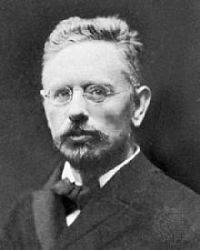 Otto Jespersen,
Language: Its Nature, Development and Origin
Otto Jespersen,
Language: Its Nature, Development and Origin
“ Sometimes it requires a phonetician’s knowledge to understand the individual sound-laws of a child. Thus I pick out from some specimens given by O’Shea, p. 135 f. (girl, 2.9) , the following words: pell (smell) , teeze (sneeze) , poke (smoke) , tow (snow) , and formulate the rule: s + a nasal became the voiceless stop corre [108] sponding to the nasal, a kind of assimilation, in which the place of articulation and the mouth-closure of the nasals were preserved, and the sound was made unvoiced and non-nasal as the s. In other combinations m and n were intact. ”
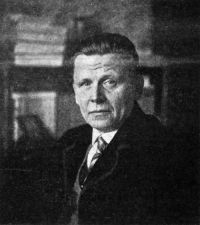 Fráňa Šrámek,
The Best Continental Short Stories of 1924-1925
(1925)
Fráňa Šrámek,
The Best Continental Short Stories of 1924-1925
(1925)
“ It seems as if a solid and vigorous squeeze, as of a hearty handgrip, enters our very beings, and we feel the warming up at work inside us, as a mason works busily from below to brace a tottering wall. Every bit of this good feeling comes from our stomachs, and our hearts hasten to share in it. When we again plunge out into the rain, we work our jaws, thinking that now we can hold our own. ”
Frank E. Miller, The Voice: Its Production, Care and Preservation
“ It should rise from the lungs through the bronchial tubes, the windpipe and the larynx into the mouth and flow out from between the lips like a river between smooth and even banks and bearing voice upon its current—a stream of melody. ”
 Clement of Alexandria,
Ante-Nicene Fathers Vol. II, The Instructor…
(1885)
Clement of Alexandria,
Ante-Nicene Fathers Vol. II, The Instructor…
(1885)
“ The Word prohibits us from doing violence to nature [101] by boring the lobes of the ears. For why not the nose too?—so that, what was spoken, may be fulfilled: “As an ear-ring in a swine’s nose, so is beauty to a woman without discretion.” ”
Emma Seiler, The Voice in Singing
“ It is these physical sensations that have given occasion to many erroneous conjectures in regard to the formation of tones, but we are satisfied that they have no direct relation to the generation of sound, and appear so only through the nerves active in the process. ”
 Anna Sewell,
Black Beauty
(1877)
Anna Sewell,
Black Beauty
(1877)
“ Those who have never had a bit in their mouths cannot think how bad it feels; a great piece of cold hard steel as thick as a man's finger to be pushed into one's mouth, between one's teeth and over one's tongue, with the ends coming out at the corner of your mouth, and held fast there by straps over your head, under your throat, round your nose, and under your chin ”
 Francis Galton,
Inquiries into Human Faculty and Its Development
Francis Galton,
Inquiries into Human Faculty and Its Development
“ When the limits of audibility are approached, the sound becomes much fainter, and when that limit is reached, the sound usually gives place to a peculiar sensation, which is not sound but more like dizziness, and which some persons experience to a high degree. Young people hear shriller sounds than older people, and I am told there is a proverb in Dorsetshire, that no agricultural labourer who is more than forty years old, can hear a bat squeak. ”
 Barry Pain,
General Observations
(1896)
Barry Pain,
General Observations
(1896)
“ For cheek is what gets you on in the world nowadays. Why, if I had the cheek of that bird, I might be the Queen of Sheba. And yet he knew where to draw the line, did William. When I got the cage down, and stood it on the table with the door open, he understood that he'd got to go back, and let me catch him and put him back without so much as a murmur. ”
Popular Science Monthly (1873)
“ It is kept gently on the stretch by two small muscles, one of which draws it tighter, and the other loosens it, by acting upon a chain of small bones. We shall not undertake to describe the curious and complicated anatomy of the inner ear—the drum, containing air, the curious chain-work of minute vibrating bones, the labyrinth filled with water containing little crystalline particles and fine elastic bristles, and where the delicate fibres of the auditory nerve commence. ”
“ For the purposes of vocal utterance, inspiration into the thorax produces an expiration from the abdomen by way of the œsophagus, accompanied by vocal sound, while an inspiration into the abdomen produces an expiration from the thorax by way of the trachea, accompanied by vocal sound; the special mode of inspiration regulating the special sound to be produced. ”
 Friedrich Schiller,
Aesthetical and philosophical essays
(1899)
Friedrich Schiller,
Aesthetical and philosophical essays
(1899)
“ His mouth also marks a supreme sadness, which depresses the lower lip and seems to weigh upon it, while the upper lip, contracted from the top to the bottom, expresses at once both physical suffering and that of the soul. Under the mouth there is an expression of indignation that seems to protest against an undeserved suffering, and is revealed in the nostrils, which swell out and enlarge and draw upwards. ”
Katherine Jewell Everts, Vocal Expression: A Class-book of Voice Training and Interpretation
“ Each must locate for himself his own difficulty, or go to a vocal specialist and have it located. The tension may be altogether in the muscles [Pg 318] governing the throat, or it may be in those about the mouth. There is the resultant, breathy tone, the hard tone, the nasal tone, the guttural tone, the tone that issues from a set jaw or an unruly tongue. All mean tension of muscles somewhere, and must be met by relaxation of these muscles and the freeing of the channel. How to relax the throat shall be our initial point of attack. ”
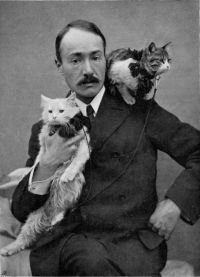 Arnold Henry Savage Landor,
Across Unknown South America
Arnold Henry Savage Landor,
Across Unknown South America
“ Others, more inquisitive, would explore the inside of your ears; while millions—actually millions—of pium, the tiny gnats—more impertinent than all the others taken together—dashed with great force up your nose, into your eyes, into your mouth, and far into your ears, and were most troublesome to remove. ”
Emma Seiler, The Voice in Singing
“ Thus, by singing staccato the syllable koo, slowly at first and gradually quicker, with a movement of the larynx and windpipe that is both seen and felt; and with the tongue and lips at rest and motionless, the right movement is given to the organ in trills and all other embellishments, and by continued practice the movement becomes more rapid. Those who need to be taught this movement must never practice continuously for any length of time, for we must avoid fatiguing the organs. ”
Emma Seiler, The Voice in Singing
“ A correct touch of the voice consists in causing the air, brought into vibration by the vocal ligaments, to rebound from immediately above the front upper teeth, where it must be concentrated as much as possible, rebounding thence to form in the mouth continuous vibrations, which are, at the same time, communicated to the external air. ”
James Law, Text book of veterinary medicine… (1902)
“ An approximate sound may be observed by placing the palm of the left hand on the right ear and drawing a finger of the right softly over its back. The sound is quick and jerking, one or a few jerks only being heard with each inspiration as the act is cut short on account of the pain attending the friction. ”
 Charles Darwin,
The Descent of Man
(1875)
Charles Darwin,
The Descent of Man
(1875)
“ He attributes the sound to the friction of the third and preceding abdominal segments, and I find that these surfaces are marked with very fine concentric ridges; but so is the projecting thoracic collar, into which the head articulates, and this collar, when scratched with the point of a needle, emits the proper sound. ”
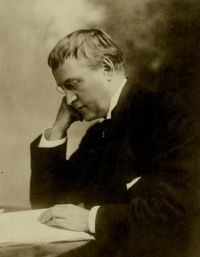 Henry T. Finck,
Romantic Love and Personal Beauty
Henry T. Finck,
Romantic Love and Personal Beauty
“ After many hours of profound meditation on this subject I have come to the conclusion that this slight folding of the ear’s margin is the beginning of a new phase of human evolution. In course of time—this cannot be disproved—the fold of the margin will become larger and larger, until finally the shells of the ear will have been transformed into mobile lids for shutting out at will disagreeable noises, even as the eyelids have been developed to shut out glaring light. ”
Carl Albert Thimm, Egyptian Self-Taught (1914)
“ It can be attained by practice, and is a vowel-sound produced far back and down in the throat. Special throat-muscles must be developed to produce it, so that a European can never imitate the sound at the first attempt. ”
Otto Jespersen,
Language: Its Nature, Development and Origin
“ To pronounce a ‘stressed’ syllable all organs are exerted to the utmost. The muscles of the lungs are strongly innervated; the movements of the vocal chords are stronger, leading on the one hand in voiced sounds to a greater approximation of the vocal chords, with less air escaping, but greater amplitude of vibrations and also greater risings or fallings of the tone. In voiceless sounds, on the other hand, the vocal chords are kept at greater distance (than in unstressed syllables) and accordingly allow more air to escape. ”
Emma Seiler, The Voice in Singing
“ On the other hand, the vocal organs show no straining when the action of a higher series of tones is kept for a lower, only the fulness of the tones is thereby diminished.III. We have further seen that only the transition from the chest register to the falsetto is in all voices at the same tones, the fa fa ; but, both in men’s and women’s voices, the other transitions of the registers are different. As the male larynx is about a third larger than the female, it is plain that the registers in the male voice have a greater expansion. ”
