Summary

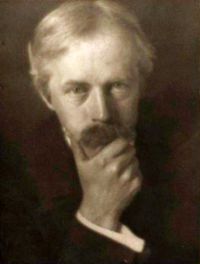
Portrait of Arthur Symons Arthur Symons An Introduction to the Study of Browning

Judgment, according to the vision, is now over. He who has chosen earth rather than heaven, is allowed his choice: earth is his for ever. How the walls of the world shrink and narrow, how the glow fades off from the beauty of nature, of art, of science; how the judged soul prays for only a chance of love, only a hope of ultimate heaven; how the ban is taken off him, and he wakes from the vision on the grey plain as Easter-morn is breaking: this, with its profound and convincing moral lessons, is told, without a didactic note, in poetry of sustained splendour.
Source: Gutenberg

Portrait of Arthur Symons Arthur Symons An Introduction to the Study of Browning

Nor do the characters of Shakespeare talk like those of any other great dramatist, except in so far as later playwrights have consciously imitated Shakespeare. Every dramatic writer has his own style, and in this style, subject to modification, all his characters speak. Just as a soul, born out of eternity into time, takes on itself the impress of earth and the manners of human life, so a dramatic creation, pure essence in the shaping imagination of the poet, takes on itself, in its passage into life, something of the impress of its abode.
Source: Gutenberg

Portrait of Arthur Symons Arthur Symons An Introduction to the Study of Browning

The quaint chime or tinkle of a metre made out of the cadence of sheep-bells renders with curious felicity the quietness and fervent meditation of the subject. A Lovers' Quarrel is in every respect a contrast. It is a whimsical and delicious lyric, with a flowing and leaping melody, a light and piquant music deepened into pathos by a mournful undertone of retrospect and regret, not without a hope for the future. All Browning is seen in this pathetic gaiety, this eagerness and unrest and passionate make-believe of a lover's mood.
Source: Gutenberg

Get perspective with Kwize: daily news enlightened by great literature