Aloes

Definition and stakes

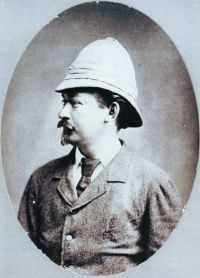
Portrait of Emil Holub Emil Holub,  Seven years in South Africa volume 1… (1881)

“ On the left bank of the Marico, spreading out over the best half of a large meadow, was a carpet of fiery red, set in a frame of verdant sward, and enclosed with the dark green foliage of the mimosa. This spectacle of beauty was caused by masses of flowering aloes, which sent forth their gorgeous spikes of blossom some three or four feet above the cluster of prickly leaves. Where the aloes were thickest, I noticed that they were not unfrequently overhung by a beautiful sulphur-coloured creeper. ”

Source: Gutenberg

Cynthia Stockley,  Blue Aloes: Stories of South Africa

“ This was the century-old hedge of blue aloes which gave the farm its name. Planted in a huge ring of many miles' circumference, the great spiked cacti, with leaves thick and flat as hide shields, and pointed as steel spears, made a barrier against cattle, ostriches, and human beings that was impassable except by the appointed gaps. No doubt it had a beauty all its own, but beneath its fantastic, isolated blooms and leaves of Madonna blue, the gnarled roots sheltered a hundred varieties of poisonous reptiles and insects. That is why, in Africa, no one likes blue aloes—they always harbour death. ”
Source: Gutenberg

Chambers's Twentieth Century Dictionary…

“ Aloe, al′ō, n. a genus of plants of considerable medicinal importance, of the 200 species of which as many as 170 are indigenous to the Cape Colony.—The so-called American Aloe is a totally different plant (see Agave) .—adj. Al′oed, planted or shaded with aloes.—The Aloes wood of the Bible was the heart-wood of Aquilaria ovata and Aquilaria Agallochum, large spreading trees. The wood contains a dark-coloured, fragrant, resinous substance, much prized for the odour it diffuses in burning. ”
Source: Gutenberg

Get perspective with Kwize: daily news enlightened by great literature