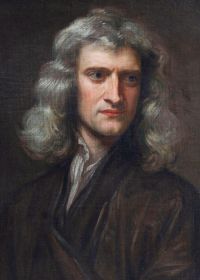
William Makepeace Thackeray,
Ballads
William Makepeace Thackeray,
Ballads
“ This Bouillabaisse a noble dish is— A sort of soup or broth, or brew, Or hotchpotch of all sorts of fishes, That Greenwich never could outdo; ”
William Makepeace Thackeray,
Ballads
“ This Bouillabaisse a noble dish is— A sort of soup or broth, or brew, Or hotchpotch of all sorts of fishes, That Greenwich never could outdo; ”
 Alexis Soyer,
Soyer's Culinary Campaign: Being Historical Reminiscences of the Late War
Alexis Soyer,
Soyer's Culinary Campaign: Being Historical Reminiscences of the Late War
“ After all, the “Reserve” is the principal place. This beautiful and picturesque restaurant, with its pavilion and slim turrets, is gracefully situated on the top of the high rock at the entrance of the old seaport. When required, the proprietor procures the particular fish alive, at the threshold of his door, and shell-fish required for the composition of this dainty dish. [7] In less than an hour—during which time we had partaken of a few small oysters, and some shell-fish peculiar to Marseilles—the bouillabaisse was upon the table, smoking hot, and perfuming the room with its aroma. ”
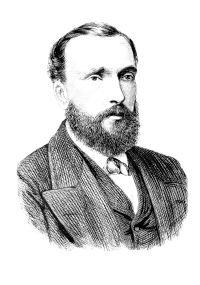 H. Charlton Bastian,
The modes of origin of lowest organisms
H. Charlton Bastian,
The modes of origin of lowest organisms
“ Fluid in contact with Ordinary Air and its Particles; Neck of Flask Sealed after the Fluid had become Cold. No. IV.—Urine remained quite bright and clear during the fifteen days in which it was kept under observation in the water-bath.48No. V.—Hay Infusion after forty-four hours showed a well-marked turbidity. In sixty-eight hours there was an increase in the amount of turbidity, and also some sediment. During the next forty-eight hours turbidity and sediment gradually increased, whilst the colour of the fluid (originally that of port wine) became several shades lighter. ”
John Cargill Brough, The fairy tales of science (1857)
“ As the temperature increases these "beaded bubbles winking at the brim" give place to much larger bubbles, which are formed at the bottom of the vessel, and which rise a little way in the liquid, and then contract and disappear in a most mysterious manner, producing a hissing or simmering sound. But as the heating goes on, these bubbles, which consist of steam, rise higher and higher in the liquid, till at last they reach the surface and escape, producing a bubbling agitation, or the phenomena of ebullition. ”
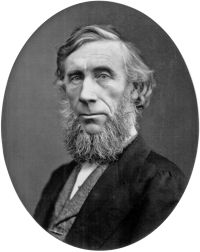 John Tyndall,
Popular Science Monthly
(1877)
John Tyndall,
Popular Science Monthly
(1877)
“ In the presence of such facts I would ask my eminent colleague whether it is necessary to dwell for a single instant on the one-sidedness of the evidence which led to the conclusion that all living matter has its life destroyed by "the briefest exposure to the influence of boiling water." An infusion proved to be barren by six months' exposure to moteless air kept at a temperature of 90° Fahr., when inoculated with full-grown, active bacteria, fills itself in two days with organisms so sensitive as to be killed by a few minutes' exposure to a temperature much below that of boiling water. ”
Stephen Hales, An account of a useful discovery to distill double the usual quantity of sea-water… (1756)
“ Thus also the putrid Water in marshy aguish Countries, may be a Cause of Agues, as well as the putrid Air which they breathe; which, as well as the putrid Water, may probably carry some of its putrid Quality into the Blood thro’ the Lungs. This Method therefore of sweetening stinking Water, by blowing Showers of Air up thro’ the stinking Water of some aguish Places, may be beneficial.72. Live Fish may well be carried several Miles, by blowing now and then fresh Air up thro’ the Water, without the Trouble of changing the Water ”
Various, Chambers's Journal of Popular Literature…
“ In other words, ale having a greater specific gravity than water, and also greater viscidity, the bubble formed has a thicker coating, and requires a longer time for its disrupture. Taking the round of all the 'frothy headings,' we find the same rule prevail. In the spray from the paddle of a steamboat, in the froth on the surface of beverages, in the sparkles on a cup of tea, the air is in the first place entangled among the particles of liquid, and thus forms bubbles in the struggle to escape. ”
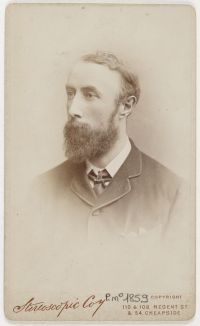 H. B. Guppy,
Observations of a Naturalist in the Pacific Between 1896 and 1899…
H. B. Guppy,
Observations of a Naturalist in the Pacific Between 1896 and 1899…
“ Only in rare cases does prolonged drying increase the period of flotation by more than a few days, examples being given at the end of the Table of Buoyancy results under Note 10. Adherent air-bubbles, a common cause of adventitious buoyancy, must always be removed. ”
 Thomas Henry Huxley,
Popular Science Monthly
(1872)
Thomas Henry Huxley,
Popular Science Monthly
(1872)
“ However clear and pellucid the liquid may have been, when first prepared, however carefully it may have been freed from even the finest visible impurities, by straining and filtration, it will not remain clear. After a time it will become cloudy and turbid; little bubbles will be seen rising to the surface, and their abundance will increase until the liquid hisses as if it were simmering on the fire. By degrees, some of the solid particles which produce the turbidity of the liquid collect at its surface into a scum, which is blown up by the emerging air-bubbles into a thick, foamy froth. ”
Mary Wollstonecraft Shelley, Rambles in Germany and Italy in 1840… (1844)
“ Boiling water, or other liquid, presents only an inanimate element, changed to the touch, not to the eye; but molten metal, red and fiery, takes a new appearance, and seems to have life,—the heat appears to give it voluntary action, and the sense of its power of injury adds to the emotion with which it is regarded; as well as the fact that it takes and preserves the form into which it flows. In this every-day world a new sensation is a new delight. ”
 Joshua Rose,
Modern Machine-Shop Practice, Volumes I and II
Joshua Rose,
Modern Machine-Shop Practice, Volumes I and II
“ While water is below its boiling point its evaporation occurs at its surface only; but when its mass is heated to boiling point, and additional heat is imparted to it, evaporation occurs from the water lying against the surface from which it receives the heat, and an ebullition is caused by the vaporized water passing through the mass, the ebullition being what is known as boiling. ”
William Edwards Henderson, An Elementary Study of Chemistry
“ Fig. 25 3. Boiling. A simpler and equally efficient method for purifying water for drinking purposes consists in boiling the water. It is the germs in water that render it dangerous to health. These germs are living forms of matter. If the [Pg 53] water is boiled, the germs are killed and the water rendered safe. While these germs are destroyed by heat, cold has little effect upon them. Thus Dewar, in working with liquid hydrogen, exposed some of these minute forms of life to the temperature of boiling hydrogen (-252°) without killing them. ”
W. Mattieu Williams, Popular Science Monthly (1883)
“ This is not boiling, as may be proved by trying the temperature with the finger. What, then, is it? It is the yielding back of the atmospheric gases which the water has dissolved or condensed within itself. These bubbles have been collected and by analysis proved to consist of oxygen, nitrogen, and carbonic acid, obtained from the air; but in the water they exist by no means in the same proportions as originally in the air, nor in constant proportions in different samples of water. ”
“ If a Bubble be blown with Water first made tenacious by dissolving a little Soap in it, 'tis a common Observation, that after a while it will appear tinged with a great variety of Colours. To defend these Bubbles from being agitated by the external Air (whereby their Colours are irregularly moved one among another, so that no accurate Observation can be made of them,) as soon as I had blown any of them I cover'd it with a clear Glass, and by that means its Colours emerged in a very regular order, like so many concentrick Rings encompassing the top of the Bubble. ”
Anonymous, Cinderella; Or, The Little Glass Slipper…
“ The sun and the air absorb or suck up the water and carry it off to their homes. Now, the bubbles are made of a little water and a little air. The water is on the end of the pipe, and Tommie blows the air into the pipe, and the bubble grows big and round. When it breaks, the air sucks up the water, which was the outside of the bubble, and the air which was inside mixes with the air in the room. ”
Mrs. Amy Harlow Waterman, A Little Preserving Book for a Little Girl
“ Water is at the boiling point when it is jumping or rolling all over. Water is not boiling when bubbles merely form on the bottom or when they begin to rise to the top. The water must be kept boiling all during the period of sterilization. ”
John Tyndall,
Popular Science Monthly
(1877)
“ It is obviously the stronghold of the English heterogenist. "Water," he says, "is boiling merrily over a fire, when some luckless person upsets the vessel so that the heated fluid exercises its scathing influence upon an uncovered portion of the body—hand, arm, or face. Here at all events there is no room for doubt. Boiling water unquestionably exercises a most pernicious and rapidly-destructive effect upon the living matter of which we are composed." ”
“ The bubbles of oyle will not last, the ayre pierceth, opening or perspiring theire thinne coates; water under oyle makes not bubbles into the oyle, butt at the side or bottome.Water and ayre doe best concurre to the making of bubbles, ayre or exhalation included in a watery coat, or ayre in an oyle habit, as in oyle boyled, wherin there are some watery parts, or vaporous attenuations that are invested in their eruption. Fire makes none, for that is to suttle to be contained, & to fluid and moving to bee contained, not affecting a circle, butt a pyramidal ascention, wh. destroyes inclusion. ”
 Hugh Longbourne Callendar,
1911 Encyclopædia Britannica, Volume 27…
(1911)
Hugh Longbourne Callendar,
1911 Encyclopædia Britannica, Volume 27…
(1911)
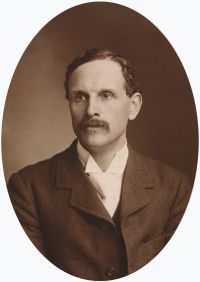
“ L. Dufour succeeded in raising small drops of water, suspended in an oil mixture of suitable density, to a temperature of nearly 180° C. under atmospheric pressure. Similar observations lead to the conclusion that the phenomenon of ebullition, or boiling with the formation of bubbles, depends essentially on the presence of air or dissolved gas to provide nuclei for the starting-points of the bubbles. This is a natural consequence of the capillary pressure due to surface tension. ”
Michael Combrune, The Theory and Practice of Brewing
“ Bubbles still continue to rise after the must is entirely covered with them; and a body of bladders is formed, called, by the brewers, the head of the drink; as the bubbles increase, the head rises in height, but the oils of the must, being as yet of different spissitudes, those which are least tenacious soon emit their air; others, somewhat stronger, being rarefied by the fermenting heat, rise on the surface higher than the rest, while such aerial bubbles as are more dense, take their place below them. ”
A. M. Worthington, The Splash of a Drop
“ The bubble is generally creased by the weight of the liquid along these channels. It must be remembered that the base of the bubble is in a state of oscillation, and that the whole is liable to burst at any moment, when such figures as 6 and 7 of the previous series will be seen.SERIES V.The Splash of a Drop, followed in detail by Instantaneous Illumination.The Size of Drop and Height of Fall are the same as before, but the hollow shell (see figs. 4 and 5 of the previous Series) does not succeed in opening, but is left as a bubble on the surface. ”
 C. V. Boys,
Soap-Bubbles and the Forces Which Mould Them
C. V. Boys,
Soap-Bubbles and the Forces Which Mould Them
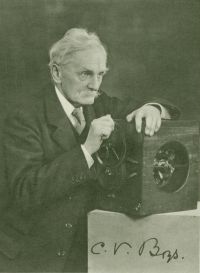
“ Now that there is a very small bubble, the pressure as measured by the water is about one quarter of an inch on the scale. The bubble is growing [Pg 57] and the pressure indicated by the water in the gauge is falling, until, when the bubble is double its former size, the pressure is only half what it was; and this is always true, the smaller the bubble the greater the pressure. As the film is always stretched with the same force, whatever size the bubble is, it is clear that the pressure inside can only depend upon the curvature of a bubble. ”
C. V. Boys,
Soap-Bubbles and the Forces Which Mould Them
“ If I again fill the pipe with water, and this time draw it rapidly out of the liquid, I shall leave behind a [Pg 82] cylinder which will break up into balls, as you can easily see (Fig. 36) . I should like now to show you, as I have this apparatus in its place, that you can blow bubbles of water containing paraffin in the paraffin mixture, [Pg 83] and you will see some which have other bubbles and drops of one or other liquid inside again. One of these compound bubble drops is now resting stationary on a heavier layer of liquid, so that you can see it all the better (Fig. 37) . ”
Dr. Doran, Table traits, with something on them (1854)
“ The noted choleraic colic of Amsterdam, in the last century, was entirely caused by the action of vegetable matter in the water-pipes.Filtration produces no good effect upon hard water. The sulphate of lime, and still more the super-carbonate of lime, are only to be destroyed by boiling. Boiled water, cooled, and agitated in contact with the atmosphere, before use, is a safe and not an unpleasant beverage. It is essential that the water be boiling when “toast and water” is the beverage to be taken.Water, doubtless, is the natural drink of man—in a natural state. ”
John Cargill Brough, The fairy tales of science (1857)
“ But there is a difference between evaporation at low temperatures and ebullition or boiling. Water must be heated until its vapour acquires an elasticity equal to that of the atmosphere before ebullition can take place. At 212° the elastic force of steam will support a column of mercury thirty inches high, and at this temperature the steam-bubbles acquire the power of breaking through the surface of the heated water, provided the barometer stands at thirty inches. ”
 Carter H. Harrison,
A Summer's Outing, and The Old Man's Story
Carter H. Harrison,
A Summer's Outing, and The Old Man's Story
“ The boiling motion is from volumes of steam working its way through the waters from the bowels of the earth and spreading upon the breeze. Boiling water elsewhere wastes itself away, but these pools boil and boil from year to year, and scarcely vary perceptibly in height. Our untutored tourist turns his eye upon the mountain bordering the valley, whose sides are so encrusted with geyserite deposit that it appears to have been formed of this material, and to have been erected by boiling springs ”
N. Hawkins, Maxims and Instructions for the Boiler Room
“ The mud drum is attached to a boiler with the expectation that it will catch and hold the larger portion of the sediment precipitated from the water. The mud drum to be effective should be protected from the heat of the fire, for so soon as it receives sufficient heat to boil the water within it can no longer serve the purpose for which it was intended as all the sediment which may have gathered would be expelled by the ebullition of the water. ”
Various, Notes and Queries, Number 174, February 26…
“ In summer time, a succession of bubbles—doubtless caused by marsh gas—keep constantly appearing on the surface. Those who believe in the tradition, find in this circumstance a strong confirmation. For, as it is the entrance to the bottomless pit, the bells must be descending still; and the bubbles would necessarily be caused by bells sinking in water. ”
H. B. Guppy,
Observations of a Naturalist in the Pacific Between 1896 and 1899…
“ In accordance with this want of relation between the specific weight of seeds and fruits and the density of sea-water, the great variety of structures concerned with buoyancy are regarded in the main, after a detailed examination of their character, as not arising from adaptation. Rather, it is urged, is buoyancy connected with structures that now serve a purpose for which they were not originally developed. Nature, it is held, has never concerned herself directly with providing means of dispersal of any sort. ”
 Shirley Hibberd,
The Amateur's Greenhouse and Conservatory
(1873)
Shirley Hibberd,
The Amateur's Greenhouse and Conservatory
(1873)
“ It is desirable to detach the flue at every point from the floor of the house by means of piers, to allow of a circulation of air around the whole exterior of the flue, and promote a consequent equable distribution of the heat. A small flue of four-inch or six-inch drain-pipes, well cemented at the joints, may suffice for a small house, but what we should consider a good flue would be two feet high and one foot wide, the sides of brickwork, and the top and bottom red foot tiles or slates. ”
 D'Arcy Wentworth Thompson,
On Growth and Form
D'Arcy Wentworth Thompson,
On Growth and Form
“ Even the soap-bubble itself is imperfectly in equilibrium, for the reason that its film, like the protoplasm of amoeba or Aethalium, is an excessively heterogeneous substance. Its surface tensions vary from point to point, and chemical changes and changes of temperature increase and magnify the variation. The whole surface of the bubble is in constant movement as the concentrated portions of the soapy fluid make their way outwards from the deeper layers; it thins and it thickens, its colours change, currents are set up in it, and little bubbles glide over it ”