“ Cane for weaving purposes should not be confused with the popularly called cane or bamboo of our southern states, where it forms the well known cane-brakes. This cane rarely exceeds a height of 20 ft. It grows rapidly and very straight, and to an appreciable diameter. Such cane is used for bamboo furniture, walking sticks, poles, etc. The ordinary domestic sugar cane, also, should not be confused with seating cane. FIG. 1. THE CANING NEEDLE.Equipment.—The tools needed in cane weaving are few in number. ”
Caning
Definition and stakes
Caning, the technique of weaving rattan or similar materials into furniture seats and frames, has long served both as a practical craft and a cultural symbol. Authors like L. Day Perry highlighted its technical accessibility, while Robert Cortes Holliday portrayed the cane as a symbol of dignity.
Caroline L. Smith illustrated it in lighthearted contexts, and Sir William Howard Russell noted its agricultural importance. Whether in furniture restoration or symbolic gestures, caning embodies a range of human practices, merging function with cultural meaning across various fields.
Quotes about “caning”
Robert Cortes Holliday, Walking-Stick Papers
“ The spear, the stave, the pilgrim's staff, the sword, the sceptre—always has the cane-carrying animal borne something in his hand. And, down the long vista of the past, the cane, in its various manifestations, has ever been the mark of strength, and so of dignity. Thus as a man originally became a gentleman, or a king, by force of valour, the cane in its evolution has ever been the symbol of a superior caste.A man cannot do manual labour carrying a cane. ”
Caroline L. Smith, Popular Pastimes for Field and Fireside…
“ The one who knows the game takes a cane in his left hand and pounds upon the floor with it, saying, “He can do little who can’t do this,” and passes the cane with his right hand to his right hand neighbor, who tries to do the same thing, but generally fails. The catch consists in quickly changing the cane from the left to the right hand before you pass it. Every one is then intent on your manner of pounding the cane on the floor. ”
 Sir William Howard Russell,
Pictures of Southern Life, Social…
Sir William Howard Russell,
Pictures of Southern Life, Social…
“ There is an air of fertile desolation that prevails in no other cultivated land. The regularity of the cane, its gardenlike freedom from grass or weeds, and the ad unguem finish and evenness of the furrows, would seem the work of nocturnal fairies, did we not realize the system of “gang labor” exemplified in a field we at length reach, where some thirty men and women were giving with the hoe the last polish to the earth around the cane, which would not be molested again until gathered for the autumnal banquet of the rolling-mills. ”
Various, The Irish Penny Journal, Vol. 1 No…
“ To guard against any unpleasantness of this nature, it should be your business the instant you receive the animals to commence operations. Let them be kept at first far apart; for it is not advisable, as their dispositions may be very different, that one should be witness of the severity you may be compelled to exercise towards the other. This done, take, according to the animals’ ages, a stout cane, a supplejack, or an iron rod. If the creatures be very young, that is, under three months, or perhaps four, the cane will be sufficient. ”
A. M. Brooks, Petals Plucked from Sunny Climes
“ The cane raised here is three per cent. richer than that raised in the Southern States. It grows from four to eight feet in height, according to the fertility of the soil. It is now March, and the summit of the cane is crowned with its useful blooms, which are gathered and dried for upholstering purposes, while the leaves are cut and used for the sustenance of stock, which are herded, watched, and fed, night and day, when not working. In passing through the country we frequently see, remote from any dwelling, small tents stretched over a cot-bed. Here is where the coolie cattle-herder sleeps. ”
 Jens Christian Bay,
Danish Fairy and Folk Tales
(1899)
Jens Christian Bay,
Danish Fairy and Folk Tales
(1899)
“ The innkeeper, in the mean time, thought that no doubt the boy's cane possessed some wonderful power, and therefore prepared himself to replace it with another which looked exactly like it. As soon as he touched the cane, however, the boy shouted, "Cane, strike!" The cane at once began to dance upon the innkeeper's back, and with so good effect that he jumped around over tables and chairs, crying: "Make it stop, make it stop, for heaven's sake! If you don't, it'll kill me! I will give you back your table-cloth!" When the boy thought the innkeeper had had enough, he said, "Cane, stop!" ”
A Boy Crusoe; or, The Golden Treasure of the Virgin Islands
“ Tinder must be procured. Like a flash came to my mind the feathery heads of the wild cane. If I could find one dry enough I thought it would do. I at once ran up stream to where the canes grew, and after a little search I found a plume that was dead and quite dry. Bending the cane down I gathered a handful of the floss from the head, and going to the foot of a cocoanut tree, I lay the cane floss down by the foot of the tree and once more tried to produce a spark. I was soon able to obtain a spark frequently, but they invariably failed to reach the floss, or to ignite when they touched it. ”
“ The cane continues to chip off the bark, and down tumble all sorts of wood-people, some of them hiding like a flash in the first moist earth they come to; others never stopping until they are well under the log, where experience has taught them they will be safe out of harm's way. And they declare to themselves, and to each other, that they will never budge from under that log until it is midnight, and that wicked meadow-lark is fast asleep. ”
Henry Hiram Riley, The Puddleford Papers; Or, Humors of the West
“ He carries a gold-headed cane, and when he marches through the streets, it rises and falls with great emphasis, in harmony with his right foot. Now and then he gives out an a-hem!—one of the lordly kind—that fairly awes down his inferiors. ”
 Johann David Wyss,
The Swiss Family Robinson; or, Adventures on a Desert Island
Johann David Wyss,
The Swiss Family Robinson; or, Adventures on a Desert Island
“ Our object being to search the neighborhood for traces of the boa constrictor, or any of his kindred, Fritz, Jack, and Franz went with me to the sugar-cane brake, and we satisfied ourselves that our enemy had not been there. It was long since we had enjoyed the fresh juice of these canes, and we were refreshing ourselves therewith, when a loud barking of dogs, and loud rustling and rattling through the thicket of canes, disturbed our pleasant occupation, and, as we could see nothing a yard off where we stood, I hurried to the open ground, and with guns in readiness we awaited what was coming. ”
 Harry Alverson Franck,
Roaming Through the West Indies
Harry Alverson Franck,
Roaming Through the West Indies
“ Then come broadening expanses of cane, with throngs of men and women working in the fields, interspersed with short stretches of arid sand, or meadows bright with pink morning-glories and dotted with splendid reddish cattle. ”
Robert Cortes Holliday, Walking-Stick Papers
“ Women as well as men play their part in the colourful story of the cane. The shepherdess's crook might be regarded as the precursor of canes for ladies. In Merrie England in the age when the May-pole flourished it was fashionable, we know from pictures, for comely misses and grandes dames to sport tall canes mounted with silver or gold and knotted with a bow of ribbon. The dowager duchess of romantic story has always appeared leaning upon her cane. ”
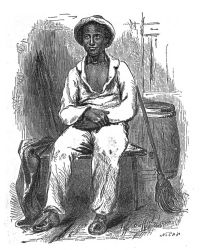 Solomon Northup,
Twelve Years a Slave
(1853)
Solomon Northup,
Twelve Years a Slave
(1853)
“ One draws the cane from the rick, or stack, cutting the top and flags from the stalk, leaving only that part which is sound and healthy. Each joint of the cane has an eye, like the eye of a potato, which sends forth a sprout when buried in the soil. ”
Robert Cortes Holliday, Walking-Stick Papers
“ Men of genius now and then have found in their choice of a cane an opportunity for the play of their eccentricity, such a celebrated cane being the tall wand of Whistler. Among the relics of great men preserved in museums for the inspiration of the people canes generally are to be found. We have all looked upon the cane of George Washington at Mount Vernon and the walking-stick of Carlyle in Cheyne Walk. ”
 Robert Barnwell Roosevelt,
The Game Fish, of the Northern States and British Provinces
Robert Barnwell Roosevelt,
The Game Fish, of the Northern States and British Provinces
“ They should be made from the upper part of the canes alone, as in that part the nodes which give them their strength are the thickest. The outside or glazed part of the cane should come on the outside of the rod, and the joints should be so perfect that they cannot be traced by the eye, as if there is the least opening water will get in and destroy the rod. ”
Various, Harper's New Monthly Magazine, No…
“ Vainly does the boy officially intrusted with the administration of the cane, strike the sides of the barrow with malignant smartness and perseverance—fish are snatched away with lightning rapidity and pickpocket neatness of hand. The hardest rap over the knuckles fails to daunt the sturdy little assailants. ”
“ It reaches a height of thirty feet. At the age of about thirty or forty years, the big cane flowers and produces an abundance of rich nourishing grains for stock and game. After flowering, the old canes die and new plants spring up from the seed. The young shoots are known as mutton cane, because deer and bear and stock grow fat on them.“This cane,” said Tatanka, after they had eaten their supper, “is like the pipe-stem reeds of the Sioux Country. The Indian boys called them spear-grass, and we threw the reeds at each other when we played war.” ”
 Dorothy Canfield Fisher,
What Shall We Do Now?: Five Hundred Games and Pastimes
Dorothy Canfield Fisher,
What Shall We Do Now?: Five Hundred Games and Pastimes
“ A cane (or broom-stick) about three feet long is held by two boys facing each other, each with a hand on each end of the cane, the respective right hands being outside the lefts, that is, nearest to the end. Then one tries to get the cane away from the other. It sounds simple, but there are a great variety of strategic tricks to be learned by practice. No struggle should last more than two minutes by the watch, when the boys should stop and get breath. The feet are not used, but it is quite allowable to use your body, if you get down on the ground in a sort of wrestling. ”
Robert Kerr, A General History and Collection of Voyages and Travels…
“ An elephant upon a hard journey having been ill-used by his keeper, and finding the fellow asleep one day near him, but out of his reach, and having green canes brought him as food, he took hold of a cane by one end with his trunk, and reached the other end to the keeper's head, which was bare, his turban having fallen off, and twisting the cane among his long hair, drew the fellow towards him, and then slew him. ”
 Alfred Russel Wallace,
The Malay Archipelago, Volume 2
Alfred Russel Wallace,
The Malay Archipelago, Volume 2
“ Whatever time of the day you enter, you are sure to find three or four people with a yard of cane in one hand, a knife in the other, and a basket between their legs, hacking, paring, chewing, and basket-filling, with a persevering assiduity which reminds one of a hungry cow grazing, or of a caterpillar eating up a leaf. ”
Edwin James, James's Account of S. H. Long's Expedition…
“ Making our way with excessive toil among these gigantic gramina, our party might be said to resemble a company of rats traversing a sturdy field of grass. The cane stalks, after being trod to the earth, often inflicted, in virtue of their elasticity, blows as severe as they were unexpected. ”
E. J. Banfield, The Confessions of a Beachcomber
“ Ascending a neighbouring tree, he will manoeuvre one end over a limb of that which he wishes to climb, and slip it through the loop, and run it up until it is fast. A cane 50 feet long, no thicker than one's little finger, fastened to the upper branch of a tree, has on trial borne the weight of three fairly-sized men. Thus tested, the black has no hesitation or difficulty in rapidly ascending, and in lowering down young birds, or eggs (wrapped in leaves) , or whatsoever his quest. ”
Thomas Baines, Shifts and Expedients of Camp Life…
“ Into the bore of the cane thus left, a mixture of sulphur and stable litter is tightly rammed, just as you would charge a hole for blasting or would load a gun. For a period of three years every shoot which shows above the ground is cut away. The best shoot of the fourth year is allowed to grow to its full altitude and bulk, which at times is truly prodigious, leading to the false conclusion that some cane of peculiar species was the subject of wonder and investigation. ”
Robert Cortes Holliday, Walking-Stick Papers
“ There is a veteran New York journalist who will be glad to show any student of canes one which he prizes highly that was made from the limb of a tree upon which a friend of his was hanged. In our age of handy inventions a type of cane is manufactured in combination with an umbrella. ”
Sir Alfred E. Pease, Hunting Reminiscences
“ Every act in the drama on nature’s stage is full of interest and life, from the moment that hounds burst like a flood through the kennel door, the huntsman astride his knowing horse shoves his horn into the case, and “whips” scramble into their saddles—until, when the Master has sounded “home,” the last good-night has been answered as heads are turned in different directions, and the patter of the pack on the muddy road, and the echo of the horses’ feet, fades on the ear as at kennel fadge they trot home in the dusk. ”
George Fracker, A voyage to South America, with an account of a shipwreck in the river La Plata…
“ Horses, bullocks, dogs and sheep, in these vast regions, run wild, in immense flocks and herds. The swine are of small size, and always black. The hunters, at certain seasons, form parties to procure the hides and tallow of the wild cattle, and leave the carcases to be devoured by the dogs.These latter animals abound here in infinite variety and numbers. Here may be seen the bull dog, mastiff, pointer, water dog, terrier, spaniel, butcher, shepherd, and ship dog, and sometimes all in a company together. ”
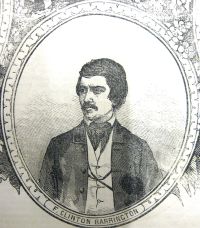 J. H. Ingraham,
The South-West, by a Yankee. In Two Volumes…
J. H. Ingraham,
The South-West, by a Yankee. In Two Volumes…
“ The cane is divested of its tops, which are thrown aside, unless they are needed for plants, which is often the case, when they are thrown together in rows, and carefully protected from the inclemencies of the weather. ”
 May Sinclair,
A Journal of Impressions in Belgium
May Sinclair,
A Journal of Impressions in Belgium
“ Only when you come up to them do you see that they are borne on the bowed backs of men and women and children. The children—when there are no bundles to be borne these carry a bird in a cage, or a dog, a dog that sits in their arms like a baby and is pressed tight to their breasts. Here and there men and women driving their cattle before them, driving them gently, without haste, with a great dignity and patience. ”
Anthony Florian Madinger Willich, Domestic Encyclopædia (1802)
“ As there will be found an obstacle at the entrance of the paunch, the cane must be pushed with additional force; and, as soon as a smell is observed to proceed from that place, and the animal's body sinks, the cure is performed, and Nature will complete the rest. ”
Various, Scientific American Supplement…
“ When the cane is ripe, they proceed to the field, each armed with a matchet. Spreading over the plantation, they commence the cutting of the cane, first by one cut at the top, which takes off the long leaves and that part which is worthless, except as fodder for the cattle. ”
 James Lane Allen,
A Kentucky Cardinal: A Story
James Lane Allen,
A Kentucky Cardinal: A Story
“ When I forced myself away from my fire before dark, and ran down to the stable to see about feeding and bedding the horses and cows, every beast had its head drawn in towards its shoulders, and looked at me with the dismal air of saying, "Who is tempering the wind now?" The dogs in the kennel, with their noses between their hind-legs, were shivering under their blankets and straw like a nest of chilled young birds. The fowls on the roost were mere white and blue puffs of feathers. Nature alone has the making of her creatures ”
Burt L. Standish, Frank Merriwell's Setback; Or, True Pluck Welcomes Defeat
“ He had nerved himself to make the throw of his life, and he made it. The stiff hemp rope swept through the air with the sinuosity of a serpent, and the noose, dropping over an end of the cane, brought the cane to the floor. ”
William T. Palmer, The English Lakes
“ I well remember assisting to drive a flock across this upland basin. Of all scenes in dales life, few are prettier than well-driven sheep passing over open land. The collies, watchful, obedient to call or whistle of their master, follow the wings of the mob; the shepherd is behind the centre, and the broad front of grey fleeces and black faces, a thousand or more strong, steadily, readily, moves to pastures new, and the delicate green grass, with grey crags and darker stripes of moss, combines all into an idyllic picture. ”
Queensland, Our First Half-Century: A Review of Queensland Progress Based Upon Official Information
“ The farmer is learning to know his cane; he studies its habits, and is 141 quick to appreciate the good and bad effects of his operations. The analyses at the mills have directed his attention to the importance of cane being a good sugar-producer, and, as he is in many cases a shareholder in a factory, he is alive to the fact that weight of cane is not the only essential to success. ”
Anthony Florian Madinger Willich, Domestic Encyclopædia (1802)
“ Eager directs a person to lay hold of it by the nostril, and one horn, while an assistant steadily holds its tongue with one hand, and pushes the cane down its throat with the other. Care, however, should be taken, not to let the animal get the knob of the cane between his grinders, and also to thrust it down far enough ”
