Edge (geometry)

Definition and stakes

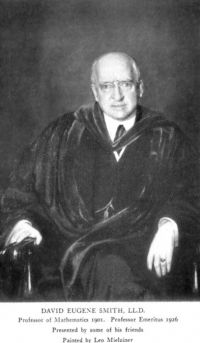
Portrait of David Eugene Smith David Eugene Smith,  The Teaching of Geometry

“ An oblique prism is equivalent to a right prism whose base is equal to a right section of the oblique prism, and whose altitude is equal to a lateral edge of the oblique prism.
This is a fundamental theorem leading up to the mensuration of the prism. Attention should be called to the analogous proposition in plane geometry relating to the area of the parallelogram and rectangle, and to the fact that if we cut through the solid figure by a plane parallel to one of the lateral edges, the resulting figure will be that of the proposition mentioned.
”
Source: Gutenberg

Portrait of David Eugene Smith David Eugene Smith,  The Teaching of Geometry

“ A few illustrations, as of an open book, the wall and floor of a room, and a swinging door, serve to make the concept clear, while a plane at right angles to the edge shows the measuring plane angle. So manifest is this [Pg 299] relationship between the dihedral angle and its measuring plane angle that some teachers omit the proposition that two dihedral angles have the same ratio as their plane angles.
Theorem. If two planes are perpendicular to each other, a straight line drawn in one of them perpendicular to their intersection is perpendicular to the other.
”
Source: Gutenberg

Various,  Encyclopaedia Britannica, 11th Edition…

“ If we take a certain line u as unit length, then the square on u is the unit of area, and the cube on u the unit of volume, that is to say, if we wish to measure a volume we have to determine how many unit cubes it contains.
A rectangular parallelepiped has, as a rule, the three edges unequal, which meet at a point. Every other edge is equal to one of them. If a, b, c be the three edges meeting at a point, then we may take the rectangle contained by two of them, say by b and c, as base and the third as altitude.
”
Source: Gutenberg

Get perspective with Kwize: daily news enlightened by great literature