“ An electric discharge cannot occur between two bodies unless the difference of their potentials is sufficiently great compared with the distance between them. If, therefore, we can keep the potentials of all bodies within a certain region equal or nearly equal, no discharge will take place between them. We may secure this by connecting all these bodies by means of good conductors, such as copper-wire ropes ”
Electric discharge
Definition and stakes
Electric discharge, the movement of electric charge through a medium such as gas, liquid, or solid, is a fundamental phenomenon in electromagnetism, enabling a wide range of applications from lightning protection to industrial processes. Researchers such as Michael Faraday investigated arc discharge, noting its ability to carry substantial currents at low voltages, while Nikola Tesla studied discharges in vacuum tubes, emphasizing their intricate energy behavior.
Joseph John Thomson focused on the interaction of electric forces within discharge processes, and Alton D. Adams tackled practical issues in controlling lightning discharges through conductive systems. These differing viewpoints highlight the concept's dual nature—as both a scientific phenomenon and a technological foundation—linking theoretical exploration with practical application.
Quotes about “electric discharge”
Alton D. Adams, Electric Transmission of Water Power
“ When a lightning discharge takes place through an arrester the resistance which the arrester offers to a flow of current is for the moment greatly reduced by the arcs which the lightning sets up in jumping the air-gaps of the arrester. Each wire of a transmission circuit must be connected alike to arresters, and the paths of low resistance through arcs in these arresters to the earth would obviously short-circuit the connected generators unless some construction were adopted to prevent this result. ”
 Nikola Tesla,
Electric Discharge in Vacuum Tubes
(1891)
Nikola Tesla,
Electric Discharge in Vacuum Tubes
(1891)
“ When the potential of the primary suddenly falls, this electrification will redistribute itself, and may pass through,the rarefied gas and produce luminosity in doing so. Whilst the discharge of the jar is going on, it is difficult, and, from a theoretical point of view, undesirable, to separate the effect into parts, one of which is called electrostatic, the other electromagnetic; what we can prove is that in this case the discharge is not such as would be produced by electromotive forces derived from a potential function. ”
Related terms
Authors who wrote about “electric discharge”
Two Gentlemen of PhiladelphiaNikola Tesla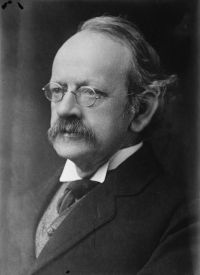 Joseph John ThomsonOtto A. Witte
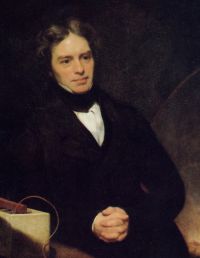 Michael FaradayW. H. McCormick
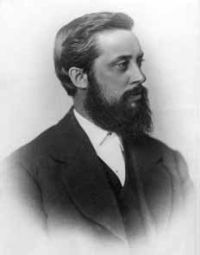 William Arnold AnthonyThomas Commerford MartinVarious
 James Clerk MaxwellAlton D. AdamsN. HawkinsFrederick Irving Anderson
 Sir Oliver Lodge
 H. Beam PiperWilliam T. JeansBertha May Clark
 John F. WoodhullAmerican School of CorrespondenceW. Mattieu Williams
Nikola TeslaJoseph John ThomsonOtto A. WitteMichael FaradayW. H. McCormickWilliam Arnold AnthonyThomas Commerford MartinVariousJames Clerk MaxwellAlton D. AdamsN. HawkinsFrederick Irving AndersonSir Oliver LodgeH. Beam PiperWilliam T. JeansBertha May ClarkJohn F. WoodhullAmerican School of CorrespondenceW. Mattieu Williams