Inertial frame of reference

Definition and stakes

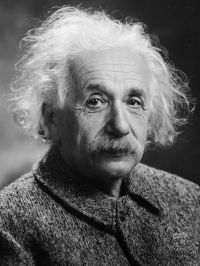
Portrait of Albert Einstein Albert Einstein,  Fundamental ideas and problems of the theory of relativity (1923)

“ The question whether Euclidian geometry is valid becomes physically significant; its validity is assumed in classical physics and also later in the special theory of relativity.
In classical mechanics the inertial frame and time are best defined together by a suitable formulation of the law of inertia: It is possible to fix the time and assign a state of motion to the system of coordinates (inertial frame) such that, with reference to the latter, force-free material points undergo no acceleration
”
Source: Gutenberg

Aram D'Abro,  The evolution of scientific thought from Newton to Einstein (1927)

“ All that we have a right to demand of any theory is that it be in harmony with the existence of an inertial frame with respect to which rotation develops centrifugal forces; for these forces have been detected by experiment. But we have no right to maintain that any experiment performed to this day has ever been sufficiently precise to demonstrate the absolute fixity of the inertial frame, or to deny that the frame may not suffer from a certain measure of indeterminateness when large masses move in its neighbourhood. ”
Source: Gutenberg

Portrait of Albert Einstein Albert Einstein,  The Meaning of Relativity (1922)

“ It appears, therefore, as if there were Cartesian systems of co-ordinates, the so-called inertial systems, with reference to which the laws of mechanics (more generally the laws of physics) are expressed in the simplest form. We may infer the validity of the following theorem: If is an inertial system, then every other system which moves uniformly and without rotation relatively to , is also an inertial system; the laws of nature are in concordance for all inertial systems. This statement we shall call the "principle of special relativity." ”
Source: Wikisource

Get perspective with Kwize: daily news enlightened by great literature