“ Nor am I thinking of any new plan or any novel kind of institution or any new agency; rather shall we do better to escape some of the excessive institutionalism and organization. We are so accustomed to think in terms of organized politics and education and religion and philanthropies that when we detach ourselves we are said to lack definiteness. It is the personal satisfaction in the earth to which we are born, and the quickened responsibility, the whole relation, broadly developed, of the man and of all men,—it is this attitude that we are to discuss. ”
Institutionalism
Definition and stakes
The theme of “institutionalism” has been addressed by authors such as L. H. Bailey, Alfred H. Lloyd and Adam Smith. It is often associated with terms like organization, government, institution, public and society.
Quotes about “institutionalism”
 Alfred H. Lloyd,
The will to doubt
Alfred H. Lloyd,
The will to doubt
“ The meaning of institutionalism is just that of some asserted end justifying any available means, and so under cover of its peculiar conceits sanctioning violence. Watch any institution and see how one or another of life's objects of devotion is become, or fast becoming, a mere utility. The institution makes life mechanical, and doing this it is as treacherous as it seems loyal to the treasured things of life, the developed ideas and established customs ”
 Adam Smith,
The Theory of Moral Sentiments
(1759)
Adam Smith,
The Theory of Moral Sentiments
(1759)
“ Second, in searching for perfection, transcendental institutionalism concentrates primarily on getting the institutions right, and it is only indirectly concerned with the societies that would ultimately emerge. ”
 John R. Commons,
The American Journal of Sociology
(1901)
John R. Commons,
The American Journal of Sociology
(1901)
“ The state becomes a larger institution, by deepening its hold on a subordinate institution which had grown up as private property under the law of survival and centralization, until it reached the point where organization tended to suppress the free movement of the persuasive principle animating its members. ”
 Laurence Housman,
Ploughshare and Pruning-Hook: Ten Lectures on Social Subjects
Laurence Housman,
Ploughshare and Pruning-Hook: Ten Lectures on Social Subjects
“ The more you spread government as an organization of the people themselves, the more humane, upon that working basis, are likely to be its operations—on one condition: that such organisation of the people, whatever its numbers, submits to the operation of its own laws and shares equally in the conditions which it imposes—that, if it provides a qualification for citizenship, it provides also the means for all to qualify. ”
 Herbert Spencer,
Illustrations of Universal Progress…
Herbert Spencer,
Illustrations of Universal Progress…
“ Not an organization of any kind—political, religious, literary, philanthropic—but what, by its ever-multiplying regulations, its accumulating wealth, its yearly addition of officers, and the creeping into it of patronage and party feeling, eventually loses its original spirit, and sinks into a mere lifeless mechanism, worked with a view to private ends—a mechanism which not merely fails of its first purpose, but is a positive hindrance to it. ”
 John Stuart Mill,
On Liberty
(1869)
John Stuart Mill,
On Liberty
(1869)
“ The constitution of such countries is an organization of the experience and practical ability of the nation, into a disciplined body for the purpose of governing the rest; and the more perfect that organization is in itself, the more successful in drawing to itself and educating for itself the persons of greatest capacity from all ranks of the community, the more complete is the bondage of all, the members of the bureaucracy included. ”
 Max Weber,
The Protestant Ethic and the Spirit of Capitalism
(1930)
Max Weber,
The Protestant Ethic and the Spirit of Capitalism
(1930)
“ Of course the official, even the specialized official, is a very old constituent of the most various societies. But no country and no age has ever experienced, in the same sense as the modern Occident, the absolute and complete dependence of its whole existence, of the political, technical, and economic conditions of its life, on a specially trained organization of officials. The most important functions of the everyday life of society have come to be in the hands of technically, commercially, and above all legally trained government officials. ”
 Frederic Austin Ogg,
The Governments of Europe
Frederic Austin Ogg,
The Governments of Europe
“ Stability of Local Institutions.—Students of political science are familiar with the fact that governmental systems are, as a rule, less stable at the top than at the bottom. Local institutions, embedded in the interests of the community and supported by the native conservatism of the ordinary man, strike root deeply; the central, national agencies of law-making and of administration are played upon by larger, more unsettling forces, with the consequence of greatly increased likelihood of change. Of this principle the history of modern France affords notable illustration. ”
John Stuart Mill,
On Liberty
(1869)
“ To determine the point at which evils, so formidable to human freedom and advancement, begin, or rather at which they begin to predominate over the benefits attending the collective application of the force of society, under its recognised chiefs, for the removal of the obstacles which stand in the way of its well-being; to secure as much of the advantages of centralized power and intelligence, as can be had without turning into governmental channels too great a proportion of the general activity—is one of the most difficult and complicated questions in the art of government. ”
 John Dewey,
The public and its problems
(1927)
John Dewey,
The public and its problems
(1927)
“ The very fact that the public depends upon consequences of acts and the perception of consequences, while its organization into a state depends upon the ability to invent and employ special instrumentalities, shows how and why publics and political institutions differ widely from epoch to epoch and from place to place. To suppose that an a priori conception of the intrinsic nature and limits of the individual on one side and the state on the other will yield good results once for all is absurd. ”
 Theodore Parker,
The Collected Works of Theodore Parker
(1863)
Theodore Parker,
The Collected Works of Theodore Parker
(1863)
“ Besides the organized institutions—visible as tools of industry or politics, or invisible in literature, science, settled and admitted principles of private morality or of public law,—which represent the history and achievements of mankind, they brought also ideas not organized in either form of institution, and sentiments not then translated into conscious thought. ”
Herbert Spencer,
Popular Science Monthly
(1881)
“ If, other things remaining the same, the political structures of a society are further developed—if the existing institutions are extended or fresh ones set up—if, for directing social activities in greater detail, extra staffs of officials are appointed, the simultaneous results are an increase in the aggregate of those who form the regulating part and a corresponding decrease in the aggregate of those who form the part regulated. In various ways all who compose the controlling and administrative organization become united with one another and separated from the rest. ”
 Carl Schurz,
Speeches, correspondence and political papers of Carl Schurz
(1913)
Carl Schurz,
Speeches, correspondence and political papers of Carl Schurz
(1913)
“ Moreover, we must adapt our rules and customs of government to the peculiar wants of our social organization. In order to be safe, we must intrust the government, in its general administration as well as in its details, to those who, by their own interests, are bound to be the natural guardians of the system. ”
 Vladimir Ilyich Lenin,
The State and Revolution
Vladimir Ilyich Lenin,
The State and Revolution
“ This distinct public power is necessary, because a self-acting armed organization of the population has become impossible with the break-up of Society into classes. ... This public authority exists in every State. ”
Robert Mercer Taliaferro Hunter, Southern Historical Society Papers (1876)
“ To the wise men who were entrusted with the formation of that union and common government, it was obvious enough that each separate society should be entrusted with the management of its own peculiar interests, and that the united government should take charge only of those interests which were common and general. ”
graf Leo Tolstoy, The Kingdom of God is Within You…
“ There are those who affirm that the State organization is the more indispensable; they declare that its overthrow would check all human progress, that no development is possible save through the channels of [220] civil government, and that all those evils which we find prevailing among nations who live under State laws are not the result of the organization, which permits progress and the attainment of the highest degree of civilization. ”
A. S. Draper, Report of the Committee of Fifteen
“ No popular government ever determined the policy and administered the affairs of such large bodies of people successfully, ever transacted such a vast volume of business satisfactorily, ever promoted high and beneficent ends, ever afforded protection to the rights of each individual of the great multitude, unless in its plan of organization there was an organic separation of executive, legislative, and judicial functions and powers. ”
 William Graham Sumner,
The Forgotten Man, and Other Essays
(1918)
William Graham Sumner,
The Forgotten Man, and Other Essays
(1918)
“ The state is only a part of the organization of society in and for itself. That organization secures certain interests and provides for certain functions which are important but which would otherwise be neglected. ”
 Daniel Webster,
The Great Speeches and Orations of Daniel Webster
Daniel Webster,
The Great Speeches and Orations of Daniel Webster
“ It brings the agency, activity, energy, and patronage of government all to bear, with united force, on the means of general intelligence, and on the adoption or rejection of political opinions. It so completely perverts the true object of government, it so entirely revolutionizes our whole system, that the chief business of those in power is directed rather to the propagation of opinions favorable to themselves, than to the execution of the laws. ”
Herbert Spencer,
Popular Science Monthly
(1881)
“ In brief, the general law, that the social organism and its units act and react in such ways as to become congruous, implies that every further extension of political organization increases the obstacle to reorganization, not only by increasing the strength of the regulative part and decreasing the strength of the part regulated, but also by producing in citizens thoughts and feelings in harmony with the resulting structure, and out of harmony with anything substantially different. ”
 Fredrika Bremer,
The Homes of the New World
(1853)
Fredrika Bremer,
The Homes of the New World
(1853)
“ Ask we too the ages what they have done to develope the true theory of political organisation, to improve the mechanism of the social system, to impart practical wisdom to its ministrations, in order that the State may discharge its high duty to the citizen, for whose sake it exists, and whose allegiance it claims. ”
 George Henry Soule,
The Intellectual and the Labor Movement
(1923)
George Henry Soule,
The Intellectual and the Labor Movement
(1923)
“ Its institutions are just as liable to encrusted bureaucracy, to cautious protection of their vested interests, as are other institutions. They have, to be sure, merits of their own, but they are not the type of an ideal world. ”
 Thomas De Quincey,
The Posthumous Works of Thomas De Quincey…
Thomas De Quincey,
The Posthumous Works of Thomas De Quincey…
“ But administration it is which organizes between the capacities of the people on the one hand, and the enlightened wishes of the government on the other—that intermediate nexus of social machinery without which both the amplest powers in a nation and the noblest policy in a government must equally and continually fall to the ground. ”
 Hilaire Belloc,
First and Last
Hilaire Belloc,
First and Last
“ Is there not institution after institution to decide on, so lacking a complete fitness to its end, larger in a way than the end it is to serve, and having, as it were, a life of its own which proceeds apart from its effect? ”
Michael Muller, Public School Education
“ The State originated from the natural desire which men experience to obtain certain goods, such as peace, security of life and property, of personal rights and privileges, etc., etc. These are goods which neither individuals, nor families, nor private corporations can procure for themselves satisfactorily. People therefore unite to establish a State, in order to attain, through the State, what they cannot do by their own private exertions. The State, then, is made by the people and for the people. In our form of government it is a mere corporate agency. ”
Carl Schurz,
Harper's Weekly Editorials by Carl Schurz…
“ It is evident that an organization so constituted must, whenever intrusted with public power, use that power for the benefit of its members and dependents, rather than for the benefit of the community ”
William Klapp Williams, The Communes of Lombardy from the VI. to the X. Century
“ We have been dealing exclusively with institutions, and the manner in which their growth has been accomplished. For it is in the institutional life of a people, and in the change and development it undergoes, that are to be found those elements which form the basis for all future changes, whether simply in the form of its government or in the structure of its social system. ”
Richard Bartlett Gregg, Gandhiism versus Socialism (1932)
“ Most people think that the world is governed by institutions and organizations such as political governments and banks, or by laws, or by certain ruling classes. But really the control is deeper and more subtle. Governments, banks, laws and ruling classes are only the exterior instruments of management. ”
Proceedings of the second National Conservation Congress at Saint Paul…
“ What I now hold to be true for all time—and you will all agree with me some day—is that that branch of the Government that under our constitutional system is designated as the one having the authority is the only branch of the Government that can benefit capital, conserve or advance the rights of the people, or do justice in any way whatever. ”
 Guillermo A. Sherwell,
Simón Bolívar (The Liberator)
Guillermo A. Sherwell,
Simón Bolívar (The Liberator)
“ The task of establishing this system and affirming the power of this great political body must rest upon that lofty authority which may direct the policies of our governments and keep their principles of conduct uniform, an authority whose name alone will calm our storms. ”
Herbert Croly, The Promise of American Life — Chapter VII (1909)
“ The subordination of the machinery of democracy to its purpose and the comprehension within that purpose of the higher interests both of the individual and society, is not only exclusive of many partial and erroneous ideas, but demands both a reconstructive programme and an efficient organization. ”
“ That a nation may manifest itself in its unity, it must be centralized in its religion, centralized in its justice, centralized in its army, centralized in its agriculture, industry, and commerce, centralized in its finances,—in a word, centralized in all its functions and faculties; the centralization must work from the bottom to the top, from the circumference to the centre; all the functions must be independent and severally self-governing. ”
 Ulysses S. Grant,
State of the Union Address
Ulysses S. Grant,
State of the Union Address
“ In contests of this nature, where a considerable body of people who have attempted to free themselves of the control of the superior government have reached such point in occupation of territory, in power, and in general organization as to constitute in fact a body politic; having a government in substance as well as in name; possessed of the elements of stability and equipped with the machinery for the administration of internal policy and the execution of its laws ”
 Charles Horton Cooley,
Social organization
(1909)
Charles Horton Cooley,
Social organization
(1909)
“ The institution represents might, and also, perhaps, right, but right organized, mature, perhaps gone to seed, never fresh and unrecognized. New right, or moral progress, always begins in a revolt against institutions. ”
Herbert Spencer,
Essays: Scientific, Political, & Speculative…
“ If your aim is a well-organized army—if you want to have sanitary departments, and educational departments, and charity-departments, managed in a business-like way—if you would have society actively regulated by staffs of State-agents; then by all means choose that system of complete centralization which we call despotism. ”
John Dewey,
Democracy and Education
(1916)
“ The institutional idealistic philosophies of the nineteenth century supplied this lack by making the national state the agency, but in so doing narrowed the conception of the social aim to those who were members of the same political unit, and reintroduced the idea of the subordination of the individual to the institution. ”
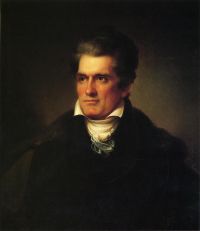 John C. Calhoun,
Works of John C. Calhoun
(1854)
John C. Calhoun,
Works of John C. Calhoun
(1854)
“ Every enlargement of the powers of the government which may be made, every measure which may be adopted to aggrandize the dominant combination which may control the government for the time, must necessarily enlarge, in a greater or less degree, his patronage and influence. With their enlargement, his power to control the other departments of the government, and the organs of public opinion, and through them, the community at large, must increase, and in the same degree. ”
Louis Fischer, A Week with Gandhi (1942)
“ I inquired. “The organization is the Congress Party,” he answered. “But if it fails me, I have my own organization, myself. I am a man possessed by an idea. If such a man cannot get an organization, he becomes an organization.” “Have you sufficient confidence in the present mood of the country? Will it follow you? This civil disobedience movement may involve heavy sacrifices for the people. ”
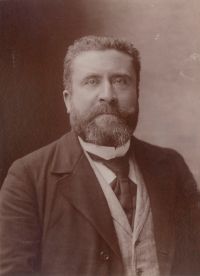 Jean Jaurès,
Studies in Socialism — II: Socialism and Life
(1906)
Jean Jaurès,
Studies in Socialism — II: Socialism and Life
(1906)
“ If we look at the national organisation we see that it is constantly becoming more unified, and more clearly sovereign, and that it has been forced to take on more and more economic functions, which we must hail as a sort of rude prelude to the social property of the future. ”
