“ Inside them the axis or stalk (rachis) is continued for a short distance only and on its sides are hinged two86 other pairs of more or less boat-shaped scales, smaller and more delicate than the glumes, and known as the pales (paleæ) , while a third pair of still smaller pales is fixed to the end of the axis. In each case one smaller and more delicate inner palea is hinged just inside its more obvious outer palea. In the closed condition of the spikelet each of the three pairs of pales is shut together, and pressed close to the axis, and the pair of glumes shut in the whole. ”
Palea
Definition and stakes
The theme of “palea” has been addressed by authors such as H. Marshall Ward and Franz Thonner. It is often associated with terms like Paleozoic, clay, fossil, Europe and Mesozoic.
Quotes about “palea”
“ Aira is distinguished by the awn: Agrostis by the very different paleæ and caryopsis.The other Poas are devoid of web, though they may have hairs below, and require very careful examination. The whole group is excessively difficult to deal with in “seed," and a special study of it is needed, since several species are important, and it forms a type. (b) No web or pencil of hairs below the “seed." (1) Apex of palea rounded, blunt, notched, or at most bluntly pointed, but with no trace of awn-or bristle-tip.142 ✲ Palea inflated, round-backed and somewhat winged, membranous. ”
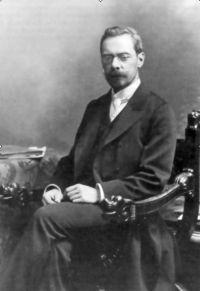 Franz Thonner,
The flowering plants of Africa
(1915)
Franz Thonner,
The flowering plants of Africa
(1915)
“ Inflorescence consisting of spikelets, rarely of single flowers, usually enclosed by 2 glumes (outer or empty glumes) and arranged in spikes, racemes, or panicles. Flowers in the axil of the flowering glume (or valve) , subtended by the usually 2-keeled palea and sometimes by one or two, rarely more, minute lodicules. Perianth none. Stamens 1-6, usually 3. Anthers opening by 2 slits or pores. Ovary 1-celled. Ovule 1, erect or laterally affixed, slightly curved, with the micropyle turned downwards. Styles 2, rarely 3 or 1. Fruit indehiscent; pericarp usually dry and adnate to the seed. ”
1911 Encyclopædia Britannica, Volume 20… (1911)
“ PALEARIO, AONIO (c. 1500-1570) , Italian humanist and reformer, was born about 1500 at Veroh, in the Roman Campagna. Other forms of his name are Antonio Delia Paglia, A. Degli Pagliaricci. In 1520 he went to Rome, where he entered the brilliant literary circle of Leo X. When Charles of Bourbon stormed Rome in 1527 Paleario went first to Perugia and then to Siena, where he settled as a teacher. In 1536 his didactic poem in Latin hexameters, De immortalitate animarum, was published at Lyons. ”
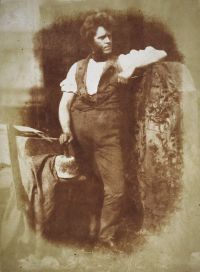 Hugh Miller,
The Testimony of the Rocks
Hugh Miller,
The Testimony of the Rocks
“ That which chiefly distinguished the Palæozoic from the Secondary and Tertiary periods was its gorgeous flora. It was emphatically the period of plants,—"of herbs yielding seed after their kind." In no other age did the world ever witness such a flora: the youth of the earth was peculiarly a green and umbrageous youth,—a youth of dusk and tangled forests, of huge pines and stately araucarians, of the reed-like calamite, the tall tree-fern, the sculptured sigillaria, and the hirsute lepidodendron. ”
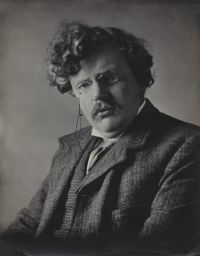 Gilbert Keith Chesterton,
Tremendous Trifles
(1909)
Gilbert Keith Chesterton,
Tremendous Trifles
(1909)
“ This was the last blow, and the next night passed like a dream. I scarcely noticed the slender, sprightly, and entirely new figure which fell into the ranks in the place of Paley, so many times deceased. What could it mean? Why was the giddy Paley unfaithful among the faithful found? Did these perpetual changes prove the popularity or the unpopularity of being Paley? Was it that no human being could support being Paley for one night and live till morning? ”
1911 Encyclopædia Britannica, Volume 20… (1911)
“ Pales plays a very subordinate part in the religion of Rome, even the sex of the divinity being uncertain. A male Pales was sometimes spoken of, corresponding in some respects to Pan; the female Pales was associated with Vesta and Anna Perenna. ”
E. M. Berens, Myths and Legends of Ancient Greece and Rome
“ As a male divinity he is more particularly the god of shepherds and flocks.As a female deity, Pales presides over husbandry and the fruitfulness of herds. Her festivals, the Palilia, were celebrated on the 21st of April, the day on which the city of Rome was founded. During this festival it was customary for shepherds to ignite a mass of straw, through which they rushed with their flocks, believing that this ordeal would purify them from sin. ”
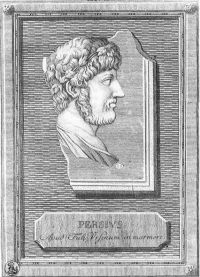 Persius,
Juvenal and Persius — Satire 2
(1918)
Persius,
Juvenal and Persius — Satire 2
(1918)
“ It is the flesh that has spoilt our oil by mingling it with casia, and misused Tyrian purple for the soaking of Calabrian fleeces; it is this that has bidden us pluck the pearl from the shell, and tear out the veins of shining ore from the native clay. ”
 Vernon Lee,
The Spirit of Rome
Vernon Lee,
The Spirit of Rome
“ The renovation of Rome, like its drinking water, has always come from the mountains; the Tiber mouth is their outlet, not the inlet of the sea. And the mountain clouds change in shape, stagnate and brood in this low trough; the mountain air faints, dies, in these fever levels.The beach of Palo is only a few yards wide: a low natural wall of corroded tufo, covered with no maritime bent, but ordinary grass ”
 James Geikie,
Fragments of Earth Lore: Sketches & Addresses Geological and Geographical
James Geikie,
Fragments of Earth Lore: Sketches & Addresses Geological and Geographical
“ To the south of the primitive back-bone of central Europe succeeds a region composed superficially of Mesozoic and Cainozoic strata for the most part, — 405 — which, along with underlying Palæozoic and Archæan rocks, are often highly-flexed and ridged up, as in the chains of the Jura, the Alps, the Carpathians, etc. One may say, in general terms, that throughout the whole Mediterranean area Archæan and Palæozoic rocks appear at the surface only when they form the nuclei of mountains of elevation, into the composition of which rocks of younger age largely enter. ”
William Jackson, The Philosophy of Natural Theology
“ Few people, however, even now-a-days, know enough of the laws which govern inorganic products to find their investigation a slight or easy task. For a purpose of comparison with any human [Pg 50] work or mechanism, most inquirers will prefer having recourse with Paley to the world of organisation. The flower and fructification of a plant or shrub growing on the heath beside Paley's watch, though carelessly passed over a thousand times, and exciting no surprise from anything unusual in its habitat, will, when observed, raise the most sincere admiration. ”
 Charles Dudley Warner,
In the Levant
Charles Dudley Warner,
In the Levant
“ Palema, who lies in public repose, in a coffin of exquisite silver filigree-work, while his skull is enclosed in solid silver and set with rubies and emeralds. This may please St. Palema, but death is never so ghastly as when it is adorned with jewelry that becomes cheap in its presence. The view from the citadel, which embraces the Gulf of Salonica and Mt. Olympus, the veritable heaven of the Grecian pantheon, and Mt. Ossa and Mt. Pelion, piercing the blue with their snow-summits, is grand enough to repay the ascent; and there is a noble walk along the wall above the town. ”
J. Cecil Hughes, The Geological Story of the Isle of Wight
“ The Palæozoic was an immense period during which life abounded in the seas,—numberless species of mollusca, crustaceans, corals, fish are found,—and there were great forests, which have formed the coal measures, on land,—forests of strange primeval vegetation, but in which beautiful ferns, large and small, flourished in great numbers. The Secondary Era may be called the age of reptiles. To this era all the rocks we have so far studied belong. Now we come to the last era, the Tertiary, the age of the mammals. Instead of reptiles on land, in sea and air, we find a complete change. ”
Henry Fairfield Osborn, 1911 Encyclopædia Britannica, Volume 20… (1911)
“ In order to illustrate the grateful services which palaeontology through restoration may render to the related earth sciences let us imagine a vast continent of the past wholly unknown in its physical features, elevation, climate, configuration, but richly represented by fossil remains. All the fossil plants and animals of every kind are brought from this continent into a great museum ”
Hugh Miller,
The Testimony of the Rocks
“ What the great Creator-worker had originated in the Palæozoic and Secondary periods, had been in after times originated by the little creature-worker, wholly unaware that his contrivance had been anticipated, and was but a repetition of a previously executed design. In the later geologic ages the organization of the various extinct animals so nearly resembled that of the animals which still live, that we may regard it as not inadequately represented by the illustrations of Paley. ”
 Thomas De Quincey,
Autobiographic Sketches
Thomas De Quincey,
Autobiographic Sketches
“ The most interesting, if only as the most mysterious, race of ancient days, the Pelasgi, that overspread, in early times of Greece, the total Mediterranean,—a race distinguished for beauty and for intellect, and sorrowful beyond all power of man to read the cause that could lie deep enough for so imperishable an impression,—they were pariahs. ”
 Alfred Russel Wallace,
The Geographical Distribution of Animals…
Alfred Russel Wallace,
The Geographical Distribution of Animals…
“ The rich and varied fauna which inhabited Europe at the dawn of the tertiary period,—as shown by the abundant remains of mammalia wherever suitable deposits of Eocene age have been discovered,—proves, that an extensive Palæarctic continent then existed; and the character of the flora and fauna of the Eocene deposits is so completely tropical, that we may be sure there was then no barrier of climate between it and the Oriental region. ”
G. G. Zerffi, A Manual of the Historical Development of Art
“ Hekatæos, Artemidoros, Eratosthenes, and Strabo describe the climate and soil of Persia as cold and sterile in the north, temperate and fertile in the central or valley regions, and hot and enervating in the south. We have, therefore, enterprising activity, energetic courage from the north, and a counteracting regulating element in the centre, tinged with the dreamy idleness of the south. ”
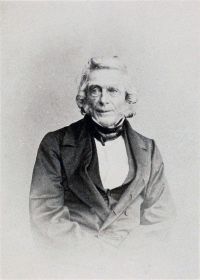 Patrick Matthew,
On Naval Timber and Arboriculture
Patrick Matthew,
On Naval Timber and Arboriculture
“ In the portion of the earth from the Atlantic eastward, through Numidia, Libya, Egypt, Nubia, Arabia, Persia, as far as the Indus, from the enormous ruins, and other vestiges of dense population, as well as from ancient records, there must have {327} existed a considerable depth of vegetable mould covering, where now little is left but pure sand, baked clay, bare rock, and saline encrustations. ”
 Isaac Newton,
The Chronology of Ancient Kingdoms Amended
Isaac Newton,
The Chronology of Ancient Kingdoms Amended
“ The first houses were of clay, 'till the brothers Euryalus and Hyperbius taught them to harden the clay into bricks, and to build therewith. In the days of Ogyges, Pelasgus, Æzeus, Inachus and Lelex, they began to build houses and villages of clay, Doxius the son of Cœlus teaching them to do it; and in the days of Lycaon, Phoroneus, Ægialeus, Phegeus, Eurotas, Myles, Polycaon, and Cecrops, and their sons, to assemble the villages into δημοι, and the δημοι into cities. ”
 Archibald Geikie,
Landscape in History, and Other Essays
Archibald Geikie,
Landscape in History, and Other Essays
“ The grey clay which forms the lower division of the Roman Pliocene series is best seen on the right side of the Tiber where it forms the lower half of the ridge of the Vatican and Monte Mario, and where for more than five-and-twenty centuries it has supplied material for making the bricks of which ancient and modern Rome has been so largely constructed. ”
Hugh Miller,
The Cruise of the Betsey
“ Be it remarked, too, that the red clay here,—evidently derived from the abrasion of the red rocks beneath,—is in dye and composition almost identical with the substance on which, as an unconsolidated sandstone, the bleaching influences, whatever their character, had operated in the Palæozoic period, so many long ages before;—it is a repetition of the ancient experiment in the Old Red, that we now see going on in the boulder-clay. ”
Pierre de Bourdeille, Lives of Fair and Gallant Ladies (1922)
“ Thereafter did come Pales, the goddess of shepherds, with six nymphs of the meadows, clad all in white of cloth of silver, with furniture of the same on their heads all beset with pearls, wearing likewise hosen of the same material with white slippers ”
 Sir John William Dawson,
Some Salient Points in the Science of the Earth
Sir John William Dawson,
Some Salient Points in the Science of the Earth
“ If such a primeval flora as that above indicated ever existed, it must have perished utterly before the incoming of the next great age of the world—that known as the Palæozoic, whose rocks are surpassingly rich in the remains of animals, especially those of the lower or invertebrate classes and those that inhabit the waters.In the oldest Palæozoic rocks we find no plants certainly terrestrial, but abundance of Algæ or seaweeds, and some gigantic members of the vegetable kingdom which seem to have been trees, with structures more akin to those of aquatic than to those of land plants. ”
Hugh Miller,
The Cruise of the Betsey
“ But in beds of a blue clay, intercalated with the sandstone, we find fossils in abundance, of a character less obscure. We spent a full half-hour in picking out shells from the bottom of a long dock-like hollow among the rocks, in which a bed of clay has yielded to the waves, while the strata on either side stand up over it like low wharfs on the opposite side of a river. ”
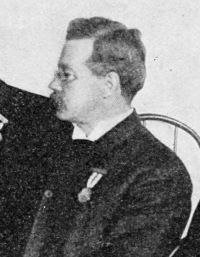 William Berryman Scott,
A history of land mammals in the Western Hemisphere
(1913)
William Berryman Scott,
A history of land mammals in the Western Hemisphere
(1913)
“ Another curious fact concerning the Paleocene mammalian faunas is that they were made up entirely of small and very small animals; not a single mammal as large as a sheep has yet been found in these beds, and the same is true of Europe.That a land-connection with the Old World existed during the Paleocene epoch, is indicated by the similarity of the faunas of North America and Europe. ”
John M. Tyler, The New Stone Age in Northern Europe
“ Here, during late Miocene and early Pliocene times, in the latter part of the Cenozoic era, a dryer and somewhat harsher climate had been accompanied by the appearance of wide plains fitted for grazing animals, as well as stretches of forest, with all varieties of landscape favoring great diversity as well as abundance of mammalian life. It was, perhaps, the golden age for most mammals, when food was plenty, climate not too severe, and every prospect pleased. ”
William Harrison, Elizabethan England
“ If it were requisite that I should speak of the sundry kinds of mould, as the cledgy, or clay, whereof are divers sorts (red, blue, black, and white) , also the red or white sandy, the loamy, roselly, gravelly, chalky, or black, I could say that there are so many divers veins in Britain as elsewhere in any quarter of like quantity in the world. Howbeit this I must need confess, that the sand and clay do bear great sway: but clay most of all, as hath been and yet is always seen and felt through plenty and dearth of corn. ”
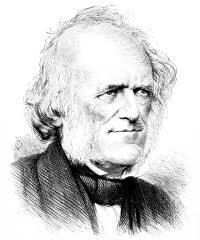 Sir Charles Lyell,
The Student's Elements of Geology
Sir Charles Lyell,
The Student's Elements of Geology
“ According to Philippi, to whom we are indebted for the best account of the tertiary shells of this island, thirty-five species out of one hundred and twenty-four obtained from the beds in central Sicily are extinct.A geologist, accustomed to see nearly all the Newer Pliocene formations in the north of Europe occupying low grounds and very incoherent in texture, is naturally surprised to behold formations of the same age so solid and stony, of such thickness, and attaining so great an elevation above the level of the sea. ”
D. Kerfoot Shute, A first book in organic evolution (1899)
“ Around these lands as a nucleus the North American Continent has been built. Therefore, at the close of the Archæan or beginning of the next, or Palæozoic era, the whole interior portion of the continent was covered by a shallow sea which beat against the Canadian Archæan land on the north, the Blue Ridge Archæan land on the east, and the Rocky Mountain Archæan land on the west. This shallow sea is known as the Palæozoic Sea. Throughout the vast ages of the Palæozoic era, immense sediments were being deposited along the marginal sea bottoms. ”
 Theodore Roosevelt,
Through the Brazilian Wilderness…
(1914)
Theodore Roosevelt,
Through the Brazilian Wilderness…
(1914)
“ The vicissitudes in the history of humanity during its stay on this southern continent have been as strange, varied, and inexplicable as paleontology shows to have been the case, on the same continent, in the history of the higher forms of animal life during the age of mammals. ”
Sir Charles Lyell,
Principles of Geology
“ Our acquaintance with the newer Pleiocene mammalia in Europe, South America, and Australia, is derived chiefly from cavern deposits, a fact which we ought never to forget if we desire to appreciate the superior facilities we enjoy for studying the more modern as compared to the more ancient terrestrial faunas. ”
 Charles Kingsley,
Madam How and Lady Why; Or, First Lessons in Earth Lore for Children
Charles Kingsley,
Madam How and Lady Why; Or, First Lessons in Earth Lore for Children
“ I say from the North—for there are no fossils, as far as I know, or sign of life, in these rocks of mill-stone grit; and therefore it is reasonable to suppose that they were brought from a cold current at the Pole, too cold to allow sea-beasts to live,—quite cold enough, certainly, to kill coral insects, who could only thrive in warm water coming from the South. ”
