“ Thus even on the most cautious reckoning, there is an interval of thirteen centuries between the close of Greek history and our own times, and the great age of Greek history—the time when Ancient Greek society was in its prime, when it was shaping its own destiny and deflecting the destiny of its neighbours—is separated from our generation by more than two thousand years. What legacy has come down, through these great periods of time, from Ancient Greek society to the contemporary world? ”
Ancient Greek history
Definition and stakes
Quotes about “Ancient Greek history”
Dorothy Mills, The book of the ancient Greeks (1925)
“ The history of Greek civilization may be divided into two periods. The first lasted until the days of Alexander; it included the early experiments made by Greek states in the art of governing themselves, the repulse of the Barbarian, the great days of Athens, the disastrous Peloponnesian War. Through all this period Greece was learning how to do things. She was in the making and was creating what was to live as long as men should love what was great, but she was living for herself. ”
James George Frazer,
Studies in Greek Scenery, Legend and History
“ Of no other part of the ancient world has a description at once so minute and so trustworthy survived, and if we had been free to single out one country in one age of which we should wish a record to be preserved, our choice might well have fallen on Greece in the age of the Antonines. No other people has exerted so deep and abiding an influence on the course of modern civilisation as the Greeks, and never could all the monuments of their chequered but glorious history have been studied so fully as 2in the second century of our era. ”
Dorothy Mills, The book of the ancient Greeks (1925)
“ The Greek people were lovers of freedom, truth, self-control and beauty. It is in their political history, their literature and their architecture that we shall see some of the outward and visible signs of the spirit that inspired them, and the land of Greece is the setting in which they played their part in the history of civilization. ”
J. P. Mahaffy, Problems in Greek history
“ It is indeed difficult to overrate the amount and the variety of the many hidden threads that unite our modern culture to that of ancient Greece, not to speak of the conscious return of our own century to the golden age of Hellenic life as the only human epoch in art, literature, and eloquence which ever approached perfection. ”
Gilbert Murray,
A History of Ancient Greek Literature
(1901)
“ Of the literature produced by the Greeks in the fifth century B.C., we possess about a twentieth part; of that produced in the seventh, sixth, fourth, and third, not nearly so large a proportion. All that has reached us has passed a severe and far from discriminating ordeal. It has secured its life by never going out of fashion for long at a time; by appealing steadily to the book-trade throughout a number of successive epochs of taste—fourth-century Greece, pre-Christian Alexandria, Augustan Rome, the great Hellenic revival of the Antonines, the narrower Attic revival of the later sophists. ”
Gilbert Murray,
A History of Ancient Greek Literature
(1901)
“ In attempting to understand the scope and development of Greek literature, our greatest difficulty comes from the fragmentary and one-sided nature of our tradition. There has perhaps never been any society in history so near to the highest side of our own as the Athens of Euripides and Plato. ”
Nevill Forbes, The Balkans: A History of Bulgaria…
“ In the middle of the fifth century B.C., Ancient Greek civilization seemed triumphantly vigorous and secure. A generation before, it had flung back the onset of a political power which combined all the momentum of all the other contemporary civilizations in the world; and the victory had proved not merely the superiority of Greek arms—the Spartan spearman and the Athenian galley—but the superior vitality of Greek politics—the self-governing, self-sufficing city-state. ”
The Great Events by Famous Historians…
“ Before we reach this period of written history we know that the Greeks had long been civilized. Their own legends scarce reach back farther than the first founding of Athens, [13] which they place about B.C. 1500. Yet recent excavations in Crete have revealed the remains of a civilization which must have antedated that by several centuries.But we grope in darkness! The most ancient Greek book that has come down to us is the Iliad, with its tale of the great war against Troy. ”
Karl Otfried Müller,
History of the Literature of Ancient Greece
(1847)
“ An inquiry, of which the object should be to select and unite all the parts of the Greek mythology which have reference to natural phenomena and the changes of the seasons, although it has never been regularly undertaken, would doubtless show that the earliest religion of the Greeks was founded on the same notions as the chief part of the religions of the East, particularly of that part of the East which was nearest to Greece, Asia Minor. ”
James Augustus St. John, The History of the Manners and Customs of Ancient Greece… (1842)
“ Most of the flowers cultivated, moreover, suggested poetical or mythological associations; for the religion of Greece combined itself with nearly every object in nature, more particularly with the beautiful, so that the Greek, as he strolled through his garden, had perpetually before his fancy a succession of fables connected with nymphs and goddesses and the old hereditary traditions of his county. ”
Karl Otfried Müller,
History of the Literature of Ancient Greece
(1847)
“ Greek literature, so far as we have hitherto followed its progress, was a common property of the different races of the nation; each race cultivating that species of composition which was best suited to its dispositions and capacities, and impressing on it a corresponding character. In this manner the town of Miletus in Ionia, the Æolians in the island of Lesbos, the colonies in Magna Graecia and Sicily, as well as the Greeks of the mother country, created new forms of poetry and eloquence. ”
George Grote,
History of Greece, Volume 01 (of 12…
“ Still less ought we to consent to break up and disenchant in a similar manner the mythes of ancient Greece,—partly because they possess the mythical beauties and characteristics in far higher perfection, partly because they sank deeper into the mind of a Greek, and pervaded both the public and private sentiment of the country to a much greater degree than the British fables in England. ”
Dorothy Mills, The book of the ancient Greeks (1925)
“ It must not be thought that the Greeks perfectly fulfilled their great ideals. Greek history shows quite clearly that they did not. If the story of the Greeks as it has been told in this book has emphasized their ideals rather than their failure always to attain these, it is because their ideals are the imperishable gifts they have given to the world. But the Greeks were not dreamers; they were practical men, keen and interested in all the practical affairs of every day life. ”
T. L. Haines, Museum of Antiquity: A Description of Ancient Life
“ The Greeks had arrived at a high degree of civilization before they can be said to have possessed a history of their own. Nations far behind them in intellectual development have infinitely excelled them in this respect. The imagination seems to have been entirely dazzled and fascinated with the glories of the heroic ages, and to have taken but little interest in the events which were daily passing around them. Poetry constitutes the chief part of early Greek literature. We give specimens of both Greek poetry and prose. ”
Edward Huntington Williams, A History of Science — Volume 1
“ We are forced to feel that we have reached the limits of progress of what historians are pleased to call the ancient world. For about eight hundred years Greek thought has been dominant, but in the ensuing period it is to play a quite subordinate part, except in so far as it influences the thought of an alien race. As we leave this classical epoch, then, we may well recapitulate in brief its triumphs. ”
J. P. Mahaffy, Problems in Greek history
“ The modern Greek antiquarians, living upon the spot, have not yet shown themselves equal to many who have never seen what they discuss. Nevertheless, this is certain, that new force, and directness, are attained by a personal acquaintance with the coasts, the mountains, the rivers of Greece, and that many a wrong inference from ancient texts may be avoided by knowing that the scene of the events precludes it. ”
Bill Clinton,
Proclamation 6979
“ On this day, it is fitting that we reflect on the enormous contributions the Greek people have made to the modern world. The legacy of the ancient Greeks, in the fields of philosophy, literature, drama, sculpture, and architecture, continues to influence our beliefs, our values, and our concept of art. And, after more than 2,000 years, the ideology of Greece-as embodied in the concept of democracy-is still the ideal that guides us in charting our course for the future. ”
Dorothy Mills, The book of the ancient Greeks (1925)
“ Their history shows how they failed in perfectly carrying out their ideals because of certain weaknesses of character and of certain conditions and limitations in their life from which the men of to-day can learn many useful lessons. The greatness of the Greeks lies, not in what they did not do or did imperfectly, but in their spirit, that spirit which in their political history, their literature and their art sought for Freedom, for Truth, and for Beauty. ”
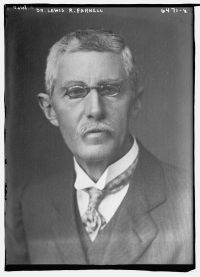
Lewis Richard Farnell,
Outline-history of Greek religion
(1921)
“ THE SOURCES AND THE EVIDENCE The foundation of a serious and scientific study of Greek religion, as distinct from the mere mythology of Hellas, may almost be said to have been an achievement of the last generation of scholars. And it is only through recent research that the Hellenic spirit, so creative and imperial in the domains of literature, art and science, can be recognised as manifesting itself not unworthily in the sphere of religion. ”
James Augustus St. John, The History of the Manners and Customs of Ancient Greece… (1842)
“ I pass over the historians known to us only by a few scanty fragments, that I may at once come to the orators, the peculiar ornament and pride of Greece, whose greatest statesmen were equally great as speakers, more especially at Athens, where, as an art, eloquence was most assiduously cultivated, and achieved its greatest triumphs. Tradition attributes to Themistocles, to Pericles, to Alcibiades consummate skill in guiding the currents of human sympathy, and a sense of their glory lingered on the high places of society like sunshine on the Alps long after they had quitted the world. ”
“ If we take utility to mean intellectual and not practical utility—and as humanists and scientists we do—we may claim without paradox that the study of Greek civilization is valuable just because it is not our own.These, then, are four points in favour of Greek history: we possess the whole tragedy, it is a magnificent expression of the plot, and it has a peculiar emotional value and a peculiar intellectual value which the drama in which we ourselves are actors cannot have for us. ”
Gilbert Murray,
Euripides and His Age
“ The greatest change that has come over our study of Greek civilization and literature in the last two generations is this: that we now try to approach it historically, as a thing that moves and grows and has its place in the whole life-history of man. ”
Marcius Willson, Mosaics of Grecian History
“ The natural causes which tended to unite the Greeks as a people were a common descent, a common language, and a common religion. Greek genius led the nation to trace its origin, where historical memory failed, to fabulous persons sprung from the earth or the gods; and under the legends of primitive and heroic ancestors lie the actual migrations and conquests of rude bands sprung from related or allied tribes. These poetical tales, accepted throughout Hellas as historical, convinced the people of a common origin. ”
George Grote,
History of Greece, Volume 01 (of 12…
“ To every god and every hero it was consistent with Grecian ideas to ascribe great diversity of human motive and attribute: each indeed has his own peculiar type of character, more or less strictly defined; but in all there was a wide foundation for animated narrative and for romantic incident. The gods and heroes of the land and the tribe belonged, in the conception of a Greek, alike to the present and to the past: he worshipped in their groves and at their festivals ”
James Augustus St. John, The History of the Manners and Customs of Ancient Greece… (1842)
“ For, where knowledge is at all held in honour, men will always be found sufficiently prone to the palpable and visible. But even these pursuits assumed a peculiar form in Greece. The genius of the nation, essentially creative, developed its force and its peculiar energy in framing systems of physics, explaining the origin of the world, the birth of the human race, its early fortunes and fabulous history. Every great philosopher became, like an intellectual sun, the centre of a system of physics, and his disciples like satellites revolved around him, receiving and reflecting his light. ”
Ralph Waldo Emerson,
Essays — First Series
“ What is the foundation of that interest all men feel in Greek history, letters, art, and poetry, in all its periods from the Heroic or Homeric age down to the domestic life of the Athenians and Spartans, four or five centuries later? What but this, that every man passes personally through a Grecian period. The Grecian state is the era of the bodily nature, the perfection of the senses,—of the spiritual nature unfolded in strict unity with the body. In it existed those human forms which supplied the sculptor with his models of Hercules, Phœbus, and Jove ”
William C. Bagley, Craftsmanship in Teaching
“ Some of the Greeks of to-day are the lineal descendants of the Athenians and Spartans, but the ancient Greek standards of conduct, the Greek ideals, died twenty centuries ago, to be resurrected, it is true, by the renaissance, and to enjoy the glorious privilege of a new and wider sphere of life,—but among an alien people, and under a northern sun. ”
James Augustus St. John, The History of the Manners and Customs of Ancient Greece… (1842)
“ No doubt we come prepared to regard them with eyes coloured, and a fancy haunted by the beauties of Grecian literature. Possibly, it is under the spell of Homeric verse that our eyes grow humid with delight at the aspect of Aphrodite, that we behold divinity in Zeus or Phœbos Apollo; but this only proves that the fragments of Hellenic civilisation throw a light upon each other, and are parts of one great whole. Perhaps, too, no man ever enjoyed the sculpture of Greece as he should, unless conversant with her poetry—the right hand of her art. ”
Percy Bysshe Shelley,
The Prose Works of Percy Bysshe Shelley…
(1897)
“ The history of ancient Greece is the study of legislators, philosophers, and poets; it is the history of men, compared with the history of titles. What the Greeks were, was a reality, not a promise. And what we are and hope to be, is derived, as it were, from the influence and inspiration of these glorious generations.Whatever tends to afford a further illustration of the manners and opinions of those to whom we owe so much, and who were perhaps, on the whole, the most perfect specimens of humanity of whom we have authentic record, were infinitely valuable. ”
“ Again and again, as we study Greek thought and literature, behind the veil woven by time and distance, the face that meets us is our own, younger, with fewer lines and wrinkles on its features and with more definite and deliberate purpose in its eyes. For these reasons we are to-day in a position, as no other age has been, to understand Ancient Greece, to learn the lessons it teaches, and, in studying the ideals and fortunes of men with whom we have so much in common, to gain a fuller power of understanding and estimating our own. ”
Lewis Richard Farnell,
Outline-history of Greek religion
(1921)
“ But, at any rate, these various evolutions had already happened indefinitely before the two strains—the Northern and the Mediterranean—had blended into the Hellenic race. The higher and the lower, the more complex and the simpler, forms of religious imagination {55} operate together throughout Hellenic history; and the higher, though dominant, never wholly absorbs the lower, both being an intellectual tradition of an indefinite past. Much work on the origins of Greek religion has been wasted because its chronology is anachronistic. ”
Karl Otfried Müller,
History of the Literature of Ancient Greece
(1847)
“ We might then commence at once with Homer and Hesiod: but if we were to adopt this course, we should, like an epic poet, place our beginning in the middle of the history; for, like the Pallas of Grecian poetry, who sprang full-armed from the head of Jupiter, the literature of Greece wears the perfection of beauty in those works which Herodotus and Aristotle, and all critical and trust-worthy inquirers among the Greeks, recognised as being the most ancient that had descended to their times. ”